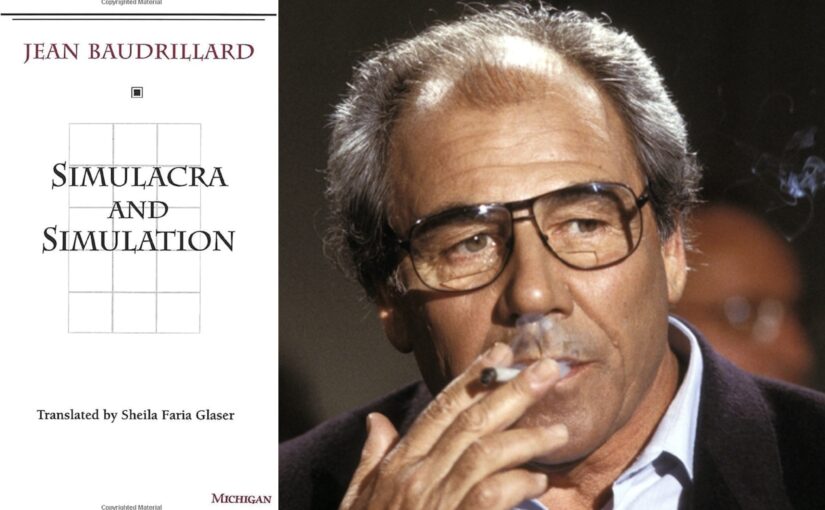
The industrial mass-market modern age brought forth intertextuality, hyperreality and meaning implosion. These concepts — that media reflect other media, rather than reality, until we can no longer separate truth from story — is a defining princiople of postmodernism.
That’s how French philosopher and controversial academic Jean Baudrillard put it in his influential 1981 treatise Simulacra and Simulation. I read excerpts as an undergrad, and his other works. I just reread the 1994 English translation by Sheila Faria Glaser.
It’s a challenging read, but like all good philosophy, whether you disagree with it all or not, Baudrillard certainly makes you think. Once strawberries were a whole food to eat seasonally and locally. Then they became an ingredient, and then chemically recreated as a flavor. How does that change us?
Below I share my notes for future reference.
My notes:
- Simulacrum: a likeness
- Borges’s 1946 fable of the exact map in “Exactitude of Science”
- “Something has disappeared: the sovereign difference, between one and the other, that constituted the charm of abstraction”
- “The poetry of the map and the charm of the territory”
- “Such would be the successive phases of the image: one it is the reflection of a profound reality; two it masks and denatures a profound reality; it masks the absence of a profound reality; it has no relation to any reality whatsoever: it is its own pure Simulacrum”
- Of 1971 Philippines and Tasaday indigenous: “ in order for ethnology to live, its object must die; by dying, the object takes its revenge for being “discovered”, and with its death defies the science that wants to grasp it.”
- And now: “We have all become living specimen in the spectral light of ethnology”
- “Everywhere we live in a universe strangely similar to the original”
- “The contrast with the absolute solitude of the parking lot – a variable concentration camp – is total”
- Author also mentions Walt Disney being “cryogenically frozen”, among several urban legends and inaccuracies he references as part of his argument
- “Disneyland is presented as imaginary in order to make us believe that the rest is real, whereas all of Los Angeles, and the America that surrounds it are no longer real, but belonged to the hyperreal order and the order of simulation”
- Of Watergate era: “The Washington Post operates in the same system as the CIA, not a rupture in the system but a ritual that reinforced the system; the scandal helps maintain the simulation; the denunciation of scandal is “always an homage to the law,”
- Disneyland is his canonical example: it’s simulation is his point
- Argues the communists don’t want to be in power. Capitalism isn’t about production but consumption and so access to intangible status can always be sold
- “Simulation is infinitely more dangerous because it always leaves open to supposition that above and beyond its object law and order themselves might be nothing but simulation”
- Watergate: “the official and sacrificial death of the king”
- The head of state “ is nothing but the sum of himself, and only that gives him the power and the quality to govern. No one would grant the least consent, the least devotion to a real person.”
- Likewise, it’s as if each worker is on strike and working in a “self-managed occupation”
- 1971’s prototype reality TV The Louds
- “Because heavenly fire no longer falls on corrupted cities, it is the camera lens that, like a laser, comes to pierce lived reality in order to put it to death.”
- “One must think instead of the media, as if they were in outer orbit, a kind of genetic code that directs the mutation of the real into the hyperreal, just as the other micro molecular code controls the passage from a representative sphere of meaning to the genetic one of the programmed signal”
- “The apotheosis of simulation: the nuclear”
- satellite/orbit” is his metaphor for system-level abstraction in July 1975: the handshake in space and the Chinese suppression of ideogrammaric characters for a version of romanized alphabet (though this never fully took, and he used this for demonstrative purposes)
- If Vietnam was a big loss for the Americans why didn’t “have any internal reprucssions?”
- A war can end without ever starting: That the act of war is the points and the bodies and leveled cities are simply consequences. He says this of Vietnam but ask what of Ukraine?
- Jakobson’s grid of functions
- “myth, chased from the real by the violence of history, finds refuge in cinema.”
- “You are the screen, and the tv watches you ”
- “ the Jews disappeared behind the televised event Holocaust” (1978 miniseries)
- “The supremacy of the televised event”
- Apocalypse Now (1979) by Coppola: “the war became the film, the film becomes war, the tour joined by their common hemorrhage into technology”
- “The war in Vietnam in itself, perhaps in fact, never happened, it is a dream, a baroque dream of napalm end of the tropics, a psychotropic dream that had the goal neither of a victory nor of a policy at stake, but rather the sacrificial, excessive deployment of a power already filming itself as it unfolded, perhaps waiting for nothing but consecration by a super film, which completes the mass spectacle effects of this war”
- Coppola’ “retro megalomania” —the Americans may have lost one war but they won the cinematic one
- “What should have been placed in Beaubourg? Nothing. The void that would’ve signified the disappearance of any culture of meaning and aesthetic sentiment. But this is still too romantic and destructive, this void would still have had value as a masterpiece of anti culture.”
- Beaubourg is “a monument to cultural deterrence,” that “only serves to keep up the humanist fiction of culture”
- “Beaubourg as a cultural mystification of the masses. The masses themselves rush there to enjoy this execution, this dismemberment this operational prostitution of a culture, finally liquidated, including all counter culture that is nothing, but it’s a post. The masses rushed toward Boberg as they rushed toward disaster sites, with the same irresistible Elon. Better: they are the disaster of Beaubourg.”
- Hypermarket (like the giant mall, or even today like Amazon): “the city, even a modern one, no longer absorbs It”
- “We live in a world where there is more and more information, and less and less meaning”
His three:
- Negentropic (anti-entropy) view: Information can produce meaning as a “negentropic factor,” but it can’t “make up for the brutal loss of signification,” so meaning is “lost and devoured faster than it can be reinjected,” even via “antimedia.”
- Claude Shannon view: Following Claude Shannon’s hypothesis, information is “purely functional,” a technical code that “has nothing to do with signification,” so there’s no necessary relation between the “inflation of information” and the “deflation of meaning.” (Does the text message have “fidelity” by accurately going through the system doesn’t mean all the emotion is carried with it)
- Most Baudrillardian view: On the contrary, there’s a “rigorous and necessary correlation” in which information is “directly destructive of meaning,” dissolving/neutralizing signification through the media’s mass circulation.
Other notes:
- “Information is thought to create communication, and even if the waste is enormous, a general consensus would have it that nevertheless, as a whole, there be an excess of meaning, which is distributed in all the interstices of the social Dash just as consensus would have it that material production, despite its dysfunctions in rationality, opens onto an excess of wealth and social purpose. We are all complicitous in this myth. It is the alpha and Omega of our modernity, without which the credibility of our social organization would collapse. Well, the fact is that it is collapsing, and for this very reason: because where we think that information produces meaning, the opposite occurs. Information devours its own content. It devours communication and the social.”
- mise-en-scène of communication: using the theater term to refer to how we share
- McLuhan’s medium is message gets shoutout
- “There are no more media in the literal sense of the word (I’m speaking particularly of electronic mass media) – that is, of a mediating power between one reality and another, between one state of the real and another.”
- In his Requiem for the Media he “ condemned the media as the institution of an irreversible model of communication without a response. But today? This absence of a response can no longer be understood at all as a strategy of power, but as a counter strategy of the masses themselves when they encounter power.”
- To translate this from broadcast tv (no response) to the emerging cable 24/7 and talk radio era he was writing In, we went from silent inert consumption to meaning imploding — blogs and then social media seem to follow so today we must ask: does this information create more capacity or just noisy signal?
- “The ‘thrill’ of advertising has been displaced onto the computers and onto the miniaturization of everyday life by computer science. The anticipatory illustration of this transformation was Philip K Dick‘s popula – that transistorized advertising implant, a sort of broadcasting Leach, an electronic parasite that attaches itself to the body, and that is very hard to get rid of. But the popular is still an intermediary form: it is already a kind of incorporated prosthesis, but it’s still incessantly repeats advertising messages.”
- Las Vegas. “The absolute advertising city”
- “In the United States, a child was born a few months ago, like a geranium: from cuttings” of clone
- “Dream of an eternal twinning substituted for sexual procreation that is linked to death. Cellular dream of scissiparity, the purest form of parentage, because it finally allows one to do without the other, to go from the same to the same (one still has to use the uterus of a woman, and a pitted ovum, but this support is ephemeral, and in any case anonymous: a female prosthesis could replace it). Mono cellular utopia, which by way of genetics, allows complex beings to achieve the destiny of protozoa’s. What, if not a death drive, would push sexed beings to regress to a form of reproduction prior to sexuation (besides, isn’t it this form of scissiparity, this reproduction and proliferation through pure contiguity that is for us, in the depths of our imaginary, death and the death drive – what denies sexuality and wants to annihilate it, sexuality being the carrier of life, that is to say of a critical immortal form of reproduction?) and that, at the same time, would push them metaphysically to deny all alterity, all alteration of the same in order to aim solely for the perpetuation of an identity, a transparency of the genetic inscription, no longer even subject to the vicissitude of procreation?”
- “This is how one puts an end to totality. If all information can be found in each of its parts, the whole loses its meaning. It is also the end of the body, of the singularity, called body, whose secret is precisely that it cannot be segmented into additional sales, that it is an indivisible configuration, to which it’s sexuation witness..”
- “Cloning is thus the last stage of the history and modeling of the body, the one at which, reduced to its abstract and genetic formula, the individual is destined into serial propagation. It is necessary to revisit what Walter Benjamin said of the work of art in the age of its mechanical reproducibility. What is lost in the work that is seriously reproduced, is it aura, it’s singular quality of the here and now, it’s aesthetic form (It had already lost its ritual form, and it’s aesthetic quality), and according to Benjamin, it takes on and it’s in electable destiny of reproduction, a political form. What is lost as the original, which only a history itself nostalgic and retrospective can reconstitute as ‘authentic.”
- “Technology is an extension of the body”
- “Technology is never grasped, except in the (automobile) accident”
- Author dissects J.G. Ballard 1973 novel Crash, in which a group of people become erotically aroused by car crashes, for it flattening of sex and machinery
Three orders of simulacra and example
- Natural / counterfeit simulacra: Copies imitate a “real” original. The image is trying to resemble or restore nature (or God’s order).
- Key vibe: representation, imitation, forgery.
- Example: a Renaissance painting using perspective to mimic real space, or a fake “antique” made to look like an original artifact.
- Productive / industrial simulacra: Copies are mass-produced by machines. The “original” matters less because production makes endless identical versions; reality becomes something you manufacture.
- Key vibe: factories, energy, expansion, progress.
- Example: a Ford Model T (or any mass-produced consumer product): not a single “original,” but a system of production that generates the real object at scale.
- Simulation / informational simulacra: Models and code come first, and reality conforms to them. The copy doesn’t represent reality; it produces the reality-effect (what counts as real) through data, systems, and control.
- Key vibe: information, cybernetics, operational control, hyperreality.
- Example: a credit score (or algorithmic risk score) that shapes what life you can actually live—housing, loans, insurance—so the model isn’t describing you, it’s actively making your “reality.”
Other notes:
- Animals were once sacrificed because they were more valuable than man (food, survival), now they’re sacrificed because they’re less valuable (scientific experimentation)
- “The values of the university (diplomas, etc) will proliferate and continue to circulate, a bit like floating capital or euro dollars, they will spiral without differential criteria, completely devoured in the end, but that is unimportant: there’s circulation alone is enough to create a social horizon of value, and the ghostly presence of the Phantom value will only be greater, even when it’s Reference point (it’s use value, it’s exchange value, the academic ‘work force’ that the university recoups) is lost. Terror of value without equivalence.”
- He uses 1968 as a key marker, French student-and-worker uprising (starting at Nanterre, spreading to Paris, triggering a massive general strike) that became the symbolic rupture-point for the French intellectual scene.
- “God is not dead, he has become hyper real”
- Identifies as a nihilist. “Theoretical violence not truth is the only resource left us. But such a sentiment is utopian. Because it would be beautiful to be a nihilist, if there were still a radicality – as it would be nice to be a terrorist, if death, including that of the terrorist still had meaning.”
- “There is no more hope for meaning. And without a doubt, this is a good thing: meaning is mortal. But that on which it has imposed, it’s a femoral rain, what is hoped to liquidate in order to impose the reign of the enlightenment, that is appearances, they, are immortal, and vulnerable to the nihilism of meaning or of non-meaning itself. This is where seduction begins.”