Are algorithms creating a new kind of language development, or just speeding the method we’ve always had?
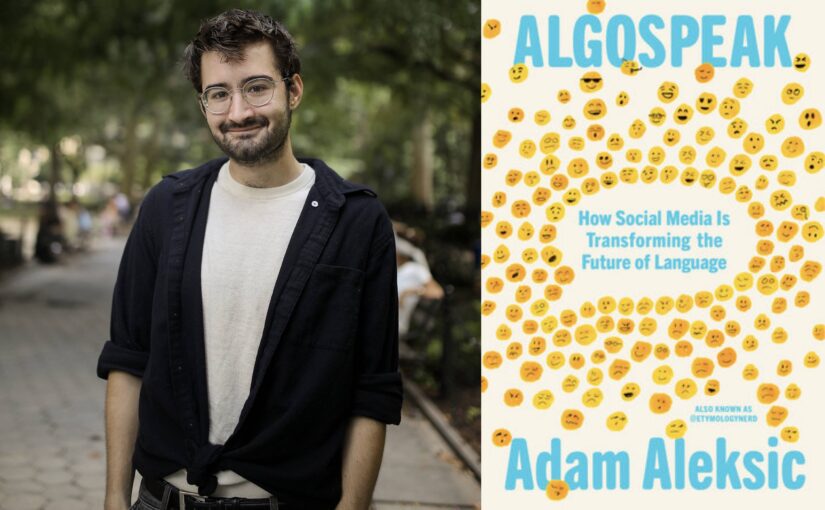
“Words aren’t just diffusing from human to human anymore: they’re now moving from human to algorithm and back to human.” That’s from Algospeak: How Social Media Is Transforming the Future of Language, the new, charming and insightful linguistics book by Adam Aleksic, a Harvard-trained, 20-something influencer creating under the ‘etymology nerd’ handle.
As he writes: “Algorithms are the culprits, influencers are the accomplices, language is the weapon and you, dear reader are the victim”
Below I share my notes for future reference.
My notes:
- The term “Unalive” was first used by the character Deadpool in Ultimate Spider-Man in 2013. The term went viral on social media, dodging online censors.” It is like other past euphemism for death — to decease came from Latin for departure as an alternative to “mors” and “to die” was an old Norse euphemism for old English verb sweltan and under English word “diegan “
- The difference is “unalive” was driven “by the invisible forces behind social media and its algorithms” (users wanted to evade blocks on the words “suicide” and dead”)
- Taylor Lorenz (who has her own insightful book about online culture) credited with popularizing the term “algospeak” in a 2022 story
- Key changes to nature of communication: written word, printing press, the internet — and now another he argues — with algorithmic social short form video
- Charles Dickens Museum (in London) was shadow banned on social media because the word “dick” — it’s the Scunthorpe problem, the unintentional blocking of online content
- Leet speak origins online, bowdlerization
- Says his linguistic explainer of “from river to sea” got his videos suppressed for three days, and facing a decline in his income he simply stopped talking about the topic
- Emily van der nagel: voldemorting
- “What we’re actually doing on social media is building up a common vocabulary to reflect our shared experiences”
- The “sociolect” of the chronically online is a new and rapidly changing “domain of use” which develop because of “communication accommodation”
- Argues that more than David Crystal’s netspeak, algorithms are shaping further into algospeak
- The Rizzler song was a pivotal moment of the brain rot change to social media, the rise of the algorithmic drafting off Tiktok and then 2020 reels
- Vine was short video but not highly personalized
- In Sept 2021 TikToker Anthony Mai got followers to use the chair emoji to replace the laughing emoji for creator KSI, it went viral but fell away — in contrast, the skull emoji did replace, why?
- In 1962 sociologist Everett Rogers introduced his Diffusion of innovations: the five categories of adopters, the “innovation-decision process” is when the innovators decide to keep the word/meme going after the laggards join or drop it as a fad — and they are influenced by whether frequency (if it fills many phrasal templates), unobtrusive and fills a semantic gap (chair was obtrusive but skull, like the word cancel and side-eye which have quietly seeped In)
- Richard Dawkins selfish gene coined the term “meme”
- Social hooks fill a curiosity gap such as
- My favorite thing about X is …
- This is my least favorite thing about X.
- I am constantly amazed by X.
- The most interesting X is …
- The best part of X is …
- It should be illegal to X.
- I hate it more than anything when X..
- 2010 Wharton research showed emotionally charged NYT headlines drove more email forwards than others
- A 2017 NYU paper showed the same for Twitter
- Second person language in social video works because it feels like its for us
- If you’re looking for X, then Y.
- You know how X?
- I’m sure you’ve heard X.
- I’m gonna need to put you onto X.
- If you do X, this is how you Y.
- You should stop doing X.
- Have you noticed X?
- Also versions that puts you in group
- I can’t be the only one who’s noticed X.
- Am I the only one who didn’t know X?
- People are finally doing X.
- One thing people don’t tell you about X is Y
- Why aren’t people talking about X?
- I don’t think people understand/realize X.
- Louisa Melcher, actress creating fake skits, tells author she sees it as performance art that is fulfilling to determine what will create the right emotions
- In 1971 Herbert Simon’s attention economy: “A wealth of information creates a poverty of attention”
- “Failure to adapt to trends is an incredibly dangerous pitfall for influencers. It’s very easy to lose touch with the ever changing algorithm unless you’re constantly keeping your finger on the pulse.” — he noted how he changed his video formats but friends didn’t and in contrast when he returned to Reddit a platform he was once one of the 100 highest ranked in the world he can no longer as readily predict what will perform
- Matthew Effect (rich get richer; connected get more connected; smarter get smarter) plays out online: the better at getting attention get better still
- “Algorithms are the culprits, influencers are the accomplices, language is the weapon and you, dear reader are the victim”
- Millennial pause
- Prestige dialect
- The broadcast accent is the same as the influencer accent: it signals in group status and prestige: listen to me (affectations)
- Linguistic founder effect
- Sophia Smith Galer: we’re programmed to talk the same way (educational influencer accent is different than others)
- Michael Steven’s Youtuber V Sauce didn’t internally change accent but sped up his voice
- “Group belongingness has become automated around your receptivity to consuming certain content. Your engagement tells the algorithm whether to let you further into a group or gate keep access.”
- Arvind Narayanan: human-algorithm interactions are “complex systems” nonlinear and self reinforcing (engagement optimization algorithm in in particular has the challenge, as “digital rubber necking” mean that rage baiting can be effective
- 1996 paper cyber balkanization
- Algorithmic social media means we find our interests faster and deeper “, creating language — that can sometimes fill wider semantic gaps (like Taylor swift 2022 “in my X era”)
- K -Pop brought delulu
- “Everyone is an early adopter in some community” even if that’s just your familect of your family
- “Words aren’t just diffusing from human to human anymore: they’re now moving from human to algorithm and back to human.” (((But is it different than the Boston newspapers publishing the slang of OK? Or mass media spreading hello as a telephone greeting?) it’s certainly faster like he says, but is it different in kind or just sped?
- Context collapse
- Goodharts law: targets become ineffective (or dangerous) once tracked
- 4chan had no user accounts so to convey in group status required language and slang like troll dank shitpost cuck and mogging and maxxing and AWALT
- Incels generated lots of language there
- (Versus volcel and fakecel ) to show blackpill — only 1% true incels, the rest could use looksmaxxing or wealth accumulation to get women — because they had to prove themselves and didn’t have algorithms, so used memes to spread
- Online disinhibition effect
- Amanda montell 2024 book ” “The Age of Magical Overthinking: Notes on Modern Irrationality“ introduced the term “doomslang” to describe modern dystopian jargon such as “dumpster fire,” “doomscroll,” and “bed rot”.
- (Bedrotting and doomscrolling and LDAR
- Poe’s law is an internet adage which states that, without a clear indicator of the author’s intent (like an emoticon, or a specific tag such as “/s”), it is impossible to distinguish between a sincere expression of extreme views and a parody of those same views. This can explain why jokes about incel language then became normal (ie beauty influencers use hunter eyes and canthal tilts )
- Poe’s law creates “a dangerous game of hopscotch” where we hop between reality and irony without knowing the line
- Ballroom scene gave us slay and yass Queen and mother — which then went to wider gay community and then white women and then broad
- Kayla Newman use of fleek — and then dance that Charlie de Amelio went viral on
- In 2022 Cory Doctorow introduced his “enshittofication
- Kendall Walton : categories of art
- In 2021 academics wrote pew to stop using generational labels
- Flanderization of ourselves as creators by playing into a caricature and tied to generational labels
- “Never before has slang been so global” mewing gets used worldwide
- UT Austin research saying Texas accents declining — [[but other research has shown more regional linguistics diversity]]