Immigrants are neither villains, nor victims.
The through put in any economy is where dynamism comes from to get a “lake society”, rather than a stagnant swamp.
More to the point, foreign workers tend to not be the same as native workers, and when that’s the case everyone benefits. So that should be the focus, less displacement and more a core component of how an economy thrives.
That’s from The Truth About Immigration: Why Successful Societies Welcome Newcomers, a 2024 book written by Wharton School professor Zeke Hernandez.
In truth this pro-immigration stance is something of a straw man. Overall, even amid partisan American culture war, as I frequently report, high-skilled immigration is bipartisan— regardless of campaign rhetoric. It’s among the few things we agree on.
Instead, in many societies the question is what is the right level of immigration.
Below are my notes for future reference.
My notes:
- Neither the villain nor the victim narrative of immigration is right
- Immigrants ensure a “lake society” rather then a swamp one (without inflows of ideas)
- 3.5% globally and 15% of US population in foreign born
- 70% of Americans view immigration as a good thing
- Founded in Guatemala in 1971, Pollo Campero is the largest Latin American chicken chain in the world, tracking immigration to the United States: Sanchez to Sanchez to Smith
- Authors dissertation and research: companies expanded where immigrants from that country most often went: “The larger the share of immigrants from specific countries in a state’s population, the likelier it was that firms from those countries would invest in that state. Those immigrants also helped companies stay in business longer – and thus create more permanent jobs.”
- Korean chaoxian in China presented natural experiment and businesses followed even this isolated community
- In 2023, EMD electronics expanded in Hometown, Pa (near Allentown and Jim Thorpe) — where German immigrants had set up in 1811
- 2019 study by Konrad Burchardi et al: ancestors from one country lead to investments there: “these effects persist over generations: even 19th century migrations significantly affect the patterns of [investment] today.”
- The 1924 National Origins Act (the Johnson-Reed Act) established harsh quotas favoring Northern and Western European immigrants and effectively banned almost all Asian immigration. It created the “consular control system” for overseas visa screening and established the U.S. Border Patrol, enforcing a four-decade pause in mass immigration to the U.S
- VC firms who invest in immigrant entrepreneurs get access to their home markets. For every six relationships with Indian immigrant founder, a U.S. VC firm makes one Indian investment (but not true of children of immigrants)
- Ashlee Li 2023 Georgia Tech high skilled immigrant workers paper: they attract more VC from home market
- Hazleton Pa got Bimbo and Mission tortilla plants after influx of Hispanic immigrants
- Immigration investment and jobs are linked
- The Chinese exclusion act and The origins act: recent research argued 1.8m missing Chinese immigrants up until 1965, which means New York, Pennsylvania and even Milwaukee Wisconsin missed out on so many that we now know would have led to more Chinese business investments — ironic that later Wisconsin tried to lure Foxconn with expensive subsidies that failed rather than just welcoming immigrants who build ties layer
- Immigrants produce more patents and high quality ones too
- Raj Choudury and Yoon Kim research: an Indian doctor Hari Har Cohly working in Mississippi knew turmeric had effects that avoided an amputation
- “The movement of people is essential to the circulation of ideas”
- Teams who lost a patent holder prematurely (died before 60) produced 9% fewer patents — and 17% more if the death was an immigrant
- Hungarian mathematician Paul Erdos denied entry in 1954 due to the exclusion acts: before 1954, 60% of his contributors were Americans, after it was 24%
- Companies headquartered near Japanese internment camps now import more Japanese products and export to Japan more
- Luis von Ahn and Marcos: both Guatemala but very different life paths (both fled violence but one was elite upbringing and the other not)
- Immigrants start more firms and employ more; half of VC-backed startups have an immigrant cofounder
- Pierre Azoulay et al: immigrant businesses employ more than native born at all company sizes
- Two immigrant entrepreneur drivers: Immigrants are more likely to go out on their own; and high skilled are more likely to have STEM degrees
- Zoom founder Eric Yuan was rejected 8 times for US visa before getting on 9th
- Author’s Uraguyan parents had to stretch to help him go to college in United States – but a crisis declined the purchaising power of the peso and the author had to console his father who could no longer make he monthly payments he had committed to
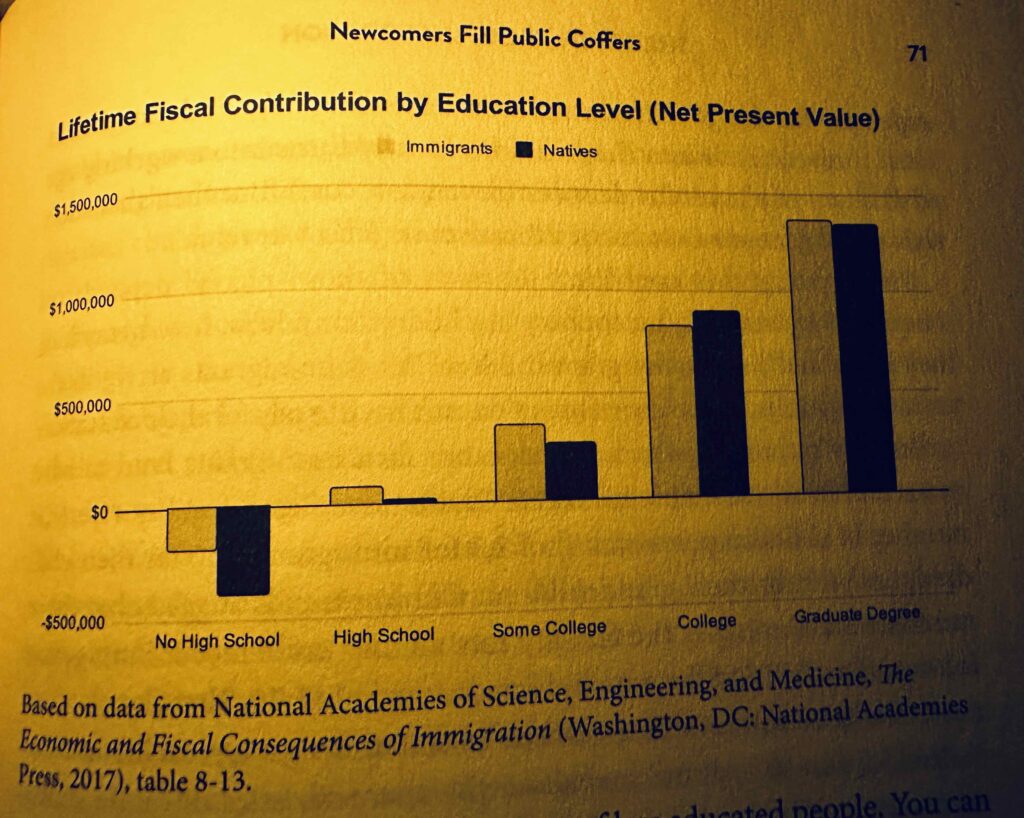
- Research showing immigrants are net positive contributors in revenue to the American government
- “Lifetime fiscal contribution” varies by education, but immigrants outperform all categories
- The Greg Abbott and DeSantis stunt of shipping migrants was a crass expression of a real complaint: a few states bear most responsibility — Democrat-run El Paso Texas shipped even more bus loads of migrants. Some states bear expenses and others get income generating immigrant years, though the federal government only sees upside
- Local governments are often net losers on immigrants while federal gov is larger winner (but the children and grandchildren of immigrants)
- Governors of Indiana and Utah have proposed letting states sponsor immigrants, and federal government reimbursement
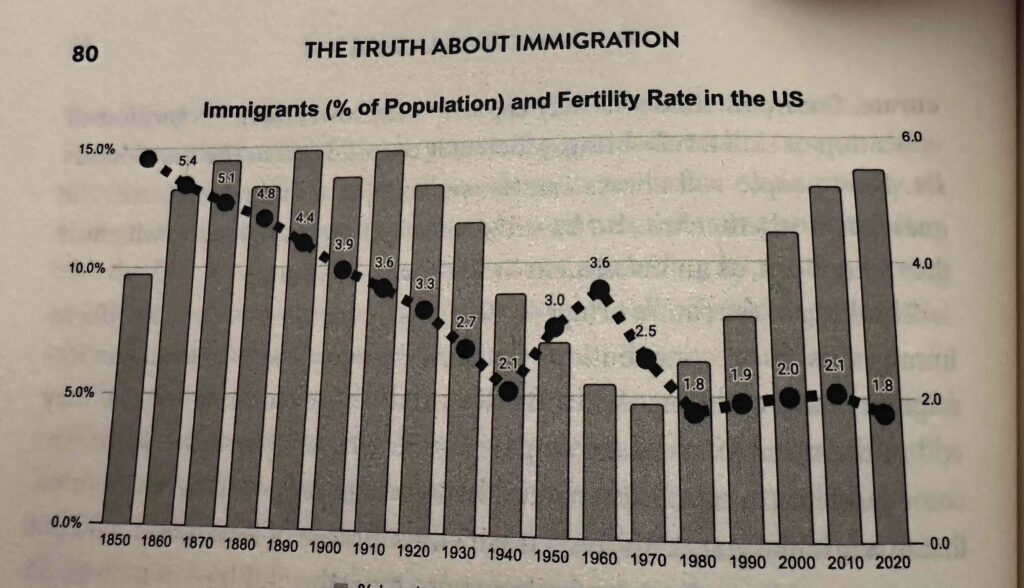
- Fiscal cliff of social security
- Mariel boatlift as classic natural experiment of immigrant shock of young men with work permits: David Card’s 1990 paper was first academic analysis. That showed no real change to wages — and his later work showed in other contexts low wage workers had modest declines nd others gained
- George Borjas in 2017 refuted Card’s findings :Though his methodology was challenged— and that one natural experiment is too narrow
- 2017 National Academies of Sciences, engineering and medicine: the impact of immigration on the overall native wage may be small and close to zero,” especially when looking over 10 year period
- Immigrants increase supply and demand, and exceptions prove the rule. After the fall of the Soviet empire, many Soviet mathematicians came to the United States (adding competition for a narrow role type but not increasing the demand for it), and Borjas et al showed American mathematicians were hurt. Likewise Germany allowed czech to work but live in Germany, and they suppressed native wages -/ because they didn’t live there to boost demand too
- Michael Clemens 2011 Study of North Carolina farming: 500k were unemployed and 6,500 farming openings but only 268 natives applied, virtually all were hired but only 163 showed up for work and just 7 finished the season. He estimated just 100 more natives would have applied if unemployment spiked sevenfold
- Giovanni Peri and Chad Sparber: low-education immigrants do more manual work and where there are more of them in a state, more natives go up to better paying roles that require more native communication
- Great Depression the American government dispelled Mexican immigrants to preserve jobs — but reversed course with the Bracero program, which JFK-LBJ ended in 1964 because of opposition. Now it looks Bracero worked, and when it was removed natives didn’t fill the roles but instead farmers patented more harvesting technology
- Michael Clemens and Ethan Lewis 2021 analysis of H2B: firms that lost the lottery did not hire more natives but their business shrank on average
- US men’s World Cup, a story of immigration: 1950 team and then the 1990s began to use more immigration
- The share American science and engineering talent; 16% in 1993, and 29% in 2007 — 45% of those with doctorates
- Economist Bill Kerr: immigrants of Nobel prizes
- But American higher education system is leaky: just 23% likely an immigrant masters degree holder would go into American labor force
- H1B lottery also presents research showing they create new native firm jobs, and shows firms use H1B to fill vacancies not replace native workers
- Britta Glennon: when H1B visas are capped, multinationals hire abroad or open new offices abroad
- N Venture Capital Association: 57% of surveyed venture backed startups said “projects had been delayed because of a lack of H1B visas”
- Those that got an H1B visa: raised more money from investors, filed higher quality patents and more likely to IPO — startups fail to be able to sponsor immigrants than big firms so they hire fewer of them relatively to size though they get similar share of applications
- The 2017 The Economic and Fiscal Consequences of immigration is an update from a 1997 report and authoritative on jobs and public finances, but not on parents and entrepreneurship or other cultural ways immigrants contribute
- Paul Romer: we used to say Portugal was important for its good and services, but the truer stance is the Portuguese people are what’s good
- Immigrants politics range
- Ohio and Indiana banned German language in 1919; those Germans then integrated LESS than in neighboring states; similar dynamic took place with Muslims after 9/11
- Psychologist John W. Berry’s acculturation framework evaluates how individuals adapt to new cultures by measuring two dimensions: valuing one’s heritage culture and engaging with the host society. Instead of forced assimilation—where immigrants abandon their heritage entirely—Berry advocates for integration, where individuals maintain their cultural identity while actively participating in the broader society
- Following the 2018 murder of his 20-year-old daughter, Mollie Tibbetts, her father Rob Tibbetts penned a Des Moines Register op-ed and spoke at her funeral, vehemently asking politicians and pundits to stop using her death to advance anti-immigration agendas.Defending the local Hispanic community, he stated: “The Hispanic community are Iowans. They have the same values as Iowans. As far as I’m concerned, they’re Iowans with better food.
- Immigrants and undocumented commit fewer crimes (crime rate in Texas)
- Sanctuary communities research: no increase in crime
- Immigrant boys who arrive young with limited education can result in crime but not if later in life — natives dont need to be protected from immigrants but other way around
- Erdal Arikan US trained Turkish engineering professor failed to get placement at the United States and so had to return home. He had a major breakthrough in 2009 to advance from 4G to 5G, with the next four years, Chinese firm Huawei bought his patents and is now one of the most powerful firms that American military worries about
- ICE shouldn’t be under DHS, author argues
- John Tanton successfully fused anti-immigration organizing with the environmental movement by utilizing an overpopulation narrative. Funded heavily by Mellon heiress Cordelia Scaife May and her Colcom Foundation, Tanton’s network—including FAIR and NumbersUSA—continues to bankroll restrictionist groups, cementing a highly partisan divide around immigration
- Milena Djourelova: changing AP language on immigration helped defuse anti-immigration sentiment
Author’s guidance across 160 immigration studies on attitude:
- Start by engaging “with people’s genuine real world concerns.” Acknowledge that those concerns are legitimate.
- Clearly root the issues “in national and local contexts” Different communities will have different needs and opportunities.
- Emphasize “shared values” instead of focusing too much on facts and “myth-busting.” People don’t like to be made to feel like idiots.
- “Those most opposed to immigrants live in the places with a few foreigners”
- Gordon Allport in 1954 contact theory prejudice between groups declines with more contact
- Mormons dispatched to communities with more immigrants become more supportive of immigrants
- White Americans who randomly live near more Arabs come to be more pro Arab
- Filipino workers trained to share a family photo and a small gift upon arriving to Middle East host: Family suffered less abuse and more reliable pay
- Whattton Rachel Arnett: cultural outsiders don’t inject enough of the unique background via “rich cultural identity expression”
- 1994 Mexican peso crisis study: flood of undocumented workers had temporary effect on native worker wages but they quickly sort out
- Ernesto Tiburcio and Kara Ross: increase in undocumented workers shifts local spending: “an underappreciated aspect of the work undocumented immigrants due is that it often enables native workers to participate more fully in the economy”
- College educated women with young kids worked fewer hours once “Secure Communities” policy was implemented, presumably because undocumented childcare workers left
- Les Miserables: Javert believed justice was punishment; the bishop felt it was for reformation
- The 85th percentile rule for highest speed limit setting
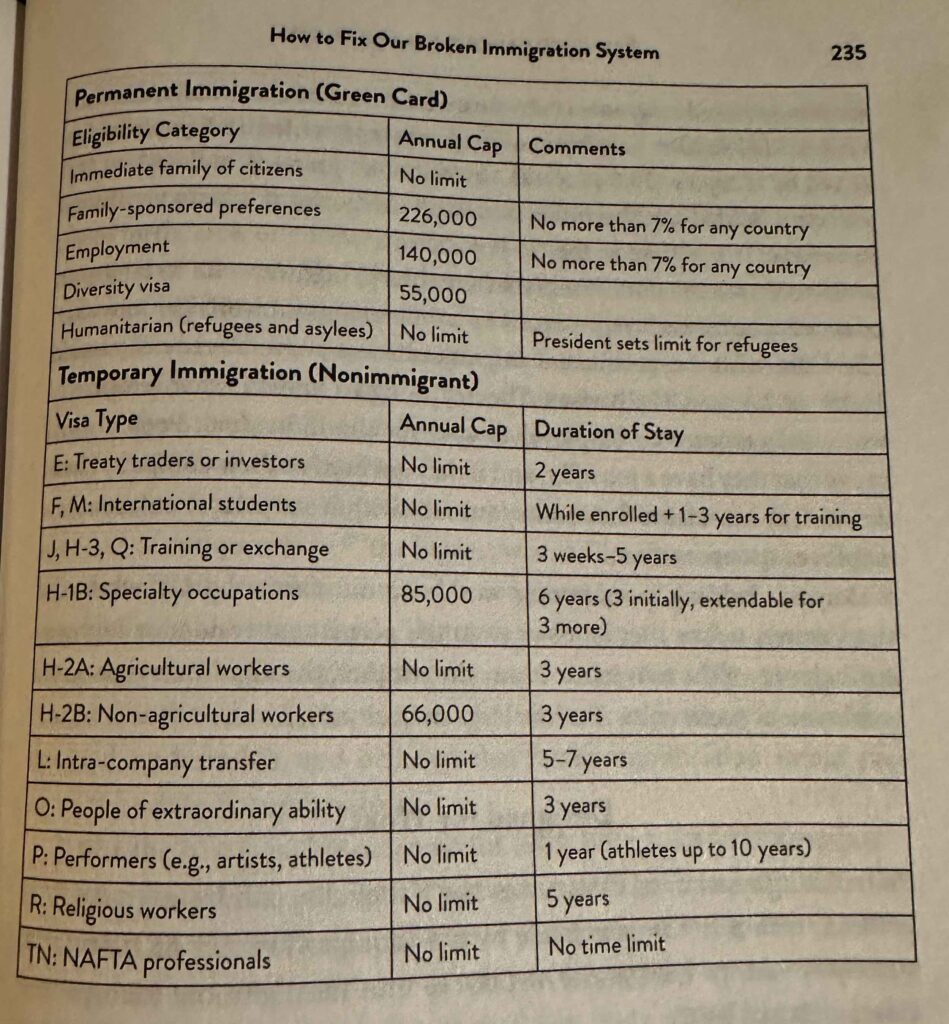
- Immigration system primarily designed by Nationality Act of 1965, overturning 1924 Origins Act, tweaked by Immigration Reform Act of 1986 and Immigration act of 1990: permanent and temporary through four lanes: family, employment, diversity and humanitarian
- Permanent immigration” chart screen shot
- Jia Lynn Yang’s 2020 book One Mighty and Irresistible Tide shares how the national origins quotas act was overturned
- The 1965 focus was tilted toward family reunification to limit racial mixing — at the expense of economic immigrants
- Penn Wharton budget model: double legal immigration and it would increase jobs and GDP
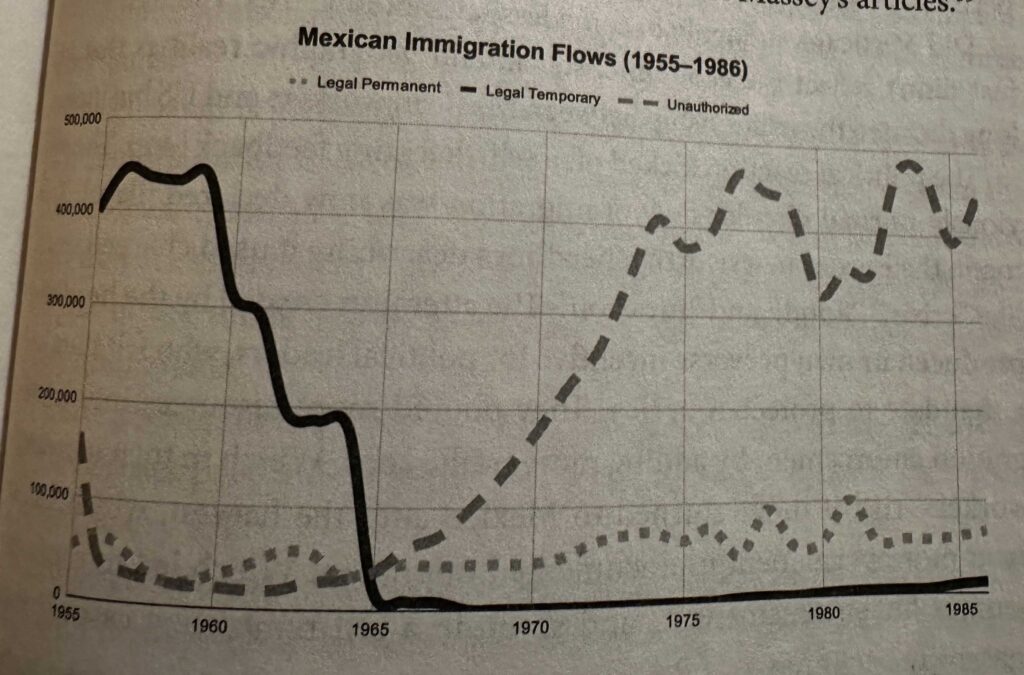
- Before 1965, there was no Mexican immigration limit and border wall — but no invasion. Mostly just more seasonal workers. 1965 made a cap below demand, which developed toxicity
- After EU added countries, there’s no big longterm flood. An initial spike and then only slightly elevated. The pull of home is real, and immigration is sticky (more southern Italians went to United States; more northern Italians went to South America)
- His solutions: reframe, grow the “speed limit” for higher numbers, lots of economic especially. Congress can decide type of visas but legislative act is too cumbersome to set the levels of each visa
- Not pre-determined skills, because central planning is silly
- Complementarities: unskilled workers boost skilled ones.
- His mother was raised on a small farm in a remote Uruguay community, a teacher recommend she move 20 miles to a small town to attend school while boarding and that set up her son to later emigrate