“Ability to deliver for clients” can’t be anathema for news organizations

Leading a small news organization puts me at an unusual crossroads: I’m as close to our sources as I am to our customers. In my experience, most of those interested in financially supporting Technical.ly know their stuff. Of course, there are exceptions, but on the whole, they’re better informed than average.

Yet I often encounter a default assumption among journalists: To demonstrate independence, many instinctively treat those who financially support their news organization worse than those who don’t. This creates perverse dynamics. I’ve had potential advertisers tell me they avoided sponsoring us because they feared their independent coverage would be perceived as bought-and-paid-for.

This is a dangerous place for news organizations. It’s a cultural tic that likely developed during an era when newsrooms operated as monopolies, flush with resources, and could afford to brush off financial supporters.

But that’s not where we are today, and it’s not where we should want to be.

I push my newsroom on this point: You don’t have to treat financial supporters better, but you certainly shouldn’t treat them worse. As a publisher with an entrepreneurial mindset, I see it as part of my role to find ways to acknowledge and thank those who support us. But I won’t force it.

What I will insist on is this: the “ability to deliver for clients” cannot be anathema for news organizations. If society equates a news organization leveraging its “halo effect” with content marketing, we’re missing the point.

Technical.ly’s reporting is guided by truth, not business objectives. That’s journalism. But attracting advertisers, sponsors, and investors whose goals align with ours isn’t a problem—it’s smart. The danger lies not in seeking aligned partners but in twisting journalistic goals to fit theirs.

Independence doesn’t require antagonism. It requires clarity of purpose.
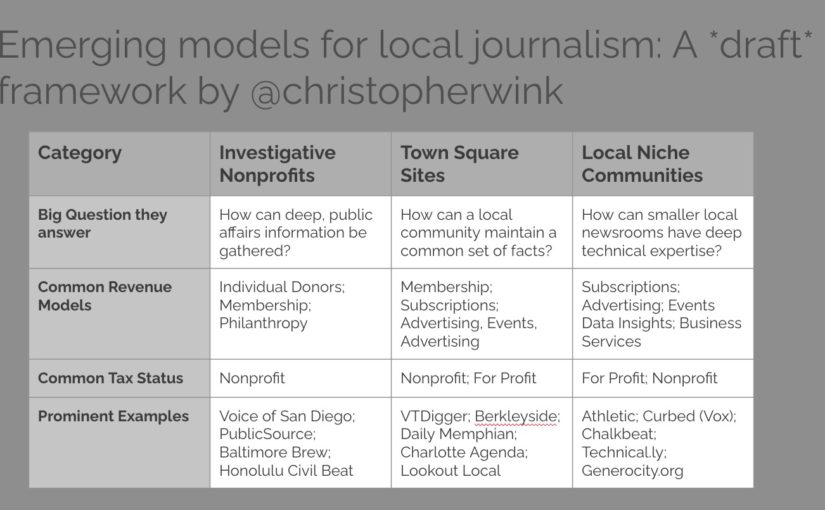
Three emerging approaches to local journalism

It’s no longer quite right to say journalism as a whole is imperiled by the internet-age. In the last decade, powerhouse national outlets have made the business model leaps. Other important and influential national and global organizations gather and produce valuable information for the civic good. Their concerns are now with truth and partisanship and objectivity. These are heady issues but they’re not directly revenue problems.

This is different from publishers with a geographic focus; previous business models don’t comport simply with web-powered scale. Local journalism is very much in crisis. I know this personally and professionally, so I follow trends closely with an applied viewpoint

I’ve long thought that we at the news organization I cofounded a decade ago are something of an outlier, trying to approach local reporting through a for-profit, multi-local strategy. (I wrote here about why Technically Media is not a nonprofit). Recently though I’ve noticed that we may fit into one of three broad approaches I see tackling local news.

This is made clear by the strengthening of the country’s superstar national commercial journalism providers as the collapse of the dominant local forms continues apace. Web-powered scale has laid bare that national and local outlets are in entirely different categories. 

Continue reading Three emerging approaches to local journalism

There was a crowd of us, now we are almost none

From an eyewitness account of the Black Death of the 1340s:

“There was a crowd of us, now we are almost none. We should make new friends, but how, when the human race is almost wiped out; and why, when it looks to me as if the end of the world is at hand? Why pretend? We are alone indeed. You see how our great band of friends has dwindled. Look, even as we speak we too are slipping away, vanishing like shadows. One minute someone hears that another has gone, next he is following in his footsteps.”

[source; first spotted in this video at 33:42; not Agnolo di Tura]

(Photo by Mads Rasmussen via Unsplash)

When ordinary fear is enough

A version of this essay was published as part of my monthly newsletter several weeks back. Find other archives and join here to get updates like this first.

I used to think all the great kinds of fear were personal ones. Artisanal fear; handcrafted fear; the kind of things that came with a story worth telling. Being lost a bit too long in Japan; crashing an ATV in Qatar; Running with the bulls. Some real life or death adventure, lest I fall victim to ordinary fear.

Back in late March, when it became increasingly clear that it was altogether conceivable that our healthcare system could collapse under the weight of this pandemic, I recognized I was experiencing a kind of universal fear. Certainly not ordinary, exactly, but something so widespread as to begin to feel ordinary. A universal fear that very nearly every person on the planet was experiencing at the same time.

Perhaps there has never been a time when more people in the world were scared of the same thing at the same time.

Continue reading When ordinary fear is enough

Civility is complicity

White Americans often have a habit of assuming the best intentions. It’s a habit I still confront in myself.

We have faith in our institutions and in American exceptionalism. Especially the educated middle class and wealthier among us have been trained to be polite and respectful. We are predisposed to acquiesce.

I’ve struggled with this myself, both as someone who does believe a lot of important work can happen behind the scenes (calling in, rather than calling out) and as a journalist who is washed in the belief of “getting both sides.” This approach as it’s time to be effective. Issues of racial equity is not one of those times.

Continue reading Civility is complicity

White Silence is Violence: a self-audit on doing the work

I run a community journalism organization in part because I believe independent voices that push honest, challenging and productive dialogue are vital.

Especially because of our audiences (a political range of business and civic minded with Technical.ly; and a social services coalition with Generocity.org), we can be a force for change in our communities. I find that everyday, which keeps me excited by our work. It’s even more true in moments of intense scrutiny.

On the heels of a pandemic and an ensuing economic shock, we are in the midst of one of the most consequential conversations on racial equity in a half-century — sparked by yet another high-profile murder of a Black man by a white police officer. I’ve found myself taking a critical look at how I’ve responded. I don’t do enough, but I’ve certainly already been to the “Acceptance Stage of Grief for white supremacy.”

Continue reading White Silence is Violence: a self-audit on doing the work

Kim Crayton on Antiracism

The pandemic has removed distractions and laid bare this country’s foundation, allowing for the largest, most sustained, widespread protests in a half-century to bring about this generation’s high-water mark in white American’s engagement with racial equity.

Do something about it.

Dubbed the Antiracist Economist, Kim Crayton led a virtual version of her Introduction to Being Antiracist Saturday. My small community journalism organization paid for several coworkers and myself to attend, and we kept up a constructive dialogue as a team through the three-hour session.

For years, our company has done past trainings and our reporting approaches seriously economic systems and still Kim’s approach and passion was enlightening, challenging and productive. For teammates who were new to this work and those of us who have tried to put in the work before, it was meaningful time well spent. (Thank you Kim)

You should engage her for your company, or attend her future seminars. (She does six-month engagements with companies and has other upcoming sessions This is not a duplication of her work, just sharing a few top-level notes that I can return to.

Read her 5 Stages of Grief for White Supremacy. Thanks to her prompting, I consumed and put together some notes on a podcast season called ‘Seeing White.”

Read more

Don’t Blame the Hammer

I had a general contractor boss who would giggle whenever I struggled to pin decking. When I couldn’t push nail to wood and hammer to nail in one sleek motion, he’d shout at me: Is the hammer fighting back?

He loved to tell me: “Don’t blame the hammer.” It became a rallying cry for all his advice to me. His point: I had to get more skilled, which meant both improving how I used tools and learning to pick the right tools for the job.

I think about this all the time now. Too often, we’re quick to dismiss a tool—an app, a process, or a framework—as “bad” when the real problem is a lack of skill or a mismatch between the tool and the task. Before blaming the hammer, ask: Am I using it well? And just as importantly: Is this the tool I actually need?

The tools we use are only as good as how we wield them.

Notes from Scene on Radio’s ‘Seeing White’ in 2017

Ahead of an Antiracist seminar that several coworkers and I are attending, organizer Kim Crayton recommended attendees listen back to the popular 2017 podcast season of Scene on the Radio ‘Seeing White.”

Though it’s several years old, I appreciated listening in greater detail and with fresh eyes. It’s as timely today as ever. Here I will share notes for me to return to, but I strongly suggest you listen to the entire excellent 14-episode series on “whiteness,” the historical construct of race and its implications today.

Continue reading Notes from Scene on Radio’s ‘Seeing White’ in 2017