The corporation was invented to serve the people

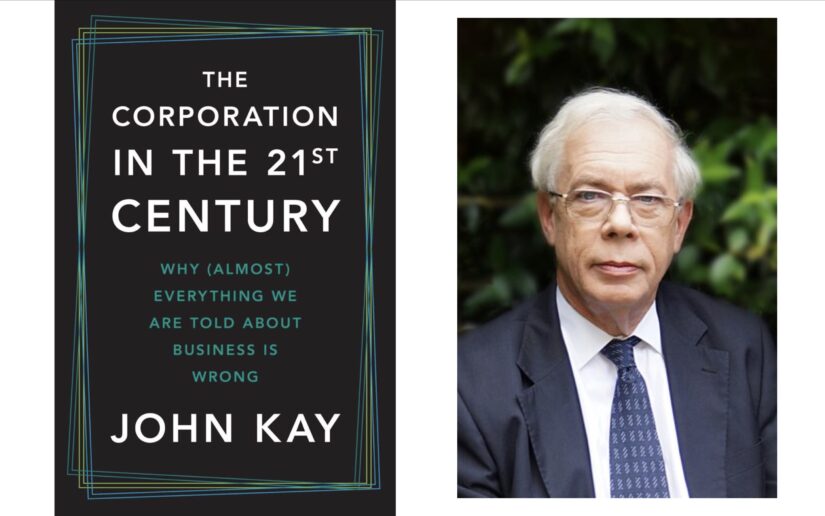
Notes from The Corporation in the Twenty-First Century: Why (Almost) Everything We Are Told About Business Is Wrong, a 2024 book by knighted economist John Kay.

Apple and Amazon are valued by public markets far in excess of their tangible assets, because of their “intangibles” in R&D and brand recognition. By historic standards, they own very little.

In contrast, AerCap and Prologis are among the world’s largest owners of the “means of production.” One leases aircraft to most large airlines. The other is the world’s largest industrial real estate company, leasing warehouses and data centers. They own the stuff.

Both “are nevertheless rather unimportant intermediaries in the modern economy” that now reflect “a long chain of intermediation” that means the system is more distributed. Yet our view and language about how companies fit into our world hasn’t changed.

That’s from The Corporation in the Twenty-First Century: Why (Almost) Everything We Are Told About Business Is Wrong, a 2024 book by knighted economist John Kay.

The old industrial meaning of “capital” meant the owned means of production — mills, railways, steel plants, assembly lines. In many modern firms, Kay argues, those assets are fungible, often rented, and less important than the firm’s collective capabilities.

Among his criticisms is how today’s shareholder priority has distracted from the corporation’s origins as a device of the state. Executives can extract value in the short term, but this narrow-mindedness is provably harmful to corporations in the medium term. Business and economics thought has become far too self interested. Its champions treat “collective action” and “collective knowledge” as accidental overflow rather than our truly natural state. The book is thoughtful and important, given that its from among its closest insiders.

Below I have my notes for future reference.

Continue reading The corporation was invented to serve the people

The deadliest infectious disease of all time is curable

Notes from “Everything Is Tuberculosis: The History and Persistence of Our Deadliest Infection,” a March 2025 book by American author, novelist and Youtuber John Green.

Tuberculosis (TB) is the deadliest infectious disease in history, having caused more than 1 billion deaths over the past 200 years. It is currently the leading infectious killer globally, recently surpassing COVID-19 to regain this status. TB has plagued humanity for thousands of years.

And yet, it is a preventable and curable disease. Most cases of active TB can be successfully treated and cured with a standard course of antibiotics. Tuberculosis death isn’t really caused by the bacteria anymore but by social determinants of health. Something should be done.

That’s from “Everything Is Tuberculosis: The History and Persistence of Our Deadliest Infection,” a March 2025 book by American author, novelist and Youtuber John Green. It is short, charming, insightful and harrowing. I recommend reading, and joining his cause.

“The real cause of contemporary tuberculosis is, for lack of a better term, us,” he writes. “So we have entered a strange era of human history: a preventable, curable infectious disease remains are deadliest. That’s the world we are currently choosing.”

Below are my notes for future reference.

Continue reading The deadliest infectious disease of all time is curable

Where the American policy of backing violent insurgents started

Notes from The Jakarta Method: Washington's Anticommunist Crusade and the Mass Murder Program that Shaped Our World, a 2020 book by American journalist Vincent Bevins.

The Cold War was a sprawling, decades-long global imperial campaign advancing American-style capitalism. It worked, at least for those who orchestrated it. Anywhere any unaligned effort, and certainly any movement connected toward the Soviet communistic system, faced direct or indirect American military and special forces. 

Little known strategies from Indonesia and Brazil in the 1960s, as poorly known as they are, became models exported worldwide. That’s from The Jakarta Method: Washington’s Anticommunist Crusade and the Mass Murder Program that Shaped Our World, a 2020 book by American journalist Vincent Bevins.

As he writes: “I am not saying that the United States won the Cold War because of mass murder. The Cold War ended mostly because of the internal contradiction of Soviet communism, and the fact that its leaders in Russia accidentally destroyed their own state. I do want to claim that this loose network of extermination programs, organized, and justified by anti-communist principles, was such an important part of the US victory that the violence profoundly shaped the world we live in today.”

Below I share notes from the book for my future reference.

Continue reading Where the American policy of backing violent insurgents started

Guerrilla war follows long-standing principles that powers often overlook

Notes from William R. Polk’s 2007 book Violent Politics: A History of Insurgency, Terrorism, and Guerrilla War, from the American Revolution to Iraq.

Insurgencies are usually won or lost less by battlefield tactics than by political legitimacy. Once a population comes to see the dominant power as foreign (or foreign-backed), the occupier’s position becomes structurally fragile.

That’s the central idea of William R. Polk’s 2007 book Violent Politics: A History of Insurgency, Terrorism, and Guerrilla War, from the American Revolution to Iraq. Polk argues (across 11 case studies, which I summarized below) that insurgencies follow recurring social and political patterns, and that “hearts and minds” is ultimately a legitimacy contest that outsiders rarely can win on durable terms.  Polk (1929-2020) was a long-established political scientist, foreign policy analyst and former Dept. of State official.

It is common in history for guerrilla movements to succeed enough that some leader thinks it’s time to go more traditional in their war. But this is missing the lesson altogether: Conventional war is for defense but offense benefits from guerrilla. Below I share my notes for future reference.

Continue reading Guerrilla war follows long-standing principles that powers often overlook

Great men are rarely good; good men are rarely great.

Lord Acton had it right 150 years ago

Great men are rarely good; good men are rarely great.

This perspective has long influenced my thinking, and it comes to mind again in the context of the longstanding rivalry between the late Apple cofounder Steve Jobs and Bill Gates.

I was always uncomfortable with people valorizing Jobs, because the track record seemed clear: he treated people very badly. Meanwhile, Bill Gates has done objective good with his wealth since. And yes, rehabilitating a reputation by investing in meaningful global health projects… that is a good.

But, though we don’t know the final word on the Epstein files, Gates’s relationship there does not look good, especially in light of a noncommittal interview done by his ex-wife Melinda.

Continue reading Great men are rarely good; good men are rarely great.

A History of the Eleven Rival Regional Cultures of North America

Notes from American Nations: A History of the Eleven Rival Regional Cultures of North America, the influential 2011 book by writer-researcher Colin Woodward.

There was not just one American war for independence, and there are whole nations inside the United States that do not conform to state boundaries. Linguists in accents, anthropologists on material culture and political scientists on voting patterns recognize this.

That’s from American Nations: A History of the Eleven Rival Regional Cultures of North America, the influential 2011 book by writer-researcher Colin Woodward. It sparked much follow-on research, and the Nationhood Lab, which continues developing the book’s premise today.

Below my notes for future reference.

Continue reading A History of the Eleven Rival Regional Cultures of North America

A vision for Philadelphia 250 years in the future

I'm deeply proud and honored to have helped develop a vision statement for Philadelphia for the next 250 years.

I’m deeply proud and honored to have helped develop a vision statement for Philadelphia for the next 250 years. An earlier version was shared last summer here. I shared this new version more widely for one last round of resident feedback in an Inquirer op-ed here.

The statement, a place to give feedback and information on the process can be found at PH.LY.

Below is the vision statement as it stands now.

Continue reading A vision for Philadelphia 250 years in the future

The Gulf War Did Not Take Place

Over a series of essays, French philosopher Jean Baudrillard argued the war was an expression of his concept of "hyperreality," in which emerging visual media could be used to create something false that appears even realer than reality itself.

The Gulf War was a seemingly decisive military action led by the United States against Iraq in 1991.

Over a series of essays, French philosopher Jean Baudrillard argued the war was an expression of his concept of “hyperreality,” in which emerging visual media could be used to create something false that appears even realer than reality itself.

By 1995, he assembled these essays into a final, short book called The Gulf War Did Not Take Place.

Continue reading The Gulf War Did Not Take Place

The “housing affordability crisis” is really a mobility crisis

That's from a new book by historian and Atlantic journalist Yoni Appelbaum called "Stuck: How the Privileged and the Propertied Broke the Engine of American Opportunity."

What Americans call a “housing affordability crisis” is really a mobility crisis — economic, geographic and social. Housing is where that immobility becomes most visible, and so expensive housing is more a symptom than the disease.

That’s from a new book by historian and Atlantic journalist Yoni Appelbaum called “Stuck: How the Privileged and the Propertied Broke the Engine of American Opportunity.

In healthy economies, including for much of the American golden age, people move to better jobs, cheaper places, growing regions. In the US today, people are increasingly trapped in place. When people can’t move, demand piles up in a small number of “winning” metros. Prices explode there, while other places stagnate or hollow out. I’ve written on the topic this year myself here and here.

Appelbaum’s book recounts the long trends that are piling up today. He recounts how American zoning regulations were introduced for race and class control, not for genuine health or safety concern. Early 20th century leaders, including eventual-US President Herbert Hoover, misunderstood crowded tenements and single-family homes as the obstacle and the accelerant, rather than what they really were: the launching pad and the eventual destination for those who made it out.

That history has persisted to today, where regulation and competing priorities strangle what might naturally occur. As famed mid-century urbanist Jane Jacobs said, over-planning a community is “attempting to substitute art for life”

Below I have notes for my future reference from Greenbaum’s detailed book. It’s wonky, and less colorful than I expected, but for anyone invested in the topic, it’s worth it.

Continue reading The “housing affordability crisis” is really a mobility crisis

The CIA Book Club

Notes on The Secret Mission to Win the Cold War with Forbidden Literature, a book published this summer and written by Charlie English.

In the 1980s, the American government spent billions of dollars on paramilitary campaigns to advance Cold War objectives. They also spent something like $20 million on a series of information campaigns.

Effective as it was, few are interested in celebrating the effectiveness of what more often got laughed about in military circles, including funding secret newspapers and distributing banned literature within the Soviet system, Poland in particular.

This is documented in The CIA Book Club: The Secret Mission to Win the Cold War with Forbidden Literature, a book published this summer and written by Charlie English.

The book is not really about the CIA, that’s just a particularly compelling subplot. Rather the bulk of the book is a thorough rehashing the Polish underground resistance and how that intersects and was often funded in part by the CIA. The subterfuge is inspiring in a sense, the power of free information. I enjoyed the book and recommend it to other history fans.

Below find my notes for future reference.

Continue reading The CIA Book Club