How countries go broke

The American-led political order that started in 1945 at the conclusion of the Second World War is 80 years old and due for a major reordering.

That’s from How Countries Go Broke, the most recent in the “Principles” series by Ray Dalio, the billionaire hedge fund manager who has written a collection of books on economic systems and investment strategy. I read “The Changing World Order” a few years back.

This, like others in the series, is backed what Dalio vaguely refers to a research team he employs. This makes sense, that a billionaire investor would employ research to develop an ever more detailed view of the world, but he’s become best known for a more expansive view than current economic conditions. Beyond his Bridgewater hedge fund, Dalio pumps out content now that attempts to put today into a broader historical context. No doubt simplified, his “big cycle” is the idea that eternally human qualities result in governments following predictable patterns, of relying on a hard, fixed currency before devaluing it long enough until there is a collapse.

He argues we’re something like 90%-95% through this pattern. Dalio has a reputation of prescience, if not precision: His prediction of a coming internet bubble bursting came five years too early (a half decade of earnings). I struggle with this. The books and research are compelling and interesting, but exactly because they’re comfortingly simple, they also read is unhelpful in any specific or actionable way. The interpretation is nonetheless welcome.

Below I share my notes for future reference.

Continue reading How countries go broke
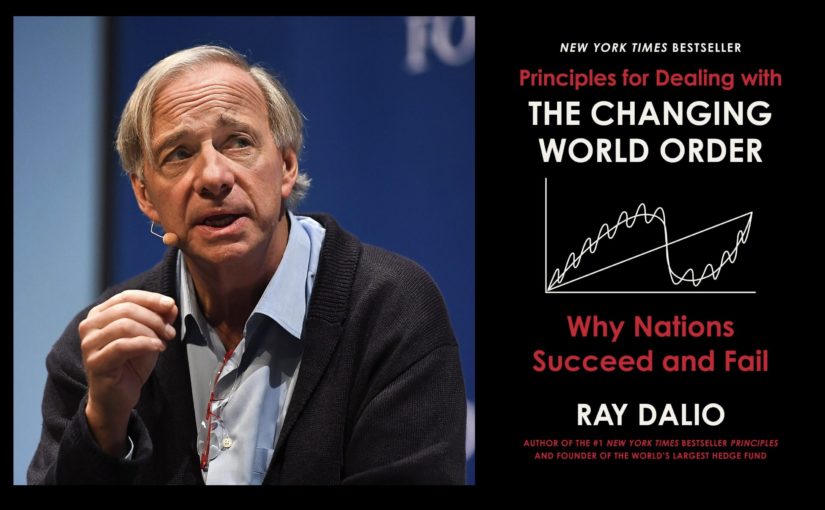
The Changing World Order: Why Nations Succeed or Fail

Empires rise and fall in predictable ways that follow long-established patterns.

An emerging power invests heavily in education, infrastructure and trade to create wealth, which it protects by strengthening its military. Elsewhere the current leading power grows decadent with rising wealth inequality, in-fighting and fading investments until the emerging power confronts it – and wins. War and revolution start the cycle anew.

That’s among the biggest themes from the high profile 2020 book from Ray Dalio, the founder of one of the world’s largest hedge funds: Principles For Dealing With The Changing World Order Why Nations Succeed And Fail. It’s part of the “principles” series that includes extensive independent research that Dalio’s team maintains here. He intends to look at the longest historical period possible to find patterns that can inform what happens next.

Most pressingly, he argues we’re at the late stage of the American empire, when the United States will continue to decline from its role as the world’s global hegemony and cede that position to China. I’ve been disappointed that much of his coverage has not challenged him on what seems a very big conflict of interest: Dalio is heavily invested in China, an authoritarian country that does not protect criticism, and he has been careful to avoid criticizing the party. In short, the book’s biggest flaws may be that he pulls his punches against China. Still, by using his own determinants and data, he paints a stark picture of unassailable patterns over the last 500 years up until today that looks like this:

Below I share my notes from reading the book for my future reference.

Continue reading The Changing World Order: Why Nations Succeed or Fail