Notes from ‘The Hard Thing About Hard Things’ by Ben Horowitz

Prominent investor Ben Horowitz’s 2014 book ‘The Hard Thing about Hard Things’ is among the seminal business philosophy books from this era of Silicon Valley entrepreneurship.

Horowitz is half of the founding team of Andresson-Horowitz, an iconic Sand Hill Road software-focused venture capital firm. His work and perspective has influenced today’s funding and startup climate, and so I finally dug into the book.

I enjoyed it and took away several insights. As per my habit, find some of my notes below.

Continue reading Notes from ‘The Hard Thing About Hard Things’ by Ben Horowitz

How to show growth for employees at a small organization

  • If you are a small company without a lot of turnover or new positions how do you make people feel that there is room for growth at your company?: We built out structured levels with half-steps and (over time) relatively clear definitions, and I’ve found our employees have appreciated that transparency and clarity. We have a Coordinator, Manager and Director structure, with just two C-levels and one VP, all of whom are senior and been with the company for a while. I’ve been mindful to avoid bloat (which I don’t think we always got right and made some mistakes there) but we do have clear ways for folks to grow. ie. Our more junior Coordinators first strive to oversee a department’s intern; our Managers tend to oversee a full-time Coordinator or at least a meaningful budget; and our few Directors lead a small team (2-3 people). (We have used the “Senior” title as a half-step, like Senior Manager or Senior Director ,to show growth)
  • How do you give promotions? Is it based on time (you’ve been here a year), responsibilities (you’ve taken on a new project) or something else (your boss is leaving)? One of the early successes that has really helped was that, with rare exception, only do promotions/salary growth two-times a year: aligned with twice-annual performance reviews. This has given structure and over time our staff really latch on to that cadence. One of the performance review questions includes a chance for teammates to call out what kind of growth they want
  • Do you wait until someone asks for a promotion, or are you clear upfront about what the next move is and when it could happen? For teammates I really want to retain, I often talk openly in their performance review check points about ways they might grow; projects and positions. Other teammates themselves voice, having seen how this works over time.
  • Do they have to add value (revenue) to warrant a promotion? Yes, most usually, we do discuss how their growth impacts the business, even for editorial. For example, we recently did a big internal promotion to a relatively junior editor of ours who worked on a smaller project exactly because she had been clever and very supportive of a newsletter subscriber growth strategy (which if not directly does indirectly tie to business goals). Our staff has grown pretty savvy in articulating how their work supports business goals. The performance reviews are good tools here: each six months a staff member is given a set of high-level priorities. Many excel at working toward them.
  • Do you give raises with promotions? Which do you find more motivating for people–promotions or raises? We always give raises with promotions. As a small local journalism org, for non-editorial roles, we haven’t always been competitive (though we’re getting better). Showing steady (if modest) salary growth year-over-year (even without promotions, we’ve usually outpaced COLA, which is easier in these low inflation years) has been important but the pathway for career growth has definitely meant a lot to many of our (best) teammates. I never judge teammates who really value salary growth, I’ve just tried to be upfront that I might not be able to meet those expectations longterm. This has been healthy.
  • Do you work with employees to create their growth plans? How does that process work? Yes, very tied to performance reviews. The aforementioned junior editor early in her time with us (four year employee) identified that she wanted a pathway to be a newsroom leader, more as editor than reporter. She is an excellent teammate so we kept finding opportunities for her professional development, which helped when the internal promotion opportunity came. She was less experienced than our external candidates but since it was part of a longterm conversation, we had de-risked so much with her that it proved an easy decision for me. That only happened because we had an open dialogue about her wants. Other staff members haven’t had as clear a personal journey (which is OK), but then I’ve likely not hit all their longterm plans.

A thank you to my coworkers ahead of Technical.ly’s 10th anniversary

A decade ago this month a couple friends and I started down a pathway that became Technical.ly so in the next couple weeks I am going to do some sharing.

A couple weeks ago, we hosted our inaugural Alumni Ball — gathering both current and former staff at the Pen and Pencil Club — and on February 26th in Philadelphia, we’re hosting a public celebration, conjoined with our largest jobs fair. We’ll also run plenty of editorial mentions honoring this anniversary.

First things first publicly, I wrote a Twitter thread unashamedly showing off about how lucky I feel about the team I am a part of right now. I’m sharing that here, with slight editing.

Continue reading A thank you to my coworkers ahead of Technical.ly’s 10th anniversary

Your retirement savings goal to strive for should mean you never dip into principal

Americans are rotten at saving for retirement.

It’s at least in part because of the seismic market change from 20th century-era defined benefit offerings (the pension you might have gotten working at a company in 1972) to today’s climate of defined contribution plans (the 401k you have at work or the IRA you might have with a company like Vanguard). More recently the Great Recession complicated the story more.

Whatever the case, we know one in three Americans has less than $5,000 in retirement savings. Two-thirds of Americans say they’ll outlive what they have saved, including the half of households that have no retirement-specific savings at all. Rules of thumb to the contrary abound: you ought to have the equivalent of a year’s salary by the time you turn 30, and you might want at least 10 times your top earning salary saved by the time you do retire.

When things are stressful, I tend to try to find some way to make them more approachable.

It’s in part why for the last several years, two childhood friends and I have gotten together once a year to discuss what we’ve tried, learned and accomplished on the subject the previous year. With a bit of nerdy glee, we call it Personal Finance Day, and we just held the fourth annual earlier this month.

Continue reading Your retirement savings goal to strive for should mean you never dip into principal

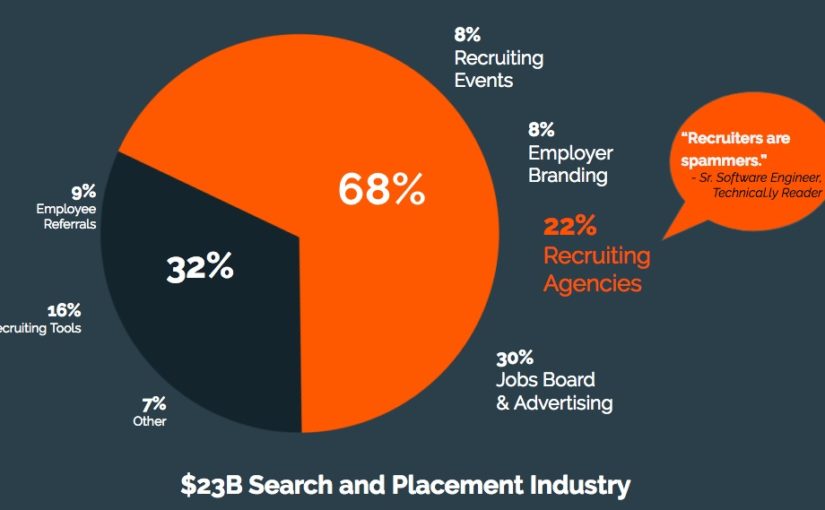
A look at the $23 billion Search and Placement industry

The Human Capital Management industry is a big one. Many segment it into Search and Placement, still a $23 billion annual gargantuan that encompasses how companies hire the right people.

In the last several years, we at Technical.ly have continued to focus on how our newsroom can compete in this cluttered industry by leveraging the trust we have and aim to develop with hard to reach jobseekers in the communities we serve. We’re producing more content on the topic, and I’ve begun to do more speaking on the topic.

I’ve also been doing lots of reading and gathering of worldview, particularly in the last year. In cleaning out a notebook, I found a slew of trends and numbers I was poking around, so I decided to share them here.

Continue reading A look at the $23 billion Search and Placement industry

What are you working toward?

version of this essay was published as part of my monthly newsletter a couple weeks back. Find other archives and join here to get updates like this first.

Earlier this year, I took a notecard from my desk and I wrote a short sentence.

It was a reminder, something I look at nearly everyday. This sentence was what I was working toward, in the simplest, most distilled form I could manage then. I then started telling my coworkers what that sentence was, so they knew my motivation, what I stood for.

From my teenage years, I’ve always written these sorts of things, quotes and priorities and reminders. Some are high-minded (I’ve had a Lao Tzu quote in my wallet since undergrad) and others are about working smarter (Your Email Inbox is Not Your To-Do List). I cherish these things. I find they do help transform my mood and habits. They are genuinely for me but, of course, they’re acts of signaling too. I am saying to the world (and therefore reinforcing for me), “Hey, These are my priorities, World!” This comforts me. I have a plan to cope.

Continue reading What are you working toward?

Lessons on “The Messy Middle” of business from Scott Belsky

You know startups. You know exits.

Most of the work of business takes place somewhere in between the very start and the very end. Yet a lot of media attention focuses on those two iconic poles. So you might know a lot less about the space between the two poles.

We need more guidance on the work stage. That’s the approach in The Messy Middle, a new book published late last year from Scott Belsky. He founded Behance, which sold in 2012 to Adobe for $150 million, and has been an active  investor.

Continue reading Lessons on “The Messy Middle” of business from Scott Belsky

My 2019 Resolutions

These are my priorities for the year for getting closer to being the person I want to be. As in years past, I want to share my resolutions.

Find past ones here.

I was proud of what I accomplished in 2018, which included a trip to Mexico City (and a visit to Paso de Cortes, as depicted above, where the Spanish conquistador entered the valley to attack the people sometimes called the Aztecs). I’m excited for 2019.

Continue reading My 2019 Resolutions