Personal finance is a social justice issue

The so-called K-shaped recovery to the pandemic economy is expected to widen inequality. It was already well-known that it is expensive to be poor. Yet we sometimes think of personal finance as the hobby of the already rich — of a white male dalliance.

Since the Great Recession and the lost generation of Millennials, there has been renewed interest in accessible financial advice. Yet even as white Millennials are finally making financial gains, it seems Black Millennials are still falling behind. For years at my company, I’ve tried to strike a balance between being positively encouraging to my team to increase their retirement savings (and to speak to the financial planner we make available to staff) without becoming too overbearing. We’ve made gains but I find the topic daunting.

Perhaps because the pandemic cancelled my annual Personal Finance Day with friends, I’ve been thinking a lot about a passion of mine: Personal finance is a social justice issue.

This is important because so many savings and investment fundamentals are simply not intuitive. Get rich schemes continue to fool many. In contrast, slowly and patiently putting a little bit aside into a passive index fund has been a remarkably reliable method for building wealth. Even God couldn’t beat dollar cost averaging.

Talk openly with your friends about what you earn, what you save and how you develop on your own journey. The internet is full of bad advice, but it’s also home to so much good stuff too. How to decide what is what? A solid rule: look toward the longterm and be committed by building habits.

(Photo of the calculator app by Kelly Sikkema via Unsplash)
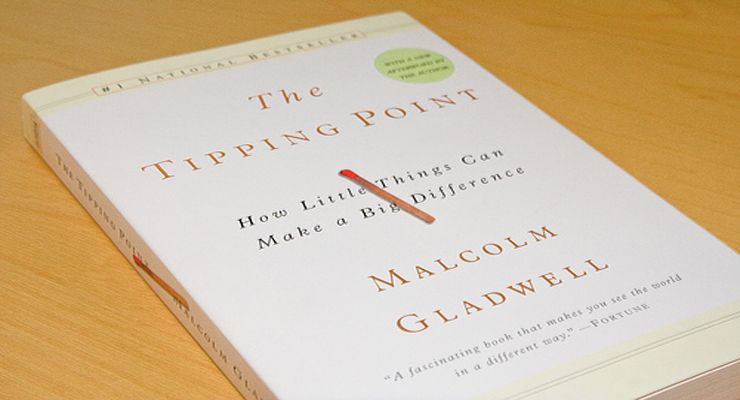
Notes on Malcolm Gladwell’s 2000 classic ‘Tipping Point’

Nothing more needs to be said on influential journalist Malcolm Gladwell’s first breakout book Tipping Point, which published 15 years ago. Like a lot of popular books, it has been aggressively criticized and dismissed.

Even if his theme is challenged, there are small points that are interesting. Though I read this several years ago, I just reread it and took down a few notes for my own future perusal. I’m sharing them here

Continue reading Notes on Malcolm Gladwell’s 2000 classic ‘Tipping Point’

The strength of weak ties

version of this essay was published as part of my monthly newsletter several weeks back. Find other archives and join here to get updates like this first.

My next-door neighbor Tom is a colorful, retired union tradesman. I adore him. This weekend, I overheard him watching the NBA playoffs in his backyard. I shouted over to see if he wanted company, and I joined him with a beer.

I’ve struggled with the social isolation of the last 15 months in many ways. I didn’t see much of my extended family, and I spent far less time with my friends and my coworkers. It was hardly enough but with these closest relationships, I did a lot of video calls and some social distance gathering.

The relationships I completely lost were my “weak ties,” as sociologists call them. In any healthy social network, we often over-estimate the importance our strong ties and under-estimate weak ties — those who you might not invite to your wedding. They give you new ideas, new information and new opportunities, exactly because you don’t overlap with your weak ties as much as your strong ties.

Continue reading The strength of weak ties