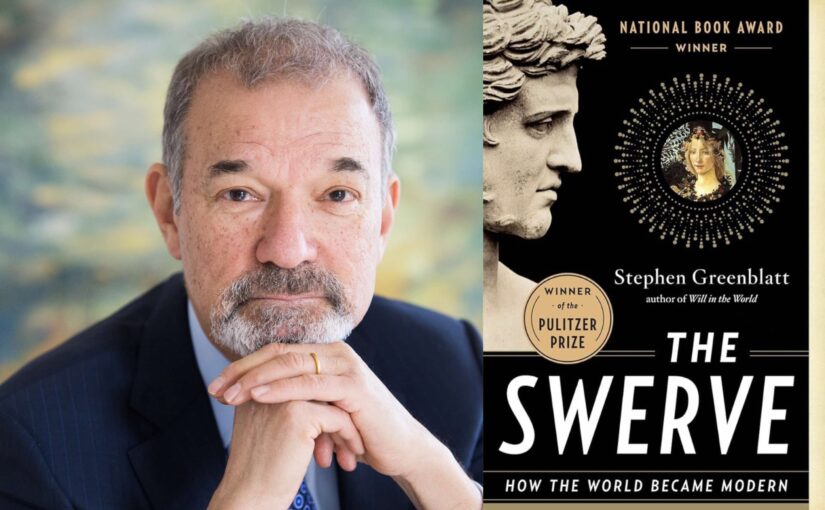
The concept hooked me: Lucretius’s On the Nature of Things, a materialist Roman poem, gets rediscovered in 1417 by book-hunter Poggio Bracciolini, and its ideas — atoms, a universe without divine design, pleasure as a worthy pursuit — help crack open the modern world.
That’s the setup of The Swerve: How the World Became Modern, a 2011 book by historian Stephen Greenblatt that won both the Pulitzer Prize and National Book Award. I just read it.
What I actually wanted was the origins story: how could anyone in the centuries BCE arrive at “atomism” at all, with no microscopes and no evidence? The book gave me less of that than I hoped, so I went digging on my own — and that turned out to be the more rewarding part. The answer: ancient atomism wasn’t a discovery. It was a logical deduction. Parmenides had argued that nothing can come from nothing and therefore change is impossible; Democritus’s answer was tiny, eternal, uncuttable bits (atomos) rearranging in a void. It only looks like modern science because the word survived. The concept was independently rebuilt on real evidence 2,000 years later.
Which reframed the whole book for me. The Swerve isn’t really a book of ideas — it’s a beautifully written, story-forward narrative built on a single irresistible image: a lone bibliophile pulling a lost masterpiece off a monastery shelf at exactly the right moment to change everything. That’s why it won: gorgeous prose, a great yarn, and a secular-humanist thesis that landed perfectly in the science-vs-religion mood of 2011.
The insight I want to keep: Greenblatt’s book is itself an example of its own thesis. It’s a work that met its moment — the right idea, well-told, arriving when the culture was primed to reward it. Drop it into today and I’m not sure it wins anything. Books, like the texts they’re about, get lucky in their timing.
Below I share my notes from the book for future reference.
My notes:
- On the Nature of Things by Lucretius was repopularized in 1417 by book-hunter Poggio Bracciolini
- His word “swerve” was the Latin “clinamen”
- In the 1330s, Petrarch pieced together History of Rome and kicked off Italian book hunting (and the humanities)
- Monks and monasteries kept books and reading alive
- Within Poggio’s life, his skills as a swift and accurate scribe declined with Gutenberg’s printing press — and then printers like Aldus in Venice followed Poggio and other handwriting to form an original popular typeface
- Benedictine rule required hard labor alongside prayer and writing and copying books counted as labor — only at day to use sunlight and avoid risk of candlelight, and so also got to skip some prayers
- In 54 BCE, Cicero called Lucretius work “brilliant genius yet highly artistic” — noting its rare place as philosophically interesting and beautifully written
- A short, disputed 4th century bio is all we know of Lucretius — that he killed himself at 44, and Cicero helped him edit: why so little contemporary information about such an important work?
- Villa of Papyri survived Vesuvius, and its collection of books
- Romans viewed Greeks as effete intellectuals, unlike their sturdier statecraft
- When Roman general Aemilius Paulus routed King Perseus in 167 BCE, among the plunder, he took the king’s library , showing the value of Greek books
- Roman Distinction between librari (copyists) and scribae (scribes): librari were slaves who worked for booksellers; the scribes worked as archivists and personal secretaries and copied books
- Authors made money from their patrons, as books could be copied at will — only 18th century copyright gave authors a protection to sell their work
- Worms were the teeth of time
- Library of Alexandria in Egypt: “The recipients of this largesse established remarkably high intellectual standards. Euclid developed his geometry in Alex-andria; Archimedes discovered pi and laid the foundation for calculus; Eratosthenes posited that the earth was round and calculated its circumference to within I percent; Galen revolutionized medicine. Alexandrian astronomers postulated a heliocentric universe; geometers deduced that the length of a year was 365¼ days and proposed adding a “leap day” every fourth year; geographers speculated that it would be possible to reach India by sailing west from Spain; engineers developed hydraulics and pneumatics; anatomists first understood clearly that the brain and the nervous system were a unit, studied the function of the heart and the digestive system, and conducted experiments in nutrition. The level of achievement was staggering.
- Freud said to Jung about the Americans “don’t they know we are bringing the plague?”
- Lucretius: not atheist but that gods were indifferent to us
- Lucretius theory: elementary particles that are infinite in number but limited in shape and size, are in motion in an infinite space and part of a universe without a creator.
- “Everything comes into being as a result of a swerve” and that swerve is the source of free will.
- A most minimum of motions (nec quam minimum), his swerve called declinatio, inclinatio of clinamen
- Nature ceaselessly experiments without an end in mind “sight did not exist before the birth of the eye, nor speech before the creation of the tongue “ — the organs were not created to fulfill an end but usefulness enabled them
- And the universe was not created for humans, and came into being not in paradise but in a battle for survival
- The point is to limit pain and enhance pleasure but do so by avoiding delusion
- But Lucretius observed in passages of remarkable frankness that in the very act of sexual consummation lovers remain in the grip of confused longings that they cannot fulfill: “Even in the hour of possession the passion of the lovers fluctuates and wanders in uncertainty: they cannot decide what to enjoy first with their eyes and hands. They tightly squeeze the object of their desire and cause bodily pain, often driving their teeth into one another’s lips and crushing mouth against mouth. (4.I076-8I)”
- …this passage-is part of what W. B. Yeats called “the finest description of sexual intercourse ever written”—Poet John Dryden translated a portion of the passage closing “ as sure they strive to be when both engage, in that tumultuous momentary rage. So tangled in the nets of love they lie, til men dissolves in that excess joy

- Painted in the mid-1480s by Italian Renaissance master Sandro Botticelli, The Birth of Venus, inspired by the opening poem
- Even to early employees: Vatican is the “lie factory”
- Why did monks faithfully copy this book that was so opposed to right thinking Christians? Like others who maintained it: : to call it just pretty poetry, to insult each other as falling prey to this Epcurean expression of pleasure or to otherwise reintroduce Christian framework
- Poggio largely distanced himself from the values; Valla interpreted just the idea of pleasure having value
- In December 1516, the Florentine Synod banned the Roman poet Lucretius and his epic poem De rerum natura (On the Nature of Things), a century after its rediscovery
- In 1549, the book was suggested to be on on the list of Probivity Book of Catholic Church , which was only ended in 1966, but Cardinal Marcello Cervini kept it off (as long as it was read as a fable)
- Thomas More Utopia ;1516) wrestled with the pleasure principle— defined by Lucretius ‘s Venus hymn. Inspired by Vespucci ‘s navigation of the Americas and stories of indigenous, his fictional Utopia’s people believe “ that no kind of pleasure is forbidden, provide provided no harm comes of it.”
- 50 original copies of the book remain , though not the first one Poggio had transcribed and he never transcribed it himself
- Shakespeare knew of it, in Romeo and Juliet he referenced “a team of little atomi” to refer to super tiny objects
- Montaigne: “ I want death to find me planting my cabbages, but careless of death, and still more of my unfinished garden”
- Galileo and Newton and the rest all appear to engage with Lucretius, the pleasure principle and atomism — Thomas Jefferson owned at least 5 copies of the book (pursuit of happiness)