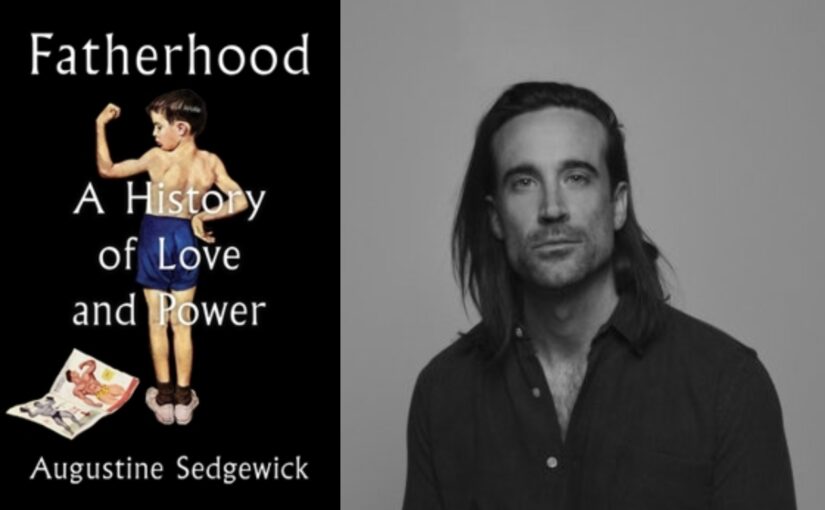
To revere, overcome and then honor someone is a relationship arc that can help us develop our own identity. It’s also something we often call fatherhood.
That doesn’t necessarily have to be a man but that has historically been most common. Our relationship to our father matters, whatever that relationship is — and so the role fatherhood has played through history matters too.
That’s the focus of Fatherhood: A History of Love and Power, a May 2026 book by writer Augustine Sedgewick. In the end, fatherhood is still evolving, as it always has, into a new form of “alloparenting.”
The book is a light read, relying on a dozen famous fathers (Thoreau and Bob Dylan, for example). It balances changing gender dynamics by reinforcing what has traditionally been true, and what we know about mammals more generally.
It’s short on anthropology and science, and heavier in biography than I expected. But gosh his conclusion is grand, I only wish we had more of his personal journey — it seems he divorced and there’s a powerful personal experience but we only get it at the end. “We are once again in search of a new idea of what men and fathers could and should be,” he writes, ever so gently implying he personally has too.
He does make clear in the intro that he’s looking narrowly at western father concept, and though Dr King and others make appearance, it’s primarily white too.
Below I share my notes
My notes:
- Erik Erikson: identity crisis (like PTSD or loss of child) — In 1944, Erik and Joan Erikson’s fourth child, Neil, was born with Down syndrome. Following the advice of his peers—including prominent anthropologist Margaret Mead and Jungian analyst Joe Wheelwright—Erikson was convinced that keeping a child with severe cognitive disabilities at home would harm his other children and impede his own academic work. Acting on this medical wisdom of the era, he had Neil placed in an institution immediately, even before his wife fully awoke from surgery. Neil lived to 21
- Norman Rockwell’s skill was “ to saturate the mundane with color and meaning, finding enchantment in even the quietest corner of everyday experience, but he struggled to do the same in real life, with his real family, just like everyone else”
- Rockwell paradox: In just 9 of 300+ Saturday Evening Post covers, Rockwell had father, mother and children — he struggled with his alcoholic wife (was he gay?) and altered Breaking Home Ties in summer 1954 during an especially challenging time
- “The history of fatherhood is a succession of identity crisis spanning thousands of years”
- Clifford Geertz: human culture is made of the stories we tell to understand ourselves
- In her groundbreaking 1949 treatise The Second Sex, French existentialist Simone de Beauvoir famously established that womanhood is not an innate, biological destiny but rather a social construct. She summarized this core concept with the iconic phrase: “One is not born, but rather becomes, a woman”
- One theory based on computer simulations: 5m years ago the drying African Savannah caused food scarcities that drove males to contribute to childcare in exchange to access to an in group
- Only in the 1980s with gene based testing did we determine paternity testing: for most of human history there was no clear understanding of a single act of sex leading to pregnancy months later
- Adrienne Rich defined the patriarchy as “the power of fathers”
- Sarah Baffler Hrdy: more variation among human fatherhood than among the other 300 other primates
- “Protecting and providing, now for status as much as for survival”
- 5 million years ago coming down from trees and at least as far back as 2 million years with human erectus, upright walking put an upper limit on how big human babies grow in utero which meant longer periods of post-natal helplessness — extended by large human brains 300k years ago
- Still today “ no species risks so much in labor” and born so young human babies require so much extra care
- Alloparental care and grandmother hypothesis (menopause allowed older women to be major part of caregiving) so fatherhood (single father as caregiver) was by no means inevitable. One theory argues infant carrying was early use of men
- Venus figurines suggest matriarchy and motherhood; paternal care much later; the “cult of the phallus” didn’t come until 8k BCE
- Writing introduced fatherhood, detailed lineages and ownership like the instructions of Shiruppag (“wisdom literature”, rules not punishments)
- Code of Hammurabi: eye for eye, rather than compensation for victim: the invention of patriarchal fatherhood ?
- Elizabeth Fisher in her 1975 book Women’s Creation: men had excess capacity to experiment with animal domestication as agriculture grew and this learning could have led to forced mating (rape) of women as a means of creating life (the penis as creator of life, and women as bearer, as Sumerian myths implied)
- Cattle breeding (even more than goats and sheep) may have been distinctly male activity from its origins
- “Men in general didn’t dominate early states — father’s did” (others were slaves or soldiers)
- In Plato’s Republic (375 BCE), he has Socrates introduce his Ideal society, beyond the private patriarchal society— and it overturned the Athenian model of single private household (more below), and replaced it with a guardian class that would mate polygamously in festivals
- Euripides has Medea say: “ I would rather stand three times in the front of battle than Baer one child” (1 in 5 classical Greek pregnancies resulted in the woman’s death)
- Brephos the fetus is born and In Greece a man had to claim it as his own and make a child, and then made a pais
- Aristotle left Athens after Plato died, and he founded biology — took up semen (activating agent) and menses (excess and waste) as the start of life in a single household, and distinct from Plato’s republic (and forming the standards of the idea that a strong father would make strong sons that followed his genes) Aristotle that Socrates could have a daughter with his famous pig nose and even in Plato’s anonymous community they’d know
- After tutoring young Alexander, Aristotle founded his Lyceum to compete with Plato’s academy; but later with the fall of Alexander he lost his status. “Pear ripens upon pear”
- Aristotle: from the moment of birth some are born to be subjects, others to rule — defended
- Domestic slavery and women as assistants in the role of men
- Aristotle’s stages of life: 37-55 was for raising kids
- Saint Augustine developed original sin and god the father while in Hippo (present day Libya)— for him fathers gave original sin, unlike Aristotle where fathers were good (at the edge of the Roman Empire Augustine had to develop his form of Christianity to compete against rival sects; and his “just war” to help Christianity thrive
- Roman Empire’s Constantine viewed Christianity as an organizing tool for his empire; He set off the Council of Nicaea in 325 (the holy trinity’s father son and Holy Spirit answered many questions of the era)
- Thomas More’s Utopia: inspired by “new world” travel writing, he argued for communal land not owned by the wealthy, yet still single households (unlike Plato’s communal family). The word utopia’s Greek origins give the sense of “no place” but was nonetheless interpreted then as a realistic depiction of this new world — this made More famous continent wide
- Martin Luther wrote that Henry VIII was “ a damnable and offensive worm… Without a spark of human reason alive in him”
- Luther felt raising kids was god’s duty (fruitfulness) and celibacy avoided it: “when a father goes ahead and washes diapers or performs some other mean task for his child”.. “god with all his angels and creatures is smiling”
- Henry VIII’s creation of Church of England put father at the center of church, state and family
- Jefferson tracked the weather in his journals, noting that it was 76 degrees with clouds on July 4, 1776
- Puritan’ founded Massachusetts to protect children from heathen England; in contrast, Virginia was founded by a company
- Lifelong bachelor John Locke collected essays into a parental advice book — parenting is a “temporary government”
- Jefferson transitioned from calling American Indians “my brothers” during the revolution to “my children” as the American power established
- Virginia switches to matrilineal line of slavery, from heritable over indebtedness or capture
- Henry David Thoreau (1817-1862) and Ralph Waldo Emerson (1803-1882) are the definitive anchors of individual philosophy in American thought. Through Transcendentalism, they argued that your highest moral obligation is to your own conscience and self-reliance, rather than to societal institutions, governments, or abstract religious dogmas.
- Alexis de Tocqueville coined the term “individualism” in his 1835 work Democracy in America to describe a new, calm social condition unique to democratic societies.
- The end of the Second Bank of the United States and the speculation in Maine timberlands were foundational triggers of the Panic of 1837 (Bank run started in 1836)
- By 1860, some states made the mother the default parent, as men went to work into an industrial age—parent manuals began to address mother
- Rousseau like Locke was also better known first as parenting expert (though Rousseau abandoned each of five children): his Emile, Or On Education (1762) was a hit especially in US arguing that children were inherently good, mothers were natural parents and fathers natural teachers
- Emerson: “cast the bantling on the rocks” (bantling = baby, so the idea is fathers were to challenge their kids) . “A sturdy lad from New Hampshire or Vermont” who has tried and failed many times “and always like a cat falls on his feet, is worth a hundred of these city dolls”
- “Henry returned to Cambridge that fall with mixed feelings. He dedicated himself to academic work and performed well enough to win a prize of twenty-five dollars and a speaking role in the commencement ceremony. Thoreau and two other students were assigned to address a theme of special relevance: “The Commercial Spirit of Modern Times, Considered in Its Influence on the Political, Moral, and Literary Character of a Nation.” Many members of his class were struggling to find jobs amid the financial panic of 1837. The twenty-year-old Thoreau wondered whether they should even be trying. Imagine looking down at Earth from “an observatory above the stars,” Thoreau asked the hundreds assembled for the graduation ceremony. How would this “beehive of ours” appear from that height? Men “hammering and chipping, baking and brewing… scraping together a little of the gilded dust upon its surface”-precisely what his father did all day while mixing graphite powder into pencil “leads.” For Henry, these workingmen had given away the most important thing they possessed: their freedom. The commercial spirit, Thoreau argued, was too much “the ruling spirit.” Its triumph had made every man “a slave of matter” Henry wanted nothing to do with the pencil factory.”
- (But Thoreau developed a better pencil, after another invention in 1844, his father changed the company name from J Thoreau and Co. to “& sons.” They were early abolitionists, opposing Florida entry as a slave state (where pencil’s red cedar was harvested by slaves: his civil disobedience essay (written after a night in jail for not paying taxes, though he stopped paying before the Mexican War: let you live to be counterfriction to stop the machine
- Darwin: his 5-year Beagle expedition (1831-1836 signed up for just two years) was for empire; military and commerce mapping of the coasts and sea; and later his own 10 children developed his natural selection on top of his own grandfather’s work
- Of Charles Darwin deciding in summer 1838 to court his cousin Emma Wedgwood for marriage or not: Sometime that summer, at the top of a blank page, Darwin wrote: “This is the question.” Underneath, on one side of the paper, was the heading “Not Marry.” Here Darwin listed the costs of marriage and fatherhood. He would lose the “Freedom to go where one likes-choice of Society… Conversation of clever men at clubs.” Having a family meant being “forced to visit relatives,” taking on the added “expense & anxiety of children,” “perhaps quarelling [sic] -Loss of time.-cannot read in the Evenings-fatness & idleness-Anxiety & responsibility,” he repeated. Not to mention “less money for books &c- if many children forced to gain one’s bread… you will be worse than a negro… but there is many a happy slave.” Glibly and privately, Darwin described fatherhood as a form of enslavement-an obligation to serve the financial and emotional demands of children and family. Glibly and privately, he thought marriage and fatherhood would be worth it. On the other side of the page, under the heading “Marry,” Darwin listed the benefits. “Children (if it Please God) -Constant companion, (& friend in old age) who will feel interested in one,-object to be beloved & played with, -better than a dog anyhow.-Home, & someone to take care of house-Charms of music & female chit-chat.” For Darwin, this was a compelling vision. “My god,” he concluded, seemingly surprised at himself, it is intolerable to think of spending one’s whole life, like a neuter bee, working, working, & nothing after all. -No, no won’t do… picture to yourself a nice soft wife on a sofa with good fire, & books & music perhaps… Marry-Mary-Marry.”
- Anna Freud’s work with children clarified the importance of a male figure “to resist, unseat and honor”
- 67k GI Bill mortgages went to NYC, but just 100 to black veterans
- Let’s face it, our teenagers are out of control : 1956 Newsweek cover [Could only find this 1966 version]
- Bob Dylan obscured his conventional upbringing and bristled against his supportive father. To a Newsweek reporter in a November 1963 profile his father said “ my son is a corporation and his public image is strictly an act” — Dylan pursued more traditional domestic life privately, leaving Joan Baez and keeping private
- In 1965, Kenneth Keniston’s book The Uncommitted explored rich young people throwing away materialism
- Monihan report about fatherhood, informed by Kenneth Clark (doll experiment) and “tangle of pathology”: two harms to black men, slavery and then a welfare system that encouraged separation
- Angela Davis quickly critical of Monihan focus on black men
- Simone de Beauvoir “the problem of men” vs “man-made” motherhood
- When Adrienne Rich (1929-2012) spoke at Haverford after 1974 National Book Award she refused to take questions from men: Raising her boys during the Vietnam War, Rich worried that the Western tradition was to train men to kill, and to train women to heal men’s wounds so they could go back out and kill again. She did not want her sons to kill or be killed. She did not want to nurse them. She wanted them “to remain… sons of the mother, yet also to grow into themselves, to discover new ways of being men even as we are discovering new ways of being women.”6 Men could have a feminism of their own….she wanted for her three sons “a manhood of nourishment and solace” but “most of our sons are in the most profound sense virtually fatherless “
- “For more than 200 million years,” Sarah baffler Hrdy “the nurture of mammalian young has been the nearly exclusive preserve of mothers” but no longer (the primatologist does argue that cooperative breeding—or “alloparenting”—has long been a feature)