Most mammals can’t have sex facing each other. Most female mammals don’t orgasm (you know, even with a really in-tune partner).
Academics still debate why, but in the end, humans evolved their sexual reproduction to create bonds. We bond for sex, and have sex for bonding. It isn’t silly, nor trivial. Two distinct, if related, parts of our closest relationships are the intimate and the sexual. Culturally we pair them together, and at our best that comes naturally. For many of us, that doesn’t, so it takes work.
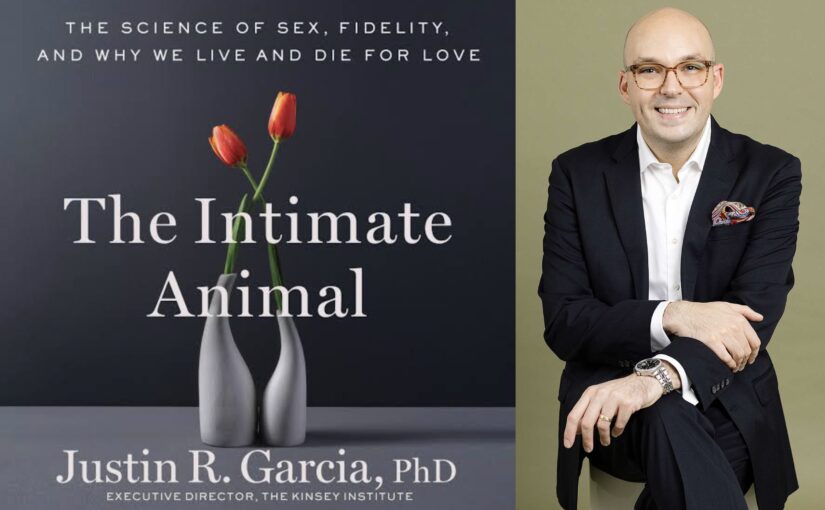
That’s from the The Intimate Animal: The Science of Sex, Fidelity, and Why We Live and Die for Love, a 2026 nonfiction book by Dr. Justin R. Garcia, an evolutionary biologist, sex researcher, and Executive Director of the Kinsey Institute.
The book includes research I appreciate, and takes an overly mature tone without reading academically. I appreciate his use of his cousin Jen’s life and love with Dave to serve as a spine for the book. This is a healthy book for anyone in a relationship, or considering one!
Below I have notes for my future reference.
My notes:
- Our drive for sex and intimacy are distinct and even at odds. We’re socially monogamous but “our sexual impulses are often in direct opposition to our existential need for love and intimacy.”
- His Match.com date research: both men and women pursue on average potential partners who are 25% more desirable than they are (based on number of messages received, replied to and to whom)
- Traditionally we learned courting habits from older generations down but with dating apps it’s gone the opposite way
- Love does change physiological responses (diminished decision making)
- Romantic love exists in all human societies
- Prairie voles (Microtus ochrogaster) and montane voles (Microtus montanus) look very similar, but they have completely different social and mating behaviors
- Sarah Blaffer Hrdy: We’re cooperative breeders because our big brains evolved to make pregnancy hard and early parenting difficult
- “Our unhappiness in love often points back to our attempts to make (or keep) a socially monogamous relationship, sexually monogamous, or vice versa.”
- The two greatest challenges to human courtship in the last 4 million years, the origin of social monogamy, was agricultural revolution and the internet, author argues
- “People were socially monogamous long before land ownership” — as far back as four million years. The agricultural revolution just tied pair bonding to inherited wealth, not invented it
- Weedy sea dragons: males give birth (females create larger gametes, the eggs; males create smaller gametes, the sperm)
- Robert Frost wrote “love is an irresistible desire to be irresistibly desired”
- Hookup culture is a response to cognitive overload with online dating: just look for something casual first
- Elizabeth Burch: online dating users swing 25% above their own status
- Claimed partner preferences can be impossibly restrictive (A guy in finance 6’5” blue eyes, as the social video had it, is extremely rare)
- Related: In the United States, approximately 2% to 3% of adult men are at least 6 feet tall and earn $100,000 or more per year.
- Daniel Conroy Beam: matching preferences in partner doesn’t actually correlate to relationship satisfaction
- Parental investment theory: women carry more burdens on birth so are choosier (in one study men swiped yes on 62% of women profiles but women swiped yes on just 4.5%)
- Eli Finkel: “suffocation model” of marriage, in The All or Nothing marriage
- The misattribution of arousal occurs when people mistakenly attribute physiological arousal (such as a fast heartbeat, sweating, or adrenaline) from one source to a completely different cause. Psychologists Donald Dutton and Arthur Aron tested this concept in a famous 1974 study (often called the Capilano Suspension Bridge experiment): Men who crossed a rickety bridge fell more for an interviewer than the men who crossed a stable bridge.
- Arthur Aron love questions
- Eight Dates: Essential Conversations for a Lifetime of Love by Dr. John Gottman and Dr. Julie Schwartz Gottman (along with Doug Abrams and Rachel Carlton Abrams) is a relationship-building guide based on decades of research from the Gottman Love Lab, like work & money and sex & intimacy.
- Helen Fisher: “slow love” though sex comes earlier (“sex interview” before first date)
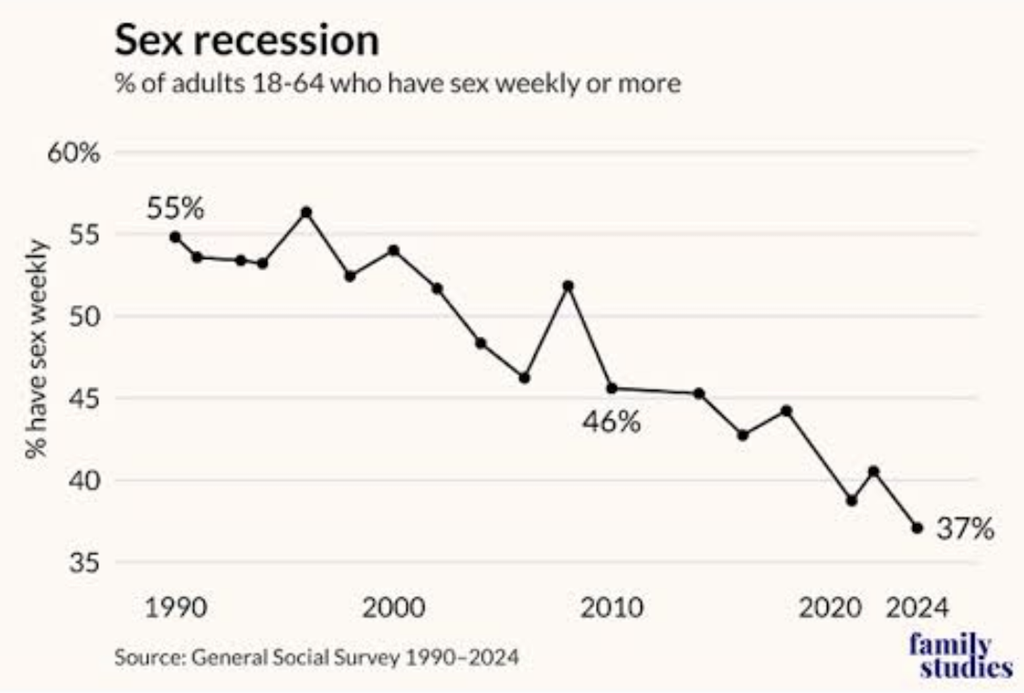
- “Coital frequency” has declined per general social survey
- “Marriage was traditionally the beginning of a partnership, today it is the final finale” author and Dr. Helen Fisher in The New Psychology of Love
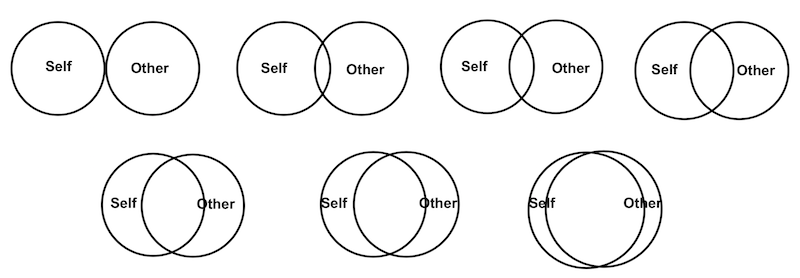
- The Inclusion of Other in the Self (IOS) Scale is a single-item, pictorial measure of interpersonal closeness developed by social psychologists Arthur Aron, Elaine N. Aron, and Danny Smollan in 1992.
- Bad breath? Disease avoidance
- Why is breast feeding “a learned behavior, not an innate one”? Because of cooperative breeding, around alloparents
- Most mammals can’t have sex facing each other, and most female mammals don’t orgasm — academics still debate why but humans evolved for sex to also create bonds
- We bond to have sex and we have sex to bond
- Consensual non-monogamy: Research from the Kinsey Institute and related studies show that roughly 1 in 5 U.S. adults (about 20% to 21.9%) have engaged in consensual non-monogamy (CNM) at some point in their lifetime. However, the number of people currently participating in a CNM relationship (such as polyamory, open relationships, or swinging) is actually around 4% to 5%. (Author writes 1 in 10)
- Positive illusion: what you believe about your partner more than others
- Kathryn Coe: ancestress hypothesis (mother daughter line, via art)
- Author and coauthors analysis of 40k heterosexual relationships: those high performing relationships had planned dates, most spent 30 minutes-plus on their last sexual encounter, reported trying new positions and discussing fantasies regularly with their partner (lots of intimacy and vulnerability)
- Lesbian women had sex declines more than straight women (“lesbian bed death,” a criticized term) over course of relationships but they remained intimate.
- Gay men had less sex declines; across all groups talking about sex was a signal of relationship strength
- Singles in America study: single parents with young kids aged 5 or younger are more likely to date and have sex than those with kids aged 5-18. The theory is that the hormones drove those to pursue help co parenting more than older kids
- Thomas Boyce: kids are either orchids or dandelions
- Just 3-5% of mammals and 15% of primates exhibit social monogamy, even fewer are sexually monogamous so many perform “mate guarding”
- “Men who exhibit mate guarding behaviors the most tend to have poor quality sperm.”
- The Coolidge effect is a biological and psychological phenomenon where sexual arousal and motivation are renewed upon the introduction of a new sexual partner, even after sexual fatigue or satiety with a previous partner.
- David Schmitt study: men want more sexual variety and so are more prone to cheat but entirely generalized
- Authors’ 2010 research team found an “infidelity gene”
- Kermyt Anderson: 1.5-2% of dads don’t know they aren’t the father of their kids — nuanced check of “paternity confidence” that improved on a previous expectation that almost 1 in 10 dads in maternity wards didn’t father the child (many knew they weren’t)
- Why hookup culture evolutionarily? Find new partners or create more diverse offspring
- “Infidelity is an act that puts the sex drive and the intimacy drive into direct and obvious competition. That’s why it can be so thrilling, so confusing and often so destructive – particularly when infidelity involves long-term, enduring relationships, beyond the pair bond rather than simple, one off sexual encounters. It is my belief that the intimate bonds forged by enduring affairs have had a long overlooked impact on our species’ evolutionary history. This is the shadow life of intimacy, in which we see an even greater collision between the two drives.”
- Author and Dylan Selterman: 8 reasons for infidelity and some are for intimacy while others for sex — this dictates how you cheat (shadow relationship or brief sexual encounter). Broadly, women more often cheat for intimacy and men cheat for sexual fulfillment
- fMRI research: brains going through heartbreak look like going through cocaine withdrawal
- “The grass is greener where you water it”
- Half of men and three quarters of women remove an ex from social media
- Two-thirds of women initiate divorce in United States
- “Just because a relationship ends, that doesn’t mean it failed”
- Amanda Gesselman: love effects health and vice versa
- Cancer is a “we disease”
- Julianne Holt-Lunstad: absence of quality relationships predicts disease and mortality — 50% increase in survival as a result of stronger social relationships
- “There is no such thing as a soulmate” there might be thousands and thousands to have a meaningful relationship
- Esther Perel: “Most of us are going to have two or three marriages or committed relationships. Some of us will have them with the same people.”
- German Politician Gabriele Pauli: marriages should be 7-year contracts and then up for renewal
- Peter Gray and Amanda Gesselman: on average sexual satisfaction increases with age for women but not men
- “In one of our national studies, one and four single adults said they would have sex with a robot if given the opportunity. Yet nearly half of singles would consider it cheating if their partner did so.”
- Our “intimacy instinct” : “ we seek out romantic love, not just for reproduction and survival, but also in the pursuit of self expansion”
- “While it’s true that we didn’t evolve to be happy, we can be, if we so choose… we are not prisoners of our drives for sex or love or even intimacy”