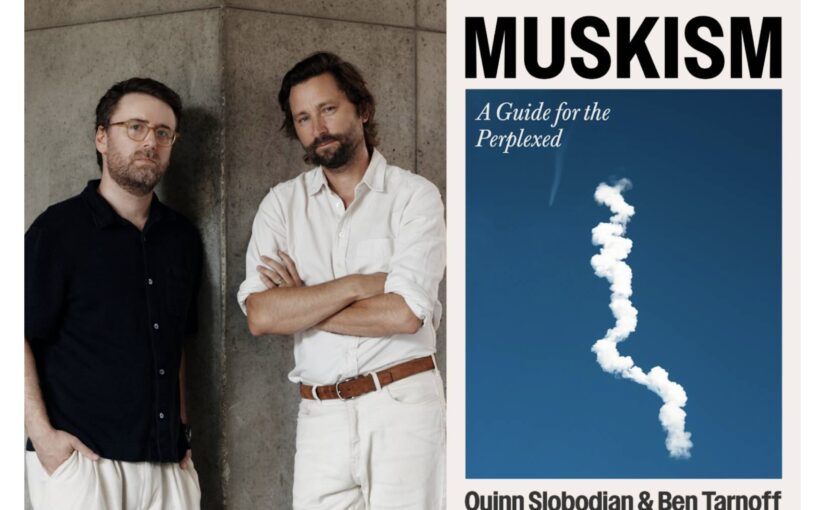
Elon Musk is more an effect than a cause. As Henry Ford was a product of an age he came to define, so too is Elon Musk, the divisive repeat entrepreneur.
That’s the angle of Muskism, a 2026 book by historian Quinn Slobodian and tech writer Ben Tarnoff. (Guardian review)
Unlike religiously anti-statist Peter Thiel, Musk’s career has blossomed by harnessing state power for his financial and cultural gain. In this way, Musk’s mega-corporations resemble the quasi-state actors of early modern corporate history — his Starlink dictated communications access for the Ukrainian army, and his SpaceX reshaped American satellite strategy.
I’ve never interviewed Musk, and in many ways he’s one-of-a-kind. But I can’t shake that he also reminds me of many other brilliant, over-confident tech executives that I have spent much of a 20-year reporting career with. At the height of Musk’s DOGE federal government purge, I wrote an op-ed proposing what seemed evident to me: he wasn’t interested in an actual coup (which many then feared), but just genuinely thought he was so much smarter than everyone else, he was going to clear the whole American bureaucracy right quick. Despite this getting me plenty of criticism, looking back now years later, my argument looks dead on.
In many ways, then, my read is Musk really is just the best known and most successful of a whole generational type. This book says something quite similar, if in a different way and tone than I might. I enjoyed its contribution.
Below I share my notes for future reference.
My notes:
- Ask not who is Musk but “what is Musk a symptom of?”
- Fordism of 20th century, so too Muskism is of 21st
- “Technomaximalism”
- Musk has cited Asimov’s The Foundation series (set as one empire fails, and the protagonist’s knowledge group becomes its own empire, the author was inspired by Edward Gibbon’s book on fall of Roman Empire)
- Likewise, Muskism was formed at the close of an old empire, ad the seed of the next
- Sovereignty through technology, defending “western civilization”
- Musk’s maternal grandfather was part of Technocracy, a vision in the 1930s of a dictatorship of engineers
- “Fortress futurism”
- Of anti-apartheid activists using the Commodore 64 and other tools lie the South African state: “technology hardened the state’s armor but could also make cracks in it”
- John Perry Barlow’s Declaration of the independence of cyberspace in February 1996
- Elon Musk’s business empire is built on a strategy of state instrumentation rather than state defiance. While his public persona often aligns with libertarian, anti-regulatory rhetoric, an analysis of his career reveals an exceptional ability to leverage public infrastructure, government funding, and strategic state partnerships across shifting presidential administrations. Over two decades, his companies have secured at least $38 billion in government contracts, subsidies, and loans: GPS for Zip2 and state loans and privatized internet; SpaceX under Bush; Tesla under Obama and its AI conglomerate under Trump
- Wired founder Kevin Kelly wrote in 1992 the book “Out of Control” about the “super organism” with a “distributed intelligence” that the Internet created
- On April 30, 1995, the U.S. National Science Foundation (NSF) officially decommissioned the NSFNET backbone, a pivotal transition that finalized the privatization of the modern internet’s core infrastructure. By transferring the operational burden from the federal government to commercial telecommunications and private network providers, the NSF completed a multi-year strategy to cultivate a self-sustaining, competitive digital marketplace.
- In 1993, .com websites were just 1.5% of the total, by 1996, they were more than half
- In 1994, cyberpunk fiction writer William Gibson cautioned against the loss of the “transnational, nonprofit” Internet, fearing corporates would turn it into an “infomall”
- In August 1995, then 24-year-old Marc Andersson took his NSF-funded project Mosaic public as Netscape: “the Internet was no longer a research network. It was an asset class.”
- In 1997 Christensen’s “innovators dilemma” popularized “disruption”
- Musk learned “the value of a startup may not be in current earnings but in imagined future profits”
- Thiel wanted erosion of the state (Pursue monopoly), Musk wanted to harness the state: Year after starting SpaceX, Musk told a Stanford class that like DARPA funded internet, NASA had funded space’s foundations
- Donald Rumsfeld’s tenure as Secretary of Defense radically accelerated the privatization of United States military and intelligence operations, creating a massive shift toward a “total force” model that heavily relies on private defense contractors. Famously, Edward Snowden worked at Booz Allen not the NSA itself
- This form of neoliberalism gave increasing power and discretion to the private sector
- SpaceX “sovereignty as a service”
- Development styles: waterfall came from the top; agile came from the engineers (lean software development influenced by Toyota production principles)
- Billionaire investor Antonio Gracias influenced Musk: it’s not the product that leads to success but the machine that builds the product (Musk lean Fordism)
- Incumbents preferred cost plus contracting versus Musk’s offer of fixed-price
- Starlink innovation: better speed by having satellites way lower (400 miles vs 20k), which required way more satellites and so much cheaper
- Musk controlling Starlink access in Crimea — unprecedented for civilian
- Obama’s clean tech era policy was industrial policy — ended by Republican obstruction and then the Shale Revolution. Unlike Solyndra, Tesla’s the only survivor of Marianne Mazzucatto’s “entrepreneurial state”
- In 2001, freshly-40 Musk and Bob Lutz on Charlie Rose show
- The American government funded the Internet of Web 1.0, and then ultra cheap money after the Great Recession subsidized the platforms of Web 2.0
- In his framework, political economist and sociologist William Davies argues that we no longer live in an “attention economy,” but rather a “reaction economy”. While the classic attention economy treats human focus as a finite resource to be witnessed and sustained, the reaction economy relies on the automated, real-time harvesting of rapid affective behavioral loops. (Facebook ‘likes’ introduced in 2009)
- First posting in 2010 casually, by 2015 Musk’s Twitter usage soared — 60 times an hour at points in 2024 — and his followers became his “real capital”
- In his political economy framework, Nick Srnicek argues that Big Tech companies like Google (Alphabet), Meta (Facebook), and Amazon represent the rise of “the new conglomerates”—digital empires that expand across unrelated industries by leveraging data and ecosystem lock-in.
- Charlie Warzel called Musk “a human meme stock”
- Musk: AI safety requires merging with the AI because as he said in a 2016 conversation with Sam Altman “we don’t have to worry about some sort of evil dictator AI because we are the AI collectively” — that requires the third layer of brain, from limbic system animal brain, to cortical layer reason brain thru the tertiary layer of digital tools
- In his September 2018 appearance on The Joe Rogan Experience (Episode #1169), then 47-year-old Elon Musk described humanity as the “biological bootloader for AI,” meaning humans are building a form of digital intelligence that will eventually outgrow and represent a tiny fraction of total intelligence.
- Ray Kurzweil’s 2005 book The Singularity is Near popularized trans humanism (its sequel)
- 1973 Jacques Vidal coins “brain-computer interface”
- In 2001 Stephen Hawking (his book) urged for “technologies that make possible a direct connection between brain and computer, so that artificial brains contribute to human intelligence rather than opposing it”
- Jan 2024: Noland Arbaugh tweets using a neural ink chip

- Neural ink ambition is two way: not just brain controlling machine but the machine also writing the brain
- In 1993, Richard Dawkins wrote of “virus of the mind,” then with pandemic lockdowns Musk repurposed the phrase as a “mind virus”
- President Joe Biden snubbed Tesla CEO Elon Musk by excluding Tesla from a White House electric vehicle summit in August 2021
- Donna Haraway’s 1985 essay, “A Cyborg Manifesto,” uses the figure of the cyborg as a hybrid of machine and organism to critique the rigid binaries of Western science and politics le. “The grid of control” — which gets at Musk seeming transphobic around his daughter Vivian. Haraway said in the western tradition “the relation between organism and machine has been a border war.”
- Musk then has “a cyborg conservatism” authors say
- Musk’s fall 2022 $44b trolling-acquisition of Twitter; from stay woke to stay@work
- Paola Gerbaudo: “the digital party” ran a “superbase” by a “hyper leader”
- Naomi Seibt, the anti-Greta, gained Musk attention by tweeting at him 600 times between October 2022-January 2025; he eventually responded June 2024, and her talking points became his
- Godwin’s Law (online, somebody eventually mentions Nazis) became an engine with Grok (MAGA version of ChatGPT)
- Norbert Wiener coined the term “cybernetics” in 1948, deriving it from the Greek word kybernetes, which means “steersman” or “pilot,” an intentional guiding of a boat
- Tim O Reilly 2010 “ government as platform” (eg provide APIs), informed 2014 US digital service which was later made into DOGE
- Edward Snowden’s disclosures in July 2013 exposed XKEYSCORE as the National Security Agency’s (NSA) “widest-reaching” mass surveillance system, confirming it was used to query and analyze vast streams of unconstitutional, warrantless digital data collected from global network infrastructure.
- Andrej Zwitter: cyber was not a “fifth domain” but a “control layer” across land, sea, air and space
- Economist Robin Hanson’s 2001 paper, “How to Live in a Simulation” (published in the Journal of Evolution and Technology), explores the pragmatic and behavioral consequences if you assign a high probability to living in a simulated reality: You should care less about others
- DOGE was “a digital-native nativism,” saved far less money, caused real harm, was erased by tax cuts but did remove some conservative bug bears
- In 1898, Hilaire Belloc wrote: “whatever happens we have got / the maxim gun and they have not” (which won colonial wars). In June 2025, Elon Musk adapted this by tweeting: “Whatever happens, we have got the spaceships, and they do not.”