The difference between reporting about policy and politics

In spring 2008 during my final interview for a prestigious post-graduate statehouse reporting internship, I got tripped up.

The impatient and inimitable Pennsylvania state government correspondent Pete Decoursey, a quirky Yale alumnus who passed in 2014, asked me to explain how I would approach my reporting on policy differently than my reporting on politics. I started. He corrected. I restarted. He interrupted. I faltered.

The truth was I didn’t yet grasp his point. He very carefully compartmentalized two kinds of government reporting: the legislating to solve problems and the campaigning to get elected power.

Continue reading The difference between reporting about policy and politics

How we speak signals education. But it is not the same thing as education: Robert Lane Greene

Language and the stories we tell about its origins are highly political. To understand one, you need to be mindful of the other.

That’s the main thesis of the 2011 book You Are What You Speak by Robert Lane Greene, who also writes a twice-monthly column on language in The Economist that I adore as a subscriber. I finished the book earlier this year as part of my continued assault on better understanding language’s history — read other reading notes of mine on language here.

This book helped cement my understanding that my favorite part of linguistics is philology, or the historical and comparative elements that seem quite cultural.

Below I share pieces of the book that stood out to me. But as always I encourage you to buy your own copy and read it; I only write nerdy posts like this when a book has really added to my worldview. So I strongly recommend it.

Continue reading How we speak signals education. But it is not the same thing as education: Robert Lane Greene

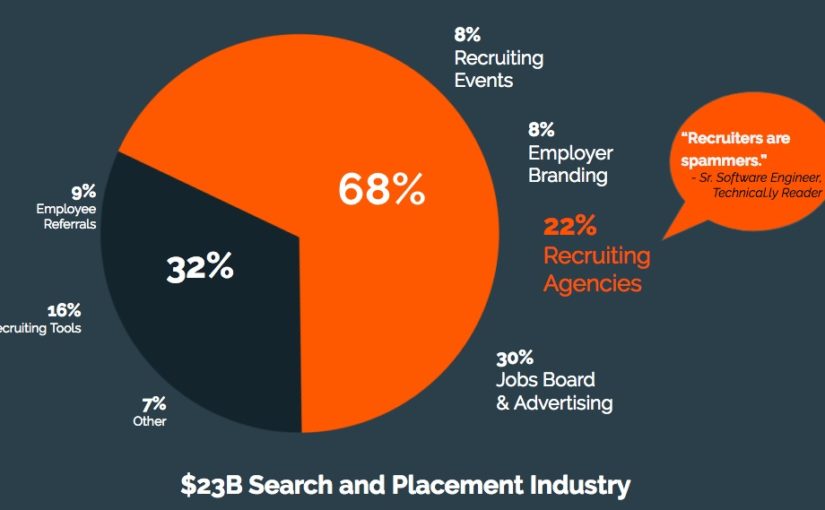
A look at the $23 billion Search and Placement industry

The Human Capital Management industry is a big one. Many segment it into Search and Placement, still a $23 billion annual gargantuan that encompasses how companies hire the right people.

In the last several years, we at Technical.ly have continued to focus on how our newsroom can compete in this cluttered industry by leveraging the trust we have and aim to develop with hard to reach jobseekers in the communities we serve. We’re producing more content on the topic, and I’ve begun to do more speaking on the topic.

I’ve also been doing lots of reading and gathering of worldview, particularly in the last year. In cleaning out a notebook, I found a slew of trends and numbers I was poking around, so I decided to share them here.

Continue reading A look at the $23 billion Search and Placement industry

7 tips on writing from a collection of essays from the Oxford American

Here are seven high-level tips on writing from the Spring 2018 issue of the Oxford American, a quarterly literary magazine a friend gifted me a subscription to for a year. It was the august publication’s 100th issue.

With a subscription you can read the pieces in depth, which I recommend. Clearly there is vastly more but as a teaser below I share one lasting takeaway from each, which I consumed months after the issue landed in my mailbox.

Continue reading 7 tips on writing from a collection of essays from the Oxford American

Do you know when humans first developed language?

Somewhere between 50,000 and 150,000 years ago, our ancestors likely first began communicating ideas through sounds in a more structured way than other species on the planet ever had before.

That’s the beginning of what we now call language, and on an evolutionary scale, it’s remarkably recent (for context, the earliest writing was some 6,000 years ago and we split from the Neanderthals some 700,000 years ago.)

In ‘The First Word,’ a 2008 book by Christine Kenneally, the research into the origins of language are unveiled. I read it earlier this year. Critics liked it when it first came out, and I enjoyed it myself. I read it for two reasons: both as part of my on-going resolution to reading books by women and people of color and to help kickoff a deep dive I’ve been doing into linguistics.

A few weeks ago I decided I just didn’t understand enough of how language developed — or how we’d figure it out. This book was an excellent foundation for me, and I was surprised (and thrilled) by how much evolutionary biology is involved in pinpointing the origins of language. For example, if chimps can do certain language-like things (like gesture, the beginning of language), then humans likely got that from our last common ancestor some four million years ago.

I was so taken by the book and many of the concepts, that I shared some notes below. Consider reading the book yourself, and use this as a jumping off point.

Continue reading Do you know when humans first developed language?

What employee counts should mean to reporters

The employee headcount at a company seems like it should be a straightforward metric. It isn’t.

As business reporters, we often use employee counts to gauge a company’s growth, size and priorities. For small, private companies especially, employee counts can be one of the most accessible and telling numbers available. But here’s the catch: Not all “employees” are created equal, and founders have plenty of incentives to inflate those numbers.

This isn’t necessarily about deception. Many founders genuinely believe their extended network of contractors, part-timers, and interns are part of their “team.” And in many cases, that broader team plays a significant role in their business. But as reporters, we need to dig deeper. If we take every headcount claim at face value, we risk misunderstanding a company’s true scale or overstating its growth.

So how do we approach employee counts with both curiosity and skepticism? Here are a few tips:

1. Clarify Full-Time Employees

When a founder shares their headcount, your next question should be: How many of those are full-time employees? This number matters because full-time employees (often salaried, W2 workers) represent a more permanent and sustained commitment from the company. Contractors and part-timers can be scaled up or down quickly, but full-timers are typically a better indicator of a company’s core operations.

For example, at my own company, Technical.ly, we have 19 full-time employees. However, if you include part-timers and contractors, that number rises to 24 people who regularly get a paycheck from us. In some contexts, we might call that a “team of 24,” but I’d expect a diligent reporter to push me on how many of those are full-time staff.

2. Consider Full-Time Equivalent (FTE)

In some industries, particularly those with lots of part-time or seasonal workers, it’s worth asking for the full-time equivalent (FTE) count. This metric translates all the hours worked by part-timers into the equivalent of 40-hour workweeks. For instance, two part-time workers clocking 20 hours a week each would count as one FTE.

FTE is a useful standard because it provides a clearer sense of the company’s overall workforce capacity. Many government and economic reports rely on FTE figures, and they can help normalize comparisons across companies with different staffing models.

3. Be Wary of Inflated Numbers

It’s not uncommon for founders to include anyone remotely connected to the company in their employee count—freelancers, one-off contractors, or even unpaid interns. This can make a company seem much larger than it actually is. While it’s fine to include those numbers in certain contexts, you should always distinguish between core staff and auxiliary contributors.

For example, a founder might proudly claim they have a “team of 400,” but if 380 of those are one-time freelancers, that paints a very different picture than a company with 400 full-time employees.

4. Think About the Narrative

Ultimately, employee counts are a storytelling tool. The number a company shares—and the one you choose to include in your reporting—should match the narrative you’re telling. Is the focus on a company’s growth trajectory? Highlight full-time employees to underscore sustained investment. Covering a gig-based startup? Mention contractors to illustrate its flexible model.

TL;DR: Always Ask the Follow-Up

Employee counts are a valuable metric for understanding a company’s size and priorities, but they require context. Always follow up to clarify:

  • How many employees are full-time?
  • What is the full-time equivalent (FTE) count?
  • Who is included in the broader “team” number?

By asking these questions, you’ll ensure your reporting accurately reflects the reality behind the numbers—and avoid falling for the illusion of scale that an inflated headcount can create.


Reporting on something wonky? Where are the people stories

A treasured former coworker of mine posted a nice tweet, recalling that I got in her (and other reporters!) ear a lot about our beat (tech and business and blah blah blah). If you’re feeling lost, remember: Where are the people stories?

Boring interview? Lost in the details? Ask the person why they do what they do. Ask them how they ended up living where they do. Ask them what else would they do if they couldn’t do this job. Anything to get it back to the people.

Notes on local news membership

Just about everyone in local news is excited about reader revenue.

The term is for membership and subscription programs, and the enthusiasm is driven (as best as I can tell) by the hope that it’s an earned income stream that philanthropists and civic-minded folk approve. I’ve remained a holdout, in large part because I’ve seen the spreadsheets before.

Back at Technical.ly’s launch in 2009 and 2010, we looked seriously at membership models. And I was keen on it as a strategic bet for an ecosystem approach to local news. But the more I learned about the math, the local economics looked difficult. The math I got interested in: at $100 year from 500 members (which always looked ambitious for most small and niche media) would get you $50k a year. Trouble is that that almost certainly would need full-time support to manage, thereby costing more than it brought in.

No doubt it could work at wider scale — true town-square news orgs, like a metro newspaper, or a regional public media outfit, or the nonprofit newsrooms that filling full news deserts. But I’ve been less certain if the bench was deep of orgs that could step. Fortunately we at Technical.ly got a generous investment from the Lenfest Institute to explore more — and this month we brought together a coalition of news orgs to bring together our joint promotion. Last fall, I presented our early findings, and I got feedback I wanted to share.

Continue reading Notes on local news membership

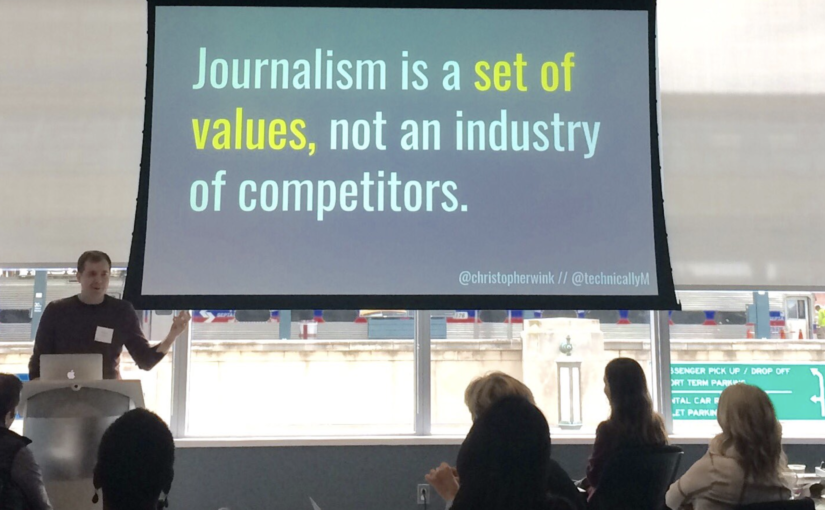
Journalism is a set of values, not an industry of competitors

Journalism is the process of helping a community near its truth, as I defined it at a conference last year.

Though it’s common among media innovators to talk about newsrooms not being in competition with each other, the central reasons why aren’t as readily addressed. Legacy business models are running on fumes. Those leading them just might close enough to retirement that they don’t feel the need to adapt. The rest of us must.

Earlier this fall at a small gathering of newsrooms from across the country and then again last month at Klein News Innovation Camp, I gave presentations that again hit upon this theme. I took a new approach to the theme.

Journalism is a set of values, not an industry of competitors.

The business model that developed over a couple centuries was so successful that we ended up with a monoculture but that was no inevitability. We must understand that what journalism practitioners share is a belief in how the world should operate. We believe journalistic standards and its related approaches are effective at building a kind of community that has power. That’s a worldview; it’s a philosophy that could be brought into many different circumstances, organizations and campaigns.

https://twitter.com/HannahDotYoung/status/920006650253271041

My slides can be found here