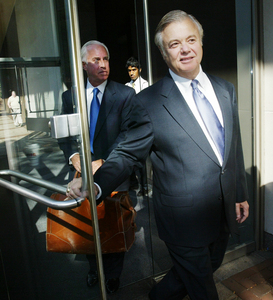
Vince Fumo: his color and charm and corruption charges leave

Vince Fumo is the funniest indicted state senator in the history of the Pennsylvania General Assembly.

To Philadelphians Fumo is tinged with corruption, his name only said amid seething recounts of his 139-count indictment looming in the fall. But in Harrisburg, his professional home since 1978, Fumo is still a force.

After a second heart attack in March and this round of indictments that came last year, Fumo announced he would not seek reelection in November and vacated his post as chairman of the Senate Appropriations committee, a powerful seat he held since 1984. Still, after each negotiating session of state leaders this budget season, it was Fumo who came out, sleeves rolled up, ready to speak to the press.

In what may be the final week of his legislative career, Fumo was loose and downright uppity.

Continue reading Vince Fumo: his color and charm and corruption charges leave

When to go to kindergarten: who are the slower ones?

A kindergarten class in 1955

Did you want a head-start or a chance to regroup before heading off to kindergarten? That topic is an interesting one that is getting even more complicated with our country’s continued dependence on standardized testing – initially the older the better the scores, so states live it. But there are much larger ramifications, unsurprisingly.

On Friday, Slate writer Emily Blazelon posted a story on the issue:

The calculus goes like this: You look at your 4-year-old, especially if he’s a boy, and consider that his summer or fall birthday (depending on the state and its birthday cutoff) means that he’ll be younger than most of the other kids in his kindergarten class. So you decide to send him a year later. Now he’s at the older end of his class. And you presume that the added maturity will give him an edge from grade to grade. The school may well support your decision. If it’s a private school, they probably have a later birthday cutoff anyway. And if it’s a public school, a principal or kindergarten teacher may suggest that waiting another year before kindergarten is in your kid’s interest despite the official policy. [Source]

Continue reading When to go to kindergarten: who are the slower ones?

The new media age is another Watergate divide for reporters

The famed photo of Washington Post reporters Carl Bernstein and Bob Woodward after breaking 'Watergate.'

I am gaining a lot of perspective, I think, while serving a post-graduate internship with the Pennsylvania Legislative Correspondents’ Association.

More than just the newspaper bubble, today’s industry fears are the result of another cultural divide, just like one journalism faced in the late 1960s and early 1970s, famed by the Watergate scandal.

We can see this in an old tradition that died here in the Capitol newsroom more than 20 years ago. This from a brief history on the PLCA, the oldest society of its kind:

…There was a prestige reason and a practical reason to be concerned with who had been in the newsroom the longest. The prestige reason was that the senior reporter was the one who terminated news conferences, not unlike the custom, still followed today, at [some] White House press conferences. When he judged that questions had been satisfactorily posed and answered, the senior reporter would say, “Thank you, governor,” and the news conference was over. That tradition later ended [in Harrisburg]. The practical reason was picking first in the “the divvy.”

The divvy was the ultimate divide between older and younger reporters.

Continue reading The new media age is another Watergate divide for reporters

Northwest New Jersey: a case for that extra geographical distinction

Today I am enjoying the Sussex County Farm & Horse Show, so I thought it was time to write down a conversation I have had too often since leaving the nest four years ago.

I grew up in northwest New Jersey. Of course, when I tell people this – anyone outside of this rural swath of the Garden State, even others from the state – they think it’s a curiously specific geographical distinction.

Click for Detail

There is North Jersey and there is South Jersey and, when pushed, there is Central Jersey. Here’s the breakdown, North Jersey is urban backfill from New York City, exurbs, grime and business sprawl. South Jersey is full of Phillies fans, Jersey tomatoes, big, greasy hair and the Shore. Central Jersey is full of elite suburbs around Princeton and the buffer between its two geography neighbors.

But my native Sussex County, and Warren County beneath it, are decidedly dissimilar from North Jersey nomenclature. Despite growing up less than 60 miles from Manhattan and 90 miles from Philadelphia, my childhood could easily be classified as small town, in the Garden State’s prime rural hinterland that you didn’t know existed.

My parents left their New York City roots for the simpler pastures of Sussex County – bringing me to Newton, N.J. when I was still an infant, so I am our first-generation of this rural community, though I didn’t know it until I left there.

Continue reading Northwest New Jersey: a case for that extra geographical distinction

Reader Response: Foment versus ferment

I already shared the wide array of reader response I got for a recent A1 story I had for the Philadelphia Inquirer that covered the Harrisburg reform movement [There’s video for the story up now, too].

I got another call yesterday that I wanted to share.

A Maria called to compliment me on the story but she had one gripe that she “had to get off [her] chest.”

Continue reading Reader Response: Foment versus ferment

Capitol Ideas: Blog post on Republican auditor general candidate

A press conference held by Republican Auditor General candidate Chet Beiler on July 31, 2008. (Photo by Christopher Wink)

Who said blog clips aren’t worth anything? Here’s one for Capitol Ideas, the popular state government blog by Morning Call reporter John L. Micek.

Republican Chet Beiler wants to be Pennsylvania’s auditor general and used the phrase “tax dollars” often enough today to prove it.

Flanked by supporters, Beiler stood in the Capitol rotunda this morning, and challenged Democratic incumbent Jack Wagner to meet him for a series of discussions of the issues.

Standing in front of a banner that promised Beiler, of Manheim, Lancaster County, said he’ll spend his time “protecting your tax dollars.” He also vowed that “wherever tax dollars go, I will be there.”

Read the rest on Capitol Ideas.

Watch out for the stronger voice in blog style, my friends, and please note the forlorn-looking boy in the right of my photograph – taken with my cell phone.

This Land is Their Land: Could You Afford to be Poor?

I am reading the book This Land is Your Land by Barbara Ehrenreich, the noted author of the 2001 investigation into the U.S. working poor Nickel and Dimed.

It is mostly the standard fare criticism of the wealth from the left – not suggesting it is justified or not, but standard nonetheless.

However, one brief chapter did stick with me, one entitled “Could You Afford to Be Poor?” [Page 41 in hardcover].

She referenced a 2006 study of the Brookings Institution, which cited the “ghetto tax,” a higher cost of living in low-income urban neighborhoods. Many of the individual examples we all know or could recognize but seeing them together collectively was daunting.

Here is her list

  • Poor people are less likely to have bank accounts, which can be expensive for those with low balances, and so they tend to cash their pay checks at check-cashing businesses, which, in cities surveyed, charged $5 to $50 for a $500 check.
  • Nationwide, low-income car buyers, defined as people earning less than $30,000 a year, pay 2 percentage points more for a car loan than more affluent buyers.

Continue reading This Land is Their Land: Could You Afford to be Poor?

Reader response for Inquirer story on Harrisburg reformers

Last week, I shared some reader response I received after a recent story on state Rep. Babette Josephs ran on the cover of the Inquirer’s Local Section.

So it comes as no surprise that getting a story on the cover the newspaper – one about the Harrisburg reform movement yesterday – got some response, too.

A man who – jokes aside – I think was intoxicated and was either complimenting or insulting my coverage of “citizens” – I sincerely couldn’t tell. No name, no number, but he called back and left a second message in which he said the following:

Oh, I forgot. My primary concern is helping and reliquifying [sic] the American middle class, and until, well, that is the basis of everthing, until that happens, this country isn’t going anywheres [sic] and you can quote me on it.”

I don’t know who he is or how to contact him or why I would want to quote him – but I sure will.

Continue reading Reader response for Inquirer story on Harrisburg reformers

Capitol feels bite of Pa. gadflies (Philadelphia Inquirer: 7/29/08)

By Christopher Wink | July 29, 2008 | Philadelphia Inquirer

HARRISBURG – They call themselves, simply, “the Coalition.”

They are an informal group of about a half-dozen citizen activists – most of them middle-aged men from Central Pennsylvania – who spend their time waging a grassroots war for governmental change in the Capitol.

Each member of the group’s cast of characters has his own political persuasion and priorities – not to mention colorful turns of phrase and memorable props to enliven the good-government message. But all are motivated by the same philosophy: State government needs fixing and elected officials aren’t doing the job.

“There is a cancer on the Capitol,” said Gene Stilp, founder of Taxpayers and Ratepayers United and one of the more visible Coalition members. “The question is if it’s incurable.”

Continue reading Capitol feels bite of Pa. gadflies (Philadelphia Inquirer: 7/29/08)

Inquirer: Front page story on Harrisburg citizen activists

See it on the front page of the Inquirer at Newseum.com.

HARRISBURG – They call themselves, simply, “the Coalition.”

They are an informal group of about a half-dozen citizen activists – most of them middle-aged men from Central Pennsylvania – who spend their time waging a grassroots war for governmental change in the Capitol.

Each member of the group’s cast of characters has his own political persuasion and priorities – not to mention colorful turns of phrase and memorable props to enliven the good-government message. But all are motivated by the same philosophy: State government needs fixing and elected officials aren’t doing the job.

“There is a cancer on the Capitol,” said Gene Stilp, founder of Taxpayers and Ratepayers United and one of the more visible Coalition members. “The question is if it’s incurable.”

Love them or hate them – and many hate them – this small group of activists has had a big impact on Harrisburg’s political landscape. Since 2005, their work has helped push out a Supreme Court justice and almost a quarter of the legislature.

Stilp is credited with prompting the 17-month probe into legislative bonuses that just this month led to a raft of political corruption charges against a dozen Harrisburg insiders.

But who are these activists? And why do they spend so much of their time – usually without pay – to do what they do?

….

Read on at Philly.com.

This ran today for the Philadelphia Inquirer. The coverage is part of a post-graduate internship with the Pennsylvania Legislative Correspondents’ Association (PLCA).