The invention of modern journalism

Newspapering is so old, and its chief champions are fusty enough that it’s easy to set aside its histories as the relics of an extinct industry — like beeper sales or switchboard operation.

But 20th century newspapers weren’t just a light-manufacturing industry. This trade developed how we gather and distribute news and information in ways that shape us today. That’s my continued interest in the “invention of the news,” and its many histories.

One of the most influential publications in shaping today’s information ecosystem was that century’s Wall Street Journal, and its longtime leader Barney Kilgore. It’s worth reviewing their origins.

That’s the focus of Restless Genius : Barney Kilgore, the Wall Street Journal, and the Invention of Modern Journalism, a 2009 book written by Harvard-trained lawyer Richard Tofel, who became ProPublica’s founding general manager. Today he is a thoughtful, and prolific journalism commentator.

Though I follow Tofel’s writing, I hadn’t read this particular book yet. It reads primarily as a history of the Wall Street Journal, and this one particular leader, but there are more lasting lessons Tofel draws. It’s still worth reading.

The broadest reading: High-quality news and information can be assembled into a product that solves clear enough problems for people to spend money on.

After the peak of Gilded Age “yellow journalism“, many modern journalistic standards were established in the 20th century. This mass-media era developed a positively-reinforcing dual incentive: quality was a distinction, especially first in business news, that attracted paying subscribers, who were valuable and hard-to-reach enough that advertising was lucrative, which in turn justified more investment in news gathering and product quality. That particular bundle was famously disrupted by various internet-enabled platforms, but the lessons remains true. Tofel helped lead a ProPublica team that attracted philanthropic and reader-donors. National and business media have also had success with new subscriber models, many newsrooms today have robust event strategies that differently package their news. In our own way, my news organization Technical.ly has come out of the pandemic selling our reporting as a service that addresses a communication gap that economic development faces (which has required entirely new language, which other journalists often sniffle at). Plenty other examples exist, and more to come.

Below my notes for future reference.

Continue reading The invention of modern journalism
What Works (and doesn’t) in Community News

This is primarily a place for my notes from this book for my future reference, but I have also included below an essay about the book I originally posted on Linkedin.

American journalism leaders rightly view local news models as worryingly limited. After nearly 20 years founding and operating a local news org, I believe many take too narrow a view of how to address that worry.

That’s why I was interested to read What Works in Community News: Media Startups, News Deserts, and the Future of the Fourth Estate, published in 2024 and written by Ellen Clegg and Dan Kennedy, two well-regarded journalism insiders who also host a podcast on local news. (Clegg is a longtime Boston Globe veteran who founded hyperlocal news site Brookline News; Kennedy is a Northeastern University faculty member.)

The book came out two years ago, and for fellow local news nerds, it’s still worth adding to you collection. Buy it!

Below, I share my reflections, and I have criticisms, but they’re more about the broader local news discourse than the book itself 🙂 I come with peace and love.

Continue reading What Works (and doesn’t) in Community News

All the News That’s Fit to Sell: notes on mass media business models from the 2003 book by James T. Hamilton

The fractured media landscape we have today was already breaking apart two decades ago, and the economic models that underpin them predicted what we have today.

That’s the benefit of reading All the News That’s Fit to Sell, a 2003 book from James T. Hamilton, a well-respected journalism professor. I’ve read Hamilton’s work before, and this book was one I’ve long had on my list. I enjoyed the work, which is just as relevant 20 years later.

His research is helpful for my understanding of journalism models that I’ve spent my entire career working on. The book is also helpful for those interested in a dispassionate outline of the beginnings of the digital transformation of media – which we’re now fully immersed in.

Below I share notes for my future reflection.

Continue reading All the News That’s Fit to Sell: notes on mass media business models from the 2003 book by James T. Hamilton

Newspapers were once the big tech platform companies everyone hated

This is adapted from a Twitter thread.

There are many parallels between early newspapers and today. Like then, today big tech platforms are vilified for taking creative destruction to a more harmful end to civic discourse.

Then partisanship and misinformation gave rise to the modern concept of editing. Perhaps something akin is happening again.

Continue reading Newspapers were once the big tech platform companies everyone hated

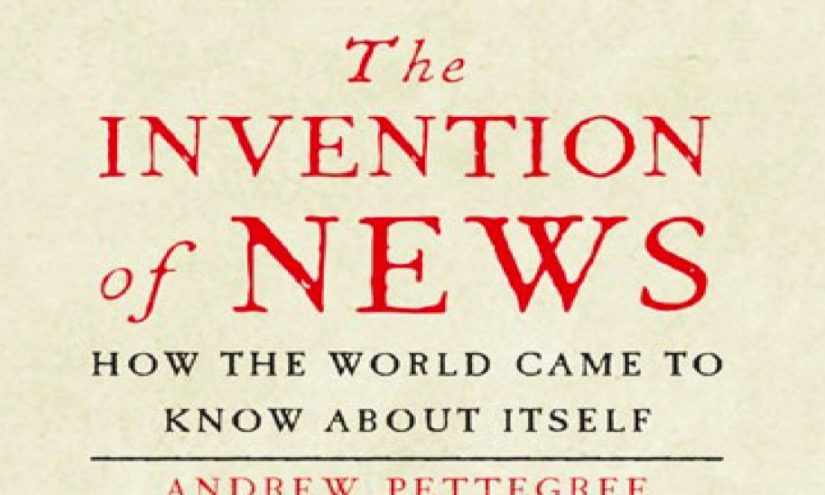
Notes on ‘The Invention of News’ by Andrew Pettegree

The journey to get to professionally-verified information includes social, economic and political coursework. To share this journey, historian Andrew Pettegree focused in his 2014 book The Invention of the News heavily on the European development.

It is dense and comprehensive, at least in the continental sense. It’s been on my list for a year or so, and I finally dug into it, with pages of notes. Find reviews of the book in the Times and Guardian, and consider buying the book yourself. The book’s focus is between the years of 1400 to 1800, and it’s clearly written by a historian, rather than a contemporary media studies approach—I prefer this more dispassionate and distant view of the origins of an industry.

Knowing that printing had earlier roots in China, the book is decidedly Eurocentric. Still I would strongly recommend it to anyone as interested as I am in the foundation of media, news and journalism. Pettegree’s stance is that the industry of professionalizing information-gathering was a European concept, which is his focus. This was one of several books on early journalism foundations I’ve read in the last year.

Find my notes below.

Continue reading Notes on ‘The Invention of News’ by Andrew Pettegree

More Americans are coal miners than local journalists

It helps to understand economic change by comparing stories.

Naturally the visualization of the soot-covered coal miner is an evocative image of blue collar industry. Almost immediately as that image became a tool during the 2016 U.S. Presidential Election, it became a political football.

To put the size of the coal industry in context, we were reminded that the middling fast food chain Arbys employed more people than the entirety of the coal industry. Turns out, though, more journalists have lost their jobs than coal miners. To understand job losses in news-gathering then, researchers asked, are journalists today’s coal miners?

Continue reading More Americans are coal miners than local journalists

Why the 20th century had such celebrated local journalism

Profit. That’s where the experimentation and funding for long-term projects came from.

As the near monopoly on the distribution of information that powered the advertising business that kept newsrooms well-stocked has faded, so too has the profitability of the companies that back them. And it has coincided with tightened budgets and, therefore, fewer commercially viable journalism products.

Continue reading Why the 20th century had such celebrated local journalism

To develop a community, you first need a common set of facts

In journalism conversations, there is a lot of concern about the need for a public square, a place in which a community can learn and share a common set of facts.

It’s something I’ve talked about in research from the Knight Foundation. The concern of filter bubble, in which the personalization of the web allows us to only reach information that confirms our beliefs, rather than challenges it.

Nationally and in some cases statewide, there is a growing patchwork of meaningful journalism practitioners. Though lacking in many ways, there is a wealth of niche and hyperlocal news providers developing in many corners of the country.

But the hole remains in broader metro regions, where broader metro daily newspapers have been hardest hit. They were, largely, the purveyor of these common sets of facts to build broader community.

We aren’t witnessing the end of this powerful form, I believe, we are simply waiting for the transition.

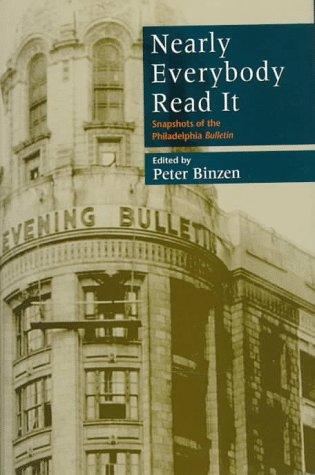
Philadelphia Evening Bulletin history: ‘Nearly Everybody Read It,’ a 1998 book from Peter Binzen

The importance, sway and influence of one of the world’s most dominant 20th century newspapers was the focus of the 1998 collection of essays about the once powerful Philadelphia Evening Bulletin, edited by its former education reporter Peter Binzen, who also wrote Whitetown USA.

Dubbed ‘Nearly Everybody Read It,’ a riff off the paper’s legendary slogan, the 163-page book has nearly 20 essays from former Bulletin reporters and editors, including its first female and black correspondents. For 135 years, the family owned paper was a powerhouse among a rich daily newspaper tradition in Philadelphia.

A central story line of the book was the Bulletin’s battle with the Inquirer, its chief rival, and how, in the end, the Inquirer, considered by many to be the chain response to the family-owned operation, won. Through all the bluster, I thought there were four primary reasons that rang most true to me:

  1. The Bulletin fundamentally failed to innovate, remaining an afternoon daily as circulation fell with growing TV news audiences, increasing transportation costs due to traffic and changing news cycles.
  2. The Bulletin failed to develop the revenue to stay competitive, including a premature sale of its nascent TV station, denying alcohol advertising and other funding methods that kept it lagging behind the Knight-Ridder funded Inquirer.
  3. The Bulletin resisted aggressive editorial reconfiguration, following the investigative spirit of the 1970s that soared the reputation of the Inquirer behind editor Gene Roberts, and pushed out its own innovative editor George Packard.
  4. The Bulletin came up short in following the suburban trend, having its 1947 purchase of the Camden Courier Post denied by the U.S. Department of Justice for anti-monopoly concerns was a large blow.

As I often do when reading something relevant to the news and innovation conversations I so adore, I wanted to share some choice thoughts from the book.

Continue reading Philadelphia Evening Bulletin history: ‘Nearly Everybody Read It,’ a 1998 book from Peter Binzen

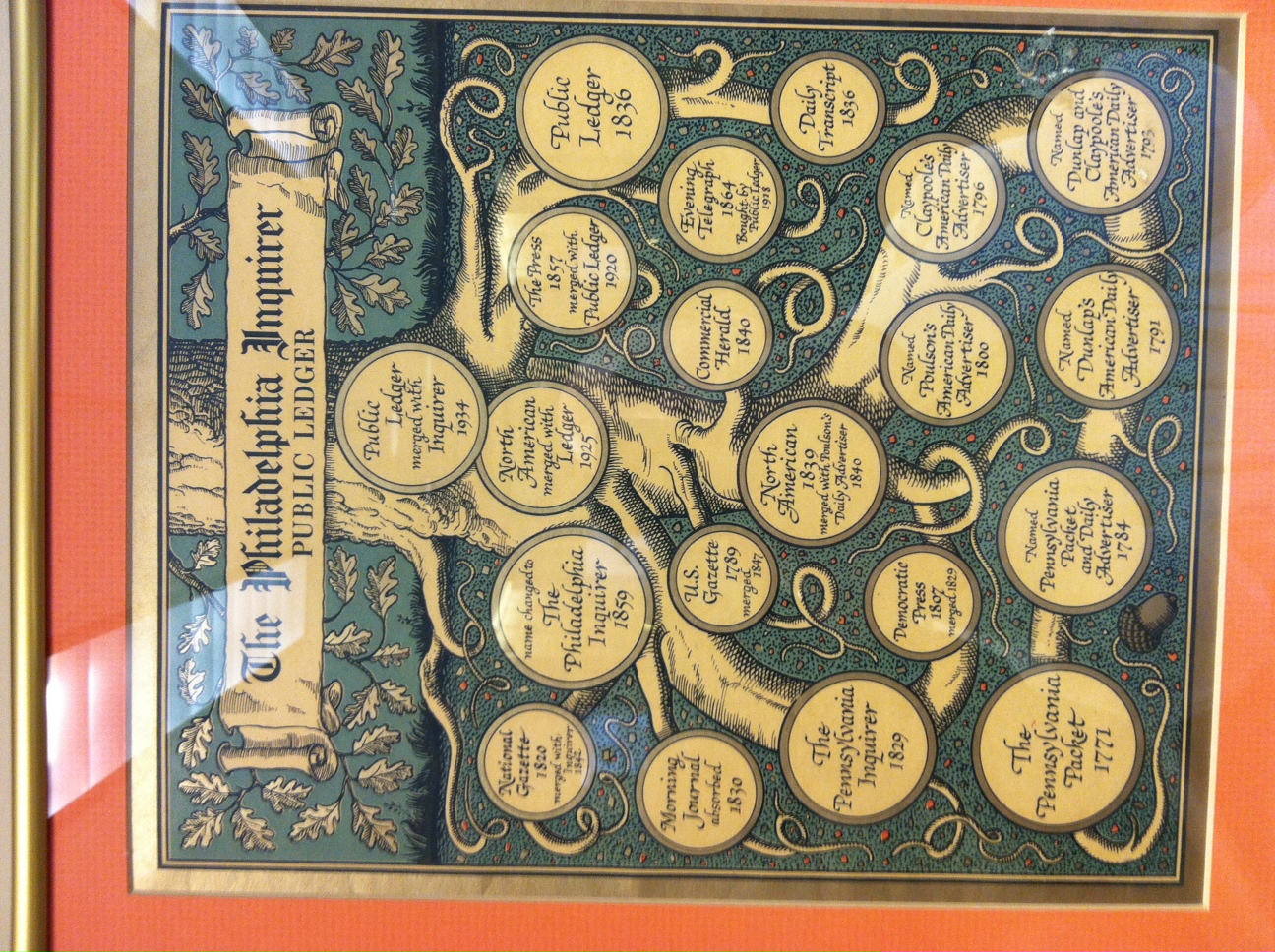
A Brief Timeline of the History of Daily Newspapers in Philadelphia

This Philadelphia daily newspaper family tree is framed in the Inquirer editorial board room at 400 N. Broad Street. Photo by Russell Cooke. Click to enlarge.

There were a dozen or more daily newspapers in Philadelphia at one time, I hear. Trouble is, I couldn’t seem to find anyone who could name what all of those papers were.

So I went and did some good old fashioned research — with some great direction from representatives of the following institutions.

Below, find a historical timeline of daily newspapers in Philadelphia, or at least what I could decode using four sources: primarily the Pennsylvania State Library newspaper collection [call number: Philadelphia] and the archives of the University of Virginia, with some help from a 1997 collection of essays called ‘Nearly Everybody Read It,’ edited by Peter Binzen (whose other book I recently read) and an essay from Broadcast Pioneers of Philadelphia member Gerry Wilkinson. (I compiled some other notes on the Inquirer here.)

Check it out below and offer any criticism or comment — I’m certainly expecting that this is incomplete, so any other leads are appreciated!

Continue reading A Brief Timeline of the History of Daily Newspapers in Philadelphia