The “housing affordability crisis” is really a mobility crisis

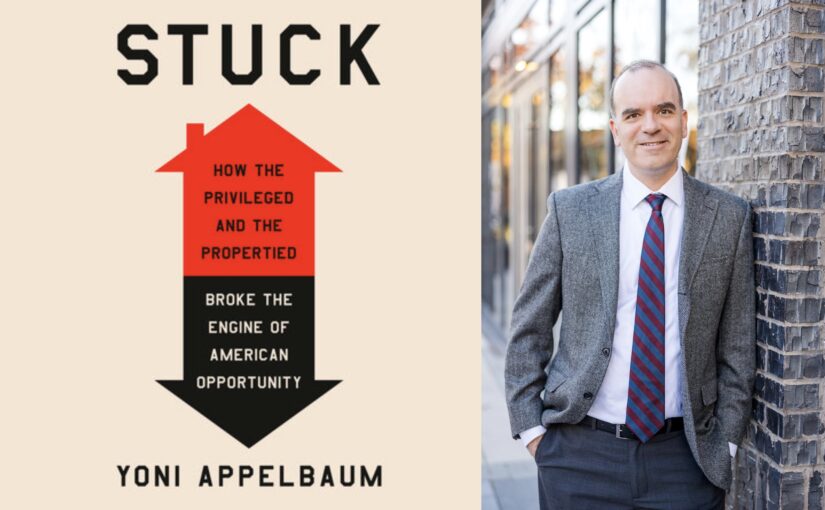
What Americans call a “housing affordability crisis” is really a mobility crisis — economic, geographic and social. Housing is where that immobility becomes most visible, and so expensive housing is more a symptom than the disease.

That’s from a new book by historian and Atlantic journalist Yoni Appelbaum called “Stuck: How the Privileged and the Propertied Broke the Engine of American Opportunity.

In healthy economies, including for much of the American golden age, people move to better jobs, cheaper places, growing regions. In the US today, people are increasingly trapped in place. When people can’t move, demand piles up in a small number of “winning” metros. Prices explode there, while other places stagnate or hollow out. I’ve written on the topic this year myself here and here.

Appelbaum’s book recounts the long trends that are piling up today. He recounts how American zoning regulations were introduced for race and class control, not for genuine health or safety concern. Early 20th century leaders, including eventual-US President Herbert Hoover, misunderstood crowded tenements and single-family homes as the obstacle and the accelerant, rather than what they really were: the launching pad and the eventual destination for those who made it out.

That history has persisted to today, where regulation and competing priorities strangle what might naturally occur. As famed mid-century urbanist Jane Jacobs said, over-planning a community is “attempting to substitute art for life”

Below I have notes for my future reference from Greenbaum’s detailed book. It’s wonky, and less colorful than I expected, but for anyone invested in the topic, it’s worth it.

Continue reading The “housing affordability crisis” is really a mobility crisis
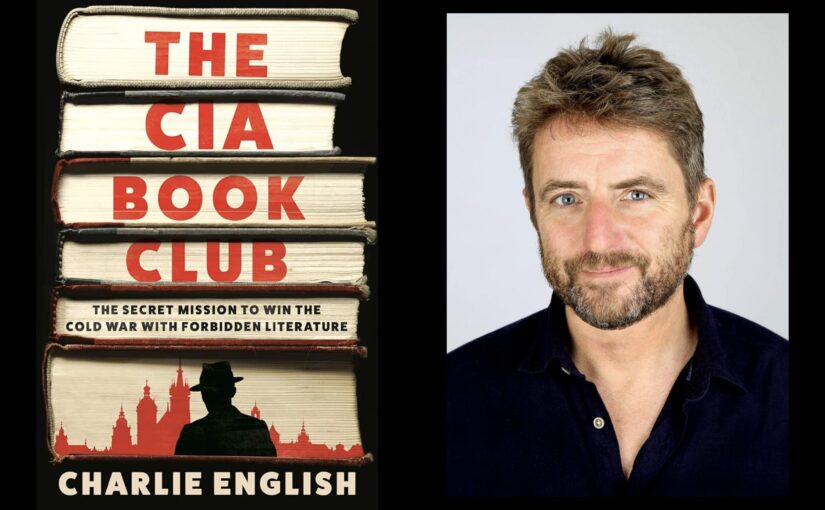
The CIA Book Club

In the 1980s, the American government spent billions of dollars on paramilitary campaigns to advance Cold War objectives. They also spent something like $20 million on a series of information campaigns.

Effective as it was, few are interested in celebrating the effectiveness of what more often got laughed about in military circles, including funding secret newspapers and distributing banned literature within the Soviet system, Poland in particular.

This is documented in The CIA Book Club: The Secret Mission to Win the Cold War with Forbidden Literature, a book published this summer and written by Charlie English.

The book is not really about the CIA, that’s just a particularly compelling subplot. Rather the bulk of the book is a thorough rehashing the Polish underground resistance and how that intersects and was often funded in part by the CIA. The subterfuge is inspiring in a sense, the power of free information. I enjoyed the book and recommend it to other history fans.

Below find my notes for future reference.

Continue reading The CIA Book Club

We’re all journalists now: Scott Gantt wrote in 2007

The 20th century “hardened an artificial distinction between professional journalists and everyone else.” The 21st century has crashed that down.

That’s from “We’re all journalists now,” a book written almost 20 years ago in 2007 by lawyer and constitutional law scholar Scott Gantt. As he wrote: “In a sense, we are returning to where we started.”

Gantt’s thin volume is a valuable representation of what was changing then. Below I share notes for future reference.

Continue reading We’re all journalists now: Scott Gantt wrote in 2007

What Baltimore’s “Black Butterfly“ teaches the rest of us

Why does there remain a plethora of social ills the disproportionally affect Black people in America over 150 years after chattel enslavement has ended? “The answer: black communities have been subjected to unrelenting an ongoing historical trauma.“

That’s from The Black Butterfly: The Harmful Politics of Race and Space in America by Dr. Lawrence T Brown in 2021. He coined the term “black butterfly” to refer to the patterns of racial segregation in Baltimore, which mirrors patterns in other US cities.

Below I share my notes for future reference.

Continue reading What Baltimore’s “Black Butterfly“ teaches the rest of us

The Rise and Decline of Nations

Coalitions strengthen a nation, and then strangle it whole.

Or so it’s been argued. In his influential 1982 political treatise called The Rise and Decline of Nations, political scientist Mancur Olson (1932-1998) builds on his earlier work on collective action to argue that stable societies tend to accumulate powerful special-interest groups over time, which in turn create institutional sclerosis.

These groups—unions, industry associations and other lobbying blocs—develop to protect their members’ economic rents, but their growing influence eventually stifles innovation, efficiency and long-term economic growth. Olson argues that this “accumulation of distributional coalitions” explains why some rich nations stagnate while others surge ahead. Post-war Germany and Japan, having lost these entrenched coalitions due to military defeat, grew rapidly in contrast to countries like the UK or the US, which retained their institutional inertia. I share notes from the book below.

Continue reading The Rise and Decline of Nations

What is Fascism?

In 1946, George Orwell wrote that “the word fascism has now no meaning except in so far as it signifies something not desirable.”

That sense is back, and since the word is used so often again, I wanted to return to a foundation. I didn’t have clear memories from my undergraduate political science reading so I picked up Fascism, an influential, well-regarded, thick, dense, 400+ page collection of writings on the topic published in 1995 and edited by Oxford political theorist Roger Griffin.

It was a slog but a firm foundation, in which the point is argued that the word was almost immediately stretched and packed with various meanings from its modern launch in the 1920s. In the simplest interpretation I can put together, fascism is a political strategy “idealizing abstraction” that uses power to protect a “mythic core” of kinship around a nation from out-groups.

Judging by the 400-page book, and oodles of dissertations and academic writing, that’s of course incomplete. I have more listed below for that matter. But it does arm me with a clearer picture, grounded in academia and without cartoonish exaggeration. Below I have other notes from the book for future reference.

Continue reading What is Fascism?

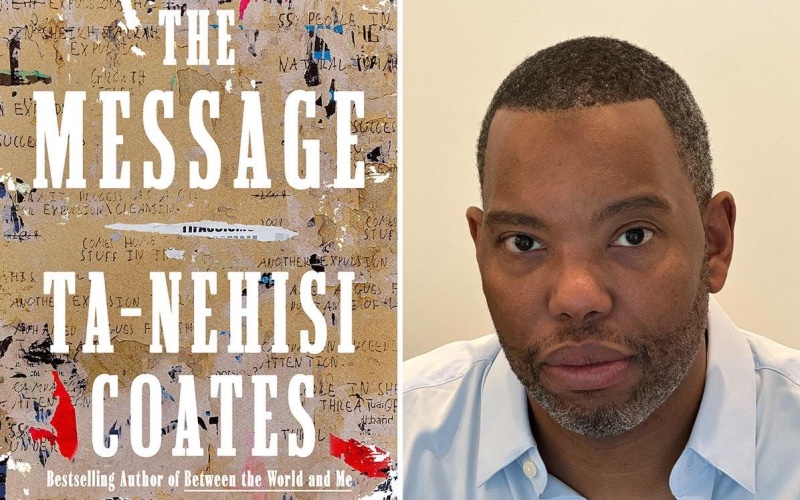
The Message by Ta Nehisi Coates

Every story is imbued with the biographies of those who hear and repeat it. And so each story gets distorted some. We can lose the author’s original intent.

It’s fitting then that I came to assume that Ta-Nehisi Coates’s new collection of essays published in the fall — one year after the Hamas attack on Israel — was exclusively about the Israeli-Palestine conflict. Notably including a CBS Morning interview, what I heard about the book was centered on the conflict.

Instead “The Message” is a curated archive of private reflections and political commentary informed by short trips Coates took to several locations to reflect on race, justice and U.S. foreign policy. Just the final chapter features a few days he spent in Israel and Palestine. The book’s overall message is less about any single conflict and more what he describes as a moral responsibility of the writer to speak plainly in moments of great public consequence.

Below my notes.

Continue reading The Message by Ta Nehisi Coates

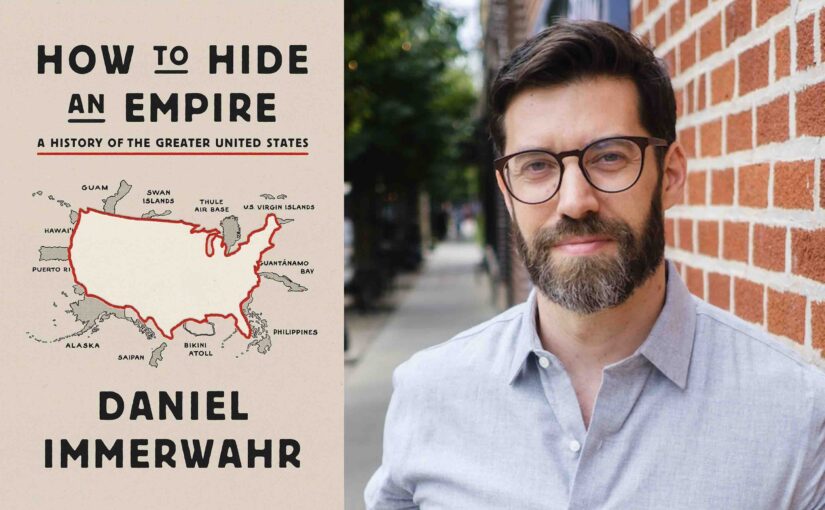
How to hide an empire

In 1916, the United Kingdom and the United States both formally commemorated new holidays. The British crown introduced Empire Day; For the Americans, it was Flag Day.

That distinction between the reigning world superpower and its quickly rising successor says a lot. Once, empire was a point of pride, a signal of strength and responsibility, but as the United States established itself as the global leader, that changed. In 1940, 1 in 3 people in the world lived in a self-described empire. By 1965, that total was 1 in 50, and falling. Though the United States hasn’t used the term, a growing body of research argues historians should.

That’s from “How to Hide an Empire: A History of the Greater United States,” a 2019 book written by historian Daniel Immerwahr. It is a kind of global version of the influential “A People’s History of the United States,” Howard Zinn’s classic from 1980 that was updated in 2003 (the version I read as an undergrad).

Immerwahr argues the American empire looks different, based less on large swaths of land and more on strategic ports. This was made easier still as American science introduced a growing number of synthetic replacements for physical goods, such as synthetic fertilizers and rubber replacements (The United States “replaced colonies with chemistry”). Nonetheless, that American flag waved over a growing number of points in the world — with similar problems that are familiar to any previous empire.

American leaders faced a “trilemma,” as Immerwahr puts it. They’ve had to choose between Republicanism, overseas expansion and white supremacy, but can only achieve two. Rather than drop white supremacy, the United States cut the Republicanism, thereby overseeing the Philippines in the past and currently maintaining Puerto Rico, Guam the US Virgin Islands and other inconsistently administered territories without full nationhood. The book is challenging and worth grappling with, regardless of your own take on it all. I recommend it.

Below my notes for future reference.

Continue reading How to hide an empire

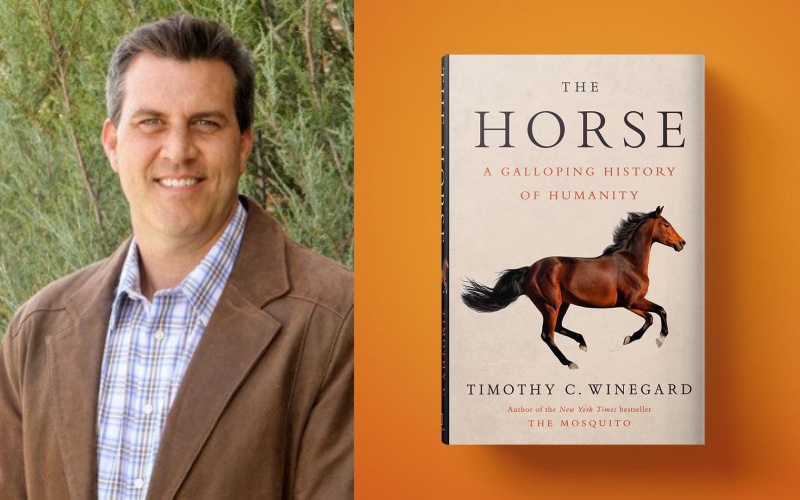
The world history of the horse

The great manure crisis of 1894 has become a half-joking reference to the very serious public health challenge that big cities around the world faced near the end of the 19th century.

A growing reliance on horse power meant the smell, disease and discomfort of manure that wasn’t being removed fast enough. Exactly because this feels so archaic a problem neatly conveys how much we relied on horses, and then how dramatically we replaced them with mechanical labor. Yet the love persists.

This is from Timothy Winegard’s summer 2024 book The Horse: A Galloping History of Humanity. It’s thicker, denser and at at times more lyrical than I expected. It’s certainly a new approach to the sweep of history. Below I share my notes for future reference.

Continue reading The world history of the horse

Why has war lasted for thousands of years?

The first recorded war involved the Sumerians in Mesopotamia almost 5,000 years ago. Prehistoric war is thought to be far older. Can we ever get rid of it?

Margaret Mead said war is older than the jury system but no less an invention to address conflict, and so it can be removed. As the anthropologist Douglas Fry more recently wrote: “War like slavery before it can be abolished.”

Whether peace or war is the more natural human state is disputed and complicated.

That’s from the 2024 book Why War?, which recasts an old question that previous literature has addressed, this time from British historian Richard Overy. The book is largely a review of the literature on war. All the disciplines in these chapters build on each other, starting in evolution, biologically evolved to demonstrated aggression.

“Warfare,” Overy wrote “ is not in our genes, but for our genes.” There is still a role for historians (and therefore journalists) to interpret the specific human actions of “why THIS  war” but there is also a broad universal answer to the question Why War: It’s been an effective means to resolve dispute, despite considerable cost, so war emerged from our systems by hijacking our instincts.

Or as the author himself concludes: “The co-evolution of culture and biology for most of the long human past created conditions within which nature and nurture together, not either one or the other, reinforced the resort to violence when regarded as necessary or advantageous.”

Below I share my notes for future reference.

Continue reading Why has war lasted for thousands of years?