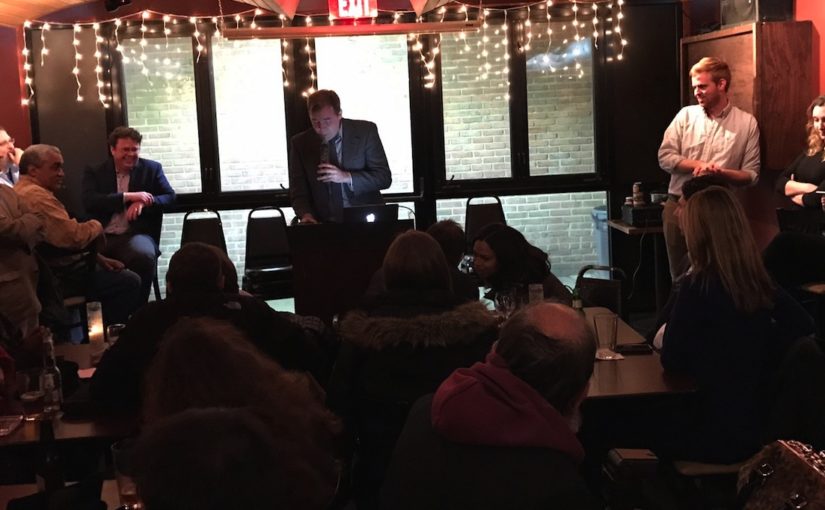
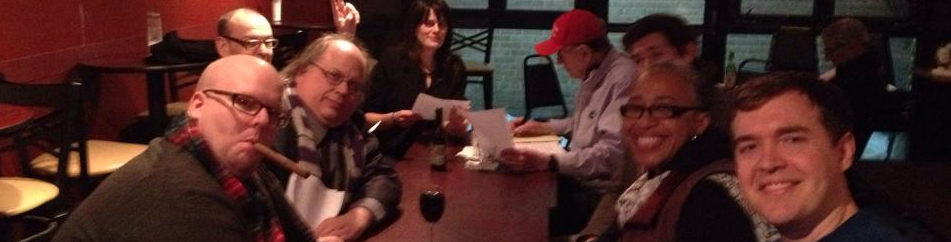
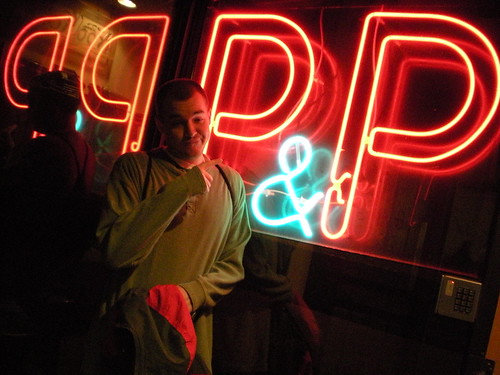
The many locations of the Pen and Pencil Club

(Note, as a past P&P board member, I drafted an earlier history, and this reflects some updates from my friend Sandy Smith. In honor of the place surviving the pandemic, with a fair bit of financial help from many of us members, I wanted to finally share what I know about the place)

The Pen & Pencil Club has had more homes than Philadelphia had daily newspapers when it was founded in 1892. Its current and permanent home at 1522 Latimer Street is the Club’s 16th residence—a fitting end to more than a century of nomadic existence.

The Club’s journey began at 133 South 11th Street, where it occupied the second floor for two years before moving to Bohemian Hall in 1894. Bohemian Hall remained the Club’s longest home, housing it until 1926. Neither of these buildings exists today; Thomas Jefferson University’s hospital now occupies the 11th Street site, and its Scott Building has stood on the Bohemian Hall site since 1970.

The Club’s third home was its first owned property: a townhouse at 1023 Spruce Street, purchased in 1926 for $42,500. Unfortunately, the Club struggled financially during Prohibition and could not sustain mortgage payments, leading to foreclosure in 1936. The building was sold in the late 1930s for $11,500.

From there, the Club rented its next ten homes. Its fourth location was in the now-demolished Walton Hotel at 233-47 South Broad Street, which it occupied from 1937 to 1941. It then moved to 1522 Walnut Street, now home to Holt’s Cigar Company, where it remained through 1944.

In 1945, the Club moved to 1523 Locust Street. Tragically, a Christmas Day fire in 1946 destroyed much of the building and the Club’s records. By January 1947, the Club had relocated to 1615 Walnut Street, where it stayed for 16 months; a New Balance store now occupies this building.

The Club’s eighth home, from 1948 to 1954, was at 239-41 South 15th Street, which drew over 1,000 attendees, including Mayor Bernard Samuel and Governor James H. Duff, to its opening. The site was later demolished, and the Academy House condo tower now stands there.

Records indicate a brief and undocumented stay at 1305 Locust Street in 1954, followed by a move in 1955 to South Camac Street, a stretch once known as the “street of clubs.” This location, at 239-41 South Camac, was also the first home of the Poor Richard Club.

The Club’s next two homes are somewhat unclear. By February 1963, 216 South 16th Street was listed as its address, and it later appeared at 1709 Chestnut Street during the 1960s.

In 1967, the Club moved into its third-longest-lived home at 218 South 16th Street/1600 Chancellor Street, where it stayed for nearly two decades. In 1986, the Club purchased its second owned property at 563 North 15th Street, but financial struggles forced it to close this location in 1990.

The Club reopened later that year at 1623 Sansom Street, where it remained until 1995. This building has since been replaced by the structure housing Abe Fisher and Dizengoff restaurants.

Finally, on August 17, 1995, the Pen & Pencil Club purchased its current home at 1522 Latimer Street. This time, the Club found stability: its mortgage was paid off early, and the milestone was celebrated in 2015 when then-President Chris Brennan ceremonially burned the note.

After more than a century of relocations, the Pen & Pencil Club has firmly settled into its home—a testament to its resilience and enduring role as the nation’s oldest surviving press club.
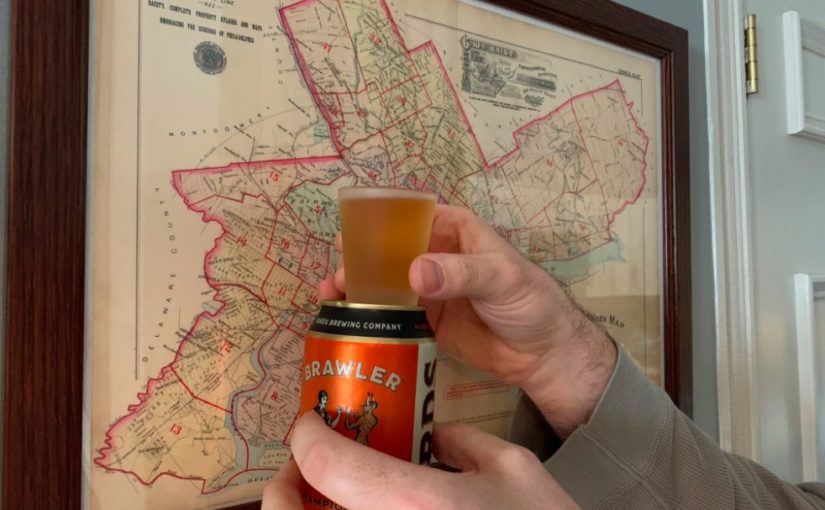

How to contribute to your community during covid-19

We are living through a pandemic. Someday I am going to look back and question if I did enough.

To be clear, no, almost certainly, no I have not and will not do enough. But I did want to push myself to gather what I have done. Perhaps it might be good for each of us to challenge ourselves on what more we could be doing in this strange war-time.

Continue reading How to contribute to your community during covid-19

Lessons on building an industry-specific community

Communities begin organically. They’re grown and strengthened intentionally. Starting them is easy. Making them last is hard.

I’ve had the privilege of being near to many new and established communities of various stripes — geographic, topical, social, professional and more. Community is any intentional grouping of people who share some commonality.

One community I’ve approached with great intentionality has been one of Philadelphia journalism. I intersect it in several ways, as a young journalist, as a small publisher and, as of last week, for the fourth year as a board member of the Pen and Pencil Club, one of the country’s oldest private press clubs and de facto reporter hangout.

Continue reading Lessons on building an industry-specific community

What I accomplished as a Pen and Pencil Club governor 

I first visited the Pen and Pencil Club in January 2009, as a spunky, 23-year-old. After visiting frequently, I finally became an official member of the country’s oldest surviving open daily press club in early 2012.

Then, in 2013 I ran and was elected to the club’s board of governors, with some encouragement from then club President Chris Brennan, a celebrated politics reporter and columnist who worked hard to grow the kind of members in the club. I was growing a reputation with Technical.ly and an active local organizer of the Online News Association.

I was proud. I learned a lot, and I put a lot of effort into being a board member. Next week, rather than run for a fifth term, I am stepping down. Here I share some of what I accomplished during the last four years.

Continue reading What I accomplished as a Pen and Pencil Club governor 

This will be my first year of saying no

For as long as I remember, I was proud of being someone whose default response was YES. It was the right mind frame for my teens and 20s. But I turned 30 last year. And I now I want to get better at the other side of that spectrum: saying no.

So I made it one of my 2017 resolutions: to say NO more often. Though I hope to do lots with that perspective, it will come down to focusing my attention.

This is my pledge to myself that I will say no, that I will limit what I do and agree to so that I only focus on what I can do well. That means I will have to say no to things I care about.

One of the clearest ways I’m doing that is by dropping and limiting my existing extra curricular activities, while being far choosier about any I add. Understand: this does not mean I don’t have interest in these or other issues. This means I’m focusing on what I can provide unique value to and fits me now.

I’m aiming to take this more into my day job (so I don’t let my office get as cluttered and messy as it was in the header photo from early 2015) but for the first clearest way to show my progress, I wanted to share what I’ve already set in motion.

Continue reading This will be my first year of saying no

In defense of “Off the Record” and back room conversations

Transparency is a modern virtue.

Its pursuit is among the more commonly inalienable constants of news media. But like a child who needs to be exposed to germs to develop resistance, we can benefit from some level of privacy among leaders. Transparency of power can lead to polarization. Some conversations need to be worked out in private.

Of course that doesn’t sit quite right with many newsrooms — or among many civic minded people. A symbolic scourge of journalism is the back room conversation — dealmaking without public discourse.

But it’s so much more complicated.

Continue reading In defense of “Off the Record” and back room conversations

Pen and Pencil Club board of governors

The Pen and Pencil Club, the country’s oldest surviving private press association, welcomed me onto its board of governors as one of its youngest members last February. This month, I am proud to say I was voted on to remain there.

Here is some background on the famous private club and my own goals for being part of its board again.

Continue reading Pen and Pencil Club board of governors

Pen and Pencil Club: I’m a member of the country’s oldest journalism club

My first trip to the Pen & Pencil Club on Jan. 28, 2009. Photo by George Miller

After more than three years of visiting and even longer being fascinated by its role, I’ve become a member of the Pen & Pencil Club, the country’s oldest press club, dating to 1892.

The private club, in a narrow shotgun building between parking garages on a narrow alleyway, requires sponsored membership, and following months of recent scheduling conflicts, Swarthmore Professor, former Daily News photographer, Pulitzer Prize winner and friend Jim MacMillan helped sign me into the club on Monday, March 26.

I’ve happily gone a few times since, each time with a friend in the press, and I’m eager to become more of a regular, being respectful of the club’s long history and existing members.

From awards and a journalism open house to coworking, media criticism and more, I’ll be interested in learning what leadership hopes to do with the famed P&P, following a recent renovation of its ground floor.