My 2012 professional resolutions with a focus on RISK; review 2011 goals

A year ago, I felt scattered. I wanted to focus in 2011, and I think, as a full-time employee of my own business with clearer goals and objectives, I have accomplished that.

As detailed below, I feel very proud of the success I had in meeting my professional resolutions for the year. So, it’s important to me that I do so again, which I also did below.

In them, I’d say the theme for my 2012 is RISK.

It’s time to risk fast or succeed for me professionally. I want to be more aggressive in business and outreach, now with a more stable company and clearer focus.

I’ll set goals to do so, but it’s also worth reviewing what has been a wonderful year. Here are some professional milestones not included in my planned resolutions below:

Below, see my 2012 resolutions and a review of how I did with my 2011 goals too.

Continue reading My 2012 professional resolutions with a focus on RISK; review 2011 goals

My 10 best trafficked posts of 2011 (and some others that I think are pretty good)

As I’ve done in passed years, as this year comes to a close, I like to dive a bit into the work I’ve done here in the last 12 months to gauge what was popular and what I was most proud of.

Below, find my 10 best read posts of the year and a few others I thought were worth reading.

Continue reading My 10 best trafficked posts of 2011 (and some others that I think are pretty good)

Social entrepreneurship: how Philadelphia could have a regional distinction for startups

Philadelphia, like any other city that wants to compete in a global marketplace, needs a regional distinction that sets it apart, and in this place, nothing makes more sense than for Philadelphia to define itself as the hub for social entrepreneurship and urban renewal.

Around the world, our hubs of innovation and culture, of education and community are densest and most alive in cities. All of the truly great problems of our time — war and crime and poverty and disease and education and violence and racism and hunger and employment — are either exacerbated by or housed most primarily in our cities.

As a country, if the United States intends to continue to play some form of a major role in the future, the sense seems to be that we will need to do that by continuing to be smarter. Adaptability, industrial might and military strength have served us well, but we need to look for the next train.

Entrepreneurship and the spirit that came out of World War II federal funding (largely in Philadelphia first) helped define the last quarter century of American cultural impact. At a time of high unemployment and a sluggish economy, high technology and scale is meant to be that next train.

So cities do a lot of hand wringing about how to replace widgets with gadgets.

The trouble is that, as a friend put it, if Silicon Valley represents the overwhelming majority of investment in the country, and New York City is in second place, then just about every other city that is even trying is in third place.

How should Philadelphia (like any other big city) try to stand out?

Continue reading Social entrepreneurship: how Philadelphia could have a regional distinction for startups

Whitetown USA: 1968 book on the ‘silent majority’ of poor urban whites by Peter Binzen

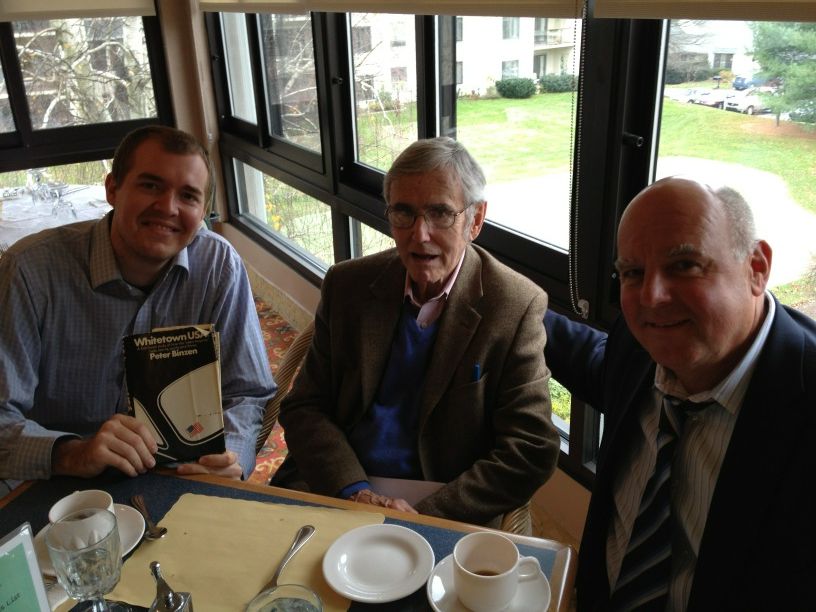
Sitting with Whitetown USA author Peter Binzen and PlanPhilly Editor Matt Golas.

Prideful, working class white ethnic neighborhoods in cities have been ignored and poorly represented for at least a half century, goes a major theme of Peter Binzen’s 1968 Whitetown USA dissection. [Google Books here.]

Written by a former Philadelphia Bulletin newspaper reporter with whom I was thrilled to have lunch last month, the book attacks the principle that whites are a monolithic group of privilege. Binzen, a former education reported, focuses heavily on the school system in the book to tell a tale of why working class and even upwardly mobile middle class whites were opposed to affirmative action and other social welfare programs perceived to help blacks.

The first third of the book features the similarities of Whitetowns from cities across the country: white neighborhoods often with many recent immigrants that are working class, prideful of place, protective, provincial, conservative and often seen as bigoted. The rest dives deepest into Kensington, a decaying industrial corridor then and a decayed shell today, and its adjacent Fishtown, a smaller, more residential neighborhood where I now live.

As I often am eager to do, I wanted to share some of my favorite passages and thoughts from the soft cover copy I tore through:
Continue reading Whitetown USA: 1968 book on the ‘silent majority’ of poor urban whites by Peter Binzen

Prediction: my children will care less about technology than I do

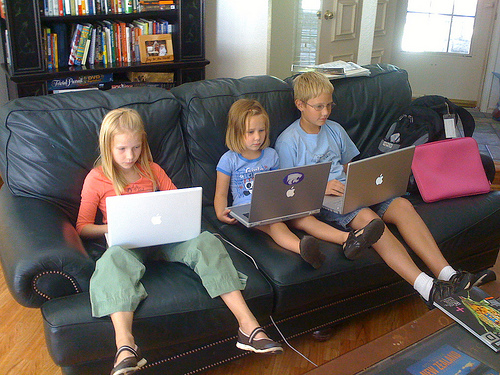
These are not my kids. I don't even have kids. This is a photo I found online of a bunch of kids using laptops. It's meant to be mildly representative of where we are today, in shoving digital technology in everyone's hands.

Two premises:

(a) Generations are cyclical.

(b) Technology is everything we were alive to see invented.

If my peers today are a part of an incredible age of change and innovation, when what is new is what matters most, I believe that my children’s generation in 20 years or so, will be characterized by rebelling against what is new — if that doesn’t happen sooner. (I don’t have kids yet, but I might have ’em someday and so I’m talking broadly)

What is considered technology today — things like web-based communication, geo location-centric discovery and adaptable information gathering — will not be abandoned necessarily (because those will be everyday tools 20 years from now) but I do believe consumer interest will go elsewhere from the newest and latest around technology in as obsessive a fashion. New ideas fuel consumer interest, but I suspect my kids won’t care about technology in the same way we do today.

What will replace technology, well, I’m not quite sure yet.

Urban imperialism: lessons from city boosterism of the 19th century for urban renewal today

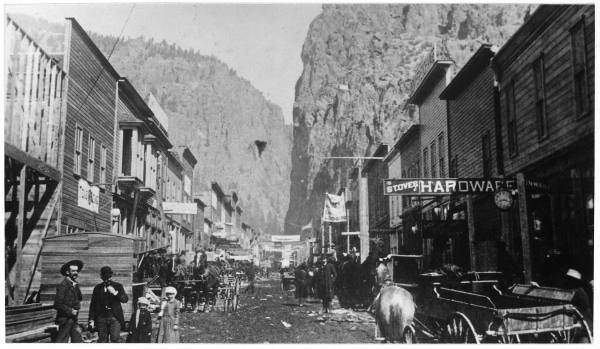
Creede, Colo. in 1880

Metropolitan boosters — men employed in the late 19th century to encourage Americans to move west to burgeoning cities — have been of interest to me lately.

I’m interested in how that concept can be brought to modern concepts or urban renewal. I came across a portion of an essay in ‘A companion to the American West,’ collected by William Francis Deverell [p. 513]:

Integral to the hinterland and ‘instant city’ models of nineteenth-century western urban history has been the figure of the urban booster. Cities in the west have been promoted, hawked and downright lied about on a scale rarely matched elsewhere in the nation. Boosters in cities on the make — Chicago in the mid-nineteenth century, San Francisco in the 1860s, Denver in the 1880s, Seattle in the 1900s, Los Angeles and Oakland in the 1920s — spared little effort in luring the investment capital, industry and residents necessary to ensure sustained economic development. Western boosters and their allies engaged in what one historian calls ‘urban imperialism,’ an endless quest for control of the markets and economic bonanzas that guaranteed real estate profits. Booster scholarship has tended to focus on the art of promotion and to see cities as products less of social construction than of capitalist fantasies. But behind boosters is the most interesting feature of western cities: urban growth as an end in itself, an economic logic fundamental to capitalism, was elevated by western boosters to the level of civic religion. In some cities, for instance, space was rarely scare but capital was. In places like Los Angeles and later Dallas and Phoenix, this led boosters to cultivate real estate markets and encourage an urban morphology that spread development horizontally across vast distances. In other cities, an opposite geography was at work, and a great deal of scare capital went into creating very expensive space. In Seattle, Portland and San Francisco, immense amounts of capital were devoted to filling tidelands and wetlands that allowed the cities to grow…