Journalism Thinking: a lightning talk at Ignite Philly

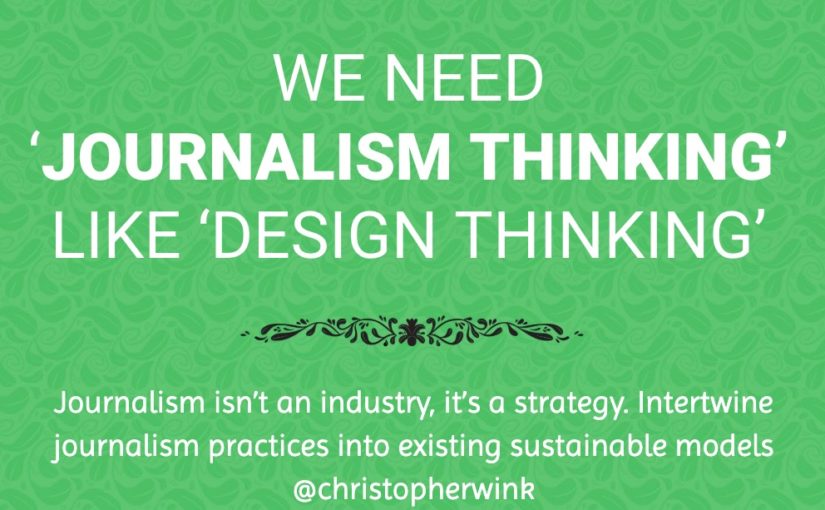
Geographically-focused acts of journalism are powerful. Professionals are increasingly rare because the business model that supported most of them has been supplanted. No one is doing the hard work of combating that. Let’s change it.

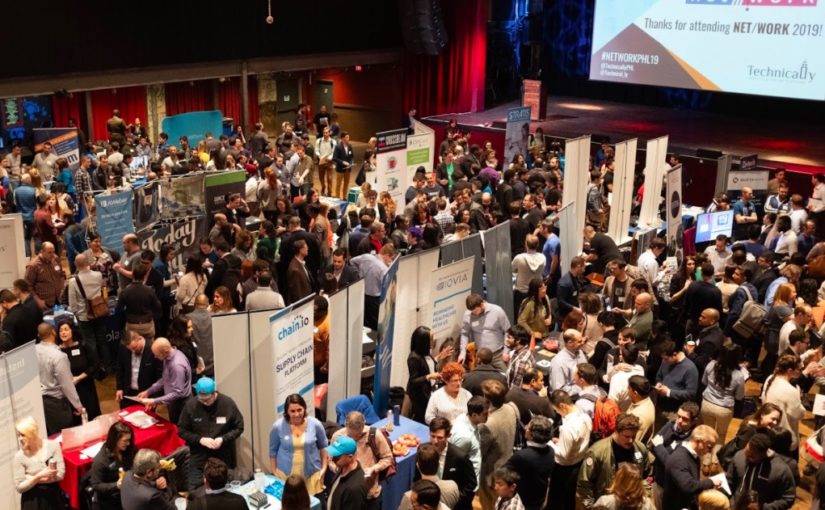
Following my journalism thinking essay, I’ve been looking to develop a more general-interest way to deliver the message. On Oct. 16, I gave my first try, at Ignite Philly, a local, volunteer-run outpost of a global confederation of big-idea events. (I spoke there in 2011 and 2013)

Find my notes and slides below, and I’ll add the video here when it’s eventually posted.

Continue reading Journalism Thinking: a lightning talk at Ignite Philly

We lose focus slowly

You’d be tricked into thinking there are most often big, grand moments of obvious distractions that you as a leader can turn down.

We lose focus, in our projects, organizations and efforts, not at once, but by slow trickle. You can’t stay focused with a single no, it takes constant vigilance. Lost focus comes with a 1,000 small questions no reasonable person would say no to.

A leader has to have a clear destination in mind and constantly remind herself of it. Sometimes, it will take grand moments of cleansing to undo many small moments gone unnoticed.

Because it is not something that comes naturally to me, I think often of focus. In 2009, I was thinking about how to fine-tune a focus on this very blog. In 2011, I made a resolution to focus, after a flurry of experiments. I did something similar when I turned 30. Entrepreneurial leaders have always advocated for obsessive focus, to be the absolute best and most powerful in one clear way, to strive for monopoly.

(Photo of Focus by Stefan Cosma via Unsplash)

Here’s what I’d do to ensure local journalism exists 20 years from now

Say the United States needs 50,000 full-time local journalists to maintain our distinct and robust discourse. That’s to have an independent voice to sniff out injustice and to put a mirror up to communities with professional rigor. (Despite our discourse, two-thirds of Americans trust their local media.)

Today there are just 37,000 working journalists in the United States, and falling. More alarmingly, even that number is increasingly made of non-local reporters, based primarily in New York City, Washington D.C. and California.

We may have half, or even fewer, the number of full-time local journalists this country may need for an informed public. (Yes, there may be more American coal miners than local U.S. reporters.)

That 50,000 number comes from a landmark report for the FCC by Steve Waldman, the editor who launched and is now running Report for America aimed at addressing just that issue. Confronting an enormous gap, his nonprofit crucially places reporters in local newsrooms (both nonprofit and for-profit) with identified coverage gaps.

The journalism practitioners among us are maybe too aware of how disrupted is the advertising model that defined our category for a couple hundred years. Frighteningly though, seven in 10 Americans still think their local news media are doing well financially.

Put another way: a central part of U.S. democracy and local civic dialogue has been broken for 20 years, we still haven’t addressed the core problem, and, apparently, the stakeholders we most need to participate (our readers) aren’t even aware of the problem. This essay is meant to outline why my professional work has focused where it has and what I hope that might offer others who care about acts of journalism.

Continue reading Here’s what I’d do to ensure local journalism exists 20 years from now
Predicting the future isn’t as hard as predicting when that future will come

On a long enough timeline, you might be right about plenty.

The cars might drive themselves. The software might generate itself. The transited American “inner cities” might become wealthy hubs segregated from poor inner-ring suburbs.

You could make predictions for days. Looked indefinitely, there are few trends I’d challenge. If a bet is a tax on bullshit, it’s not the idea I’d be as quick to challenge as the timing. That’s because, of course, it’s easier to predict the future than it is to predict when that future will happen.

Predicting the future is difficult because it’s easy to expect that future to look too similar or too different than the past. That stays tricky because

Look at predictions about 2019 that Isaac Asimov made in 1983. It’s difficult. But he just might have gotten the timing more wrong than the content.

It’s worth remembering that the very reason our memory can be faulty may be a consequence of our evolved ability to imagine a future.

(Photo by Naomi Tamar via Unsplash)

What question is your work answering?

version of this essay was published as part of my monthly newsletter a couple weeks back. Find other archives and join here to get updates like this first.

Every company is an approach to answering some question. (Every nonprofit might be a policy failure.)

Many mistakes are made in choosing that question: it might be too ambitious, or too unambitious. It could be too niche, or not focused enough. The true addressable market might be too small. The question may not be a lasting one. You can ask a question too early or too late, with the wrong leadership, team or product. Some of that can be changed by a good team, so along the company-building journey, you must change your approach.

But don’t change the question.

Continue reading What question is your work answering?