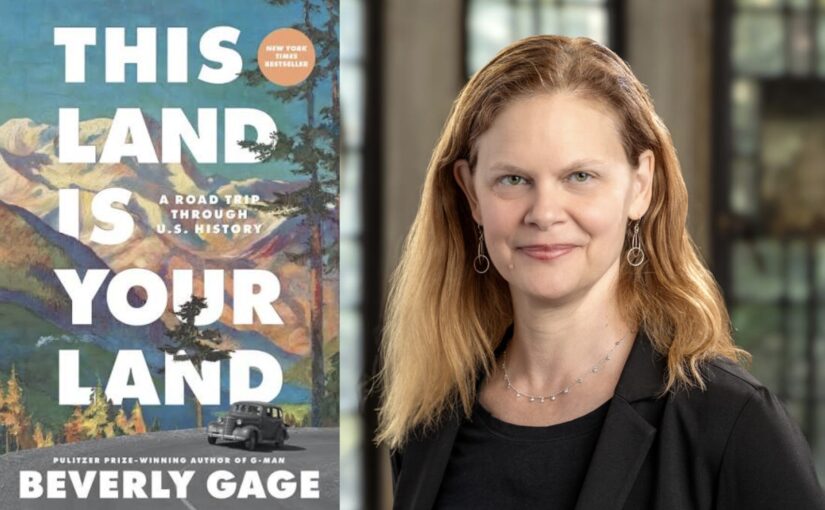
This land is your land
Our continent spanning country allows freedom of travel across it, though we don’t all exercise that right.
A third of Americans will travel abroad this year. Yet more Americans have seen ghosts than ever visited states like Alaska and North Dakota.
This year of 2026, the country’s Semiquincentennial, is worthy of a reflection on the American project, done in the 20th century style of road trip. That’s the set up of This Land is Your Land: A Road Trip Through U.S. History, a book divided into 11 road trips spread across the country by historian and road-trip enthusiast Beverly Gage.
She seeks out history’s “usable past”
She covers a lot of territory, both geographically and historically. It’s a new approach I appreciated, if it dragged at times for me. It’s a nice read and I appreciated the complicated sentiment she puts forward, but it may have tried to be several things at the same time: A travelogue, a light fun-facts read and an interpretation of the American identity. It might work for others, maybe a bit less for me, but I made it through with plenty to takeaway.
Below I have my notes for my own future reference.
My notes
- “To know your history and still love your country”
- 1777-1778: the British occupy Philadelphia for the winter and Washington encamps on Valley Forge, before the British go to secure NYC
- The 1781 Battle of Yorktown in Virginia was a turning point but really it was French ships that beat the English
- The Oneida fought alongside the Revolution and in 1794 were promised land in upstate New York, that was mostly taken over time
- Ona “Oney” Judge escaped from the President’s House in Philadelphia on May 21, 1796, while George and Martha Washington were eating dinner. (Judge learned that Martha Washington planned to give her as a wedding gift to her volatile granddaughter, Elizabeth Parke Custis Law.)
- George Washington operated a forced labor camp, not a farm. Andrew Jackson didn’t pursue “Indian removal” but an ethnic cleansing
- 1830, Cherokee supported early petitions against Jackson Indian removal, wirh special support in the northeast — which Jackson pointed out had accomplished full Indian removal before anywhere else
- Davy Crockett voted against Jackson’s’ Indian removal act — and Sam Houston questioned its violence
- Crockett’s career more or less ended by that vote against Jackson, to which he told Tennessee: “you may all go to hell, and I will go to Texas”
- Any Greenberg: the Mexican war created the first American anti war movement (including young congressman Lincoln)
- In his seminal 1849 essay Civil Disobedience, Henry David Thoreau presents a scathing critique of the American government, arguing that the institution of slavery and the Mexican-American War fundamentally perverted the founding ideals of liberty and justice outlined in the Declaration of Independence and the Constitution.
- Frederick Douglass delivered his famous address, “What to the Slave Is the Fourth of July?”, on July 5, 1852, at Corinthian Hall in Rochester, New York, at the invitation of the Rochester Ladies’ Anti-Slavery Society.
- The Erie Canal corridor, spanning upstate New York from Albany to Buffalo, became the economic and ideological highway of mid-19th-century America. Famously nicknamed the “Burned-Over District” because it was so repeatedly swept by the “fires” of religious revivalism, this region fostered groundbreaking efforts to reshape American society. (women’s rights, abolitionism, utopianism and spiritualism)
- Abolitionist John Brown famously predicted more blood would follow during his 1859 trial and final hours after leading the raid on the federal armory at Harpers Ferry.
- An estimated 40% of all enslaved Africans brought to mainland North America entered through the port of Charleston, South Carolina, and Sullivan’s Island: Ellis island for black Americans
- Not far from Fort Sumter, Beaufort was an early test of reconstruction
- Custer’s last stand happened right before the centennial in Philadelphia where he was due to attend— and the rehabilitation of his reputation began immediately. Buffalo Billy Cody reenacted sn imagined Custer last stand on Little Bighorn
- Wounded Knee and other failed treaties in black hills and upstate NY
- Sitting Bull’s cabin at the 1893 World’s Columbian Exposition: Following the tragic killing of the Lakota leader by Indian agency police on December 15, 1890, at the Standing Rock Reservation, his home on the Grand River became a macabre object of public curiosity. Entrepreneurs bought it from his family, moved it to display at the Chicago world’s faire in 1893. It ended up near the first Ferris wheel. (North Dakota went with an agricultural motif of wheat and grass)
- Frederick Jackson Turner’s “Frontier Thesis” argued that the American frontier closed by 1890, and his famous address at the 1893 World’s Columbian Exposition in Chicago symbolized the shift from an agrarian, frontier-driven nation to an urban, industrial powerhouse.
- Thirstein Veblen conspicuous consumption in Gilded Age (coined by mark Twain)
- Pullman company town in Chicago: Pullman workers, including what later became a blac run Union) part of 1886 great upheaval strike
- Lucy Parsons used the phrase “Learn the use of explosives!” as a fiery call to action in her 1884–1885 writing and speeches directed at unemployed and impoverished workers
- Eugene Deb’s (1855-1926) from Terra Haute, Indiana became one of the country’s most prominent socialists
- Henry Grady: Atlanta was new South to Charleston’s old South
- At the 1895 Cotton States and International Exposition in Atlanta, organizers included a dedicated Negro Building to showcase African American achievements, contrasting sharply with the 1893 Chicago World’s Columbian Exposition where Black Americans were largely excluded
- W.E.B. Du Bois famously critiqued Booker T. Washington’s 1895 Atlanta Compromise speech (focus on vocational training, not political rights) in his 1903 collection of essays, The Souls of Black Folk, specifically in the chapter titled “Of Mr. Booker T. Washington and Others”

- Greenfield Village is a sprawling, 80-acre open-air living history museum in Dearborn, Michigan, founded by industrialist Henry Ford
- Of the Montgomery museum implying with “from slavery to mass incarceration” that there’s no difference despite “ordinary people tried to create change against daunting odds”, the author writes “I’m not sure what’s gained by suggesting that they didn’t make much difference.”
- Bloody Sunday to “turnaround Tuesday” in which MLK had his march reverse course to avoid violence — but LBJ then threw his support behind the cause and then they marched to Montgomery
- Viola Liuzzo—a 39-year-old white civil rights activist from Detroit, Michigan—was shot and killed by Ku Klux Klan members on March 25, 1965, while driving a Black passenger.
- The irony that the Edmund Pettus Bridge was made a historic landmark for civil rights (March 1965 ‘Bloody Sunday’) but that also locked in the name of a Klan leader and US Senator for which it was named in 1940
- Mound bayou black community in Mississippi
- Ole Miss frat brothers were the latest who shot up Emmet Till historical sign
- History’s “usable past”
- LBJ “the excitement of becoming”