The state of social networking: what site is the best, the worst, a waste

I’ve written about social media here more than I’d probably like to admit.

These social networking sites are transforming the way we receive our news and information. There’s no secret there.

But they keep popping up, so much so that I’ve stopped joining them, because I never know when enough’s enough.

Newspapers are still figuring out the power of the conversation, and some say that media in general is covering social media more than they are using them. It just seems no one seems interested in deciding what is worth anyone’s time.

The real lesson is that social networking and other media are tools, plainly and simply. Not all are good for everyone.

Continue reading The state of social networking: what site is the best, the worst, a waste

Love for and lessons from a newspaper's 180th anniversary

A screeenshot of the multimedia presentation from the Philadelphia Inquirer celebrating its 180th anniversary.

Go look at the online multimedia presentation on Philly.com celebrating the 180th anniversary of the Philadelphia Inquirer.

If your interest in newspapers or Philadelphia or freelancing or new media or designing or anything else. Go there.

Packaged with a keepsake insert in yesterday’s Sunday print edition, it shows depth and breadth, intellectual and historical stimulation with engaging and beautiful design. I was excited to get my print edition and played online, as part of the preview Technically Philly was granted.

I’m an engaged young reader who clicked and played and more. Although my interest level is hardly representative of most my age; I have been calling for and eagerly awaiting such an historical promotion for months, if not a year or longer still.

But they did it bigger and better than I could have imagined. I’m thrilled to see an institution I respect and admire tell the world just why it matters so much.

Big credit goes to the staff and administration of Philly.com and the Inquirer for doing a bold and forward-thinking package and doing it well. Other newspaper executives should take notice of the work done by Inquirer online editor Chris Krewson and those he credited — Frank Wiese, the Online Projects Editor, and Cynthia Greer, an artist in the Inqy’s graphics department.

And did you hear the big news that came out of it?

Continue reading Love for and lessons from a newspaper's 180th anniversary

Why not every blog is written by a blogger

bald_bloggerI’ve come to believe there’s a very real difference between a blogger and a blog.

The person updating a blog isn’t necessarily a blogger. Though I blog on and maintain this professional site and have certainly blogged elsewhere, I don’t consider myself a blogger.

For one, I’m a professional writer, so I’d need to be making money at the blogging game for me to get that title. Instead, I use the format to connect with readers and colleagues, discuss issues and share the content I create for newspapers, magazines and trade publications.

It’s a tool of social media, not a livelihood.

Of course, there are certainly bloggers who don’t do so as a living, so I thought it prudent to throw down some guidelines as to who I figure a blogger is and what I suppose makes a blog.

See my list, and let me know whatcha think, after the jump.

Continue reading Why not every blog is written by a blogger

Pointing to free online ways to train journalists

I received some degree of criticism recently on a post about journalism classes I wish were more readily available in college J-schools.

I openly admit some forms of them already are and that many colleges have wonderful professors looking forward and doing great work with them. Still, I stand by the conversation being an important one — needling great institutions further.

That’s perhaps why I thought it funny that someone e-mailed me soon after that post and directed me to a collection of 50 open courses that could offer many of the basics of j-school.

They point to a variety online resources, including a great many of them from MIT’s open coursewares — part of a phenomenon on which I’ve written before. It seemed like another swing at j-schools. It’s far away from the name recognition, networking and other assets of a traditional school, but it’s certainly good for the dialogue.

See some of the best and some thoughts below.

Continue reading Pointing to free online ways to train journalists

Bloggers need to respect old media

Updated 3:17 p.m. April 23, 2009

I was in Baltimore this weekend, which is fitting, considering some of the news that came out of the Charm City last week.

From Wired magazine blog Epicenter:

The Tribune-owned Baltimore Sun issued Jeff Quiton of Inside Charm City a cease-and-desist letter claiming that Quinton has been republishing “substantial portions” of The Sun’s content, and because the infringement was willful, Quinton could face up to $150,000 per violation in addition to lawyers fees.

The Sun took issue with Quiton copying large portions of their stories, though the suit added they don’t have a problem with a headline and a graf being used by bloggers if links are included.

It’s another case of old media taking on new media. And I am completely on the side of old media on this one.

Continue reading Bloggers need to respect old media

Journalism classes that aren't regularly available but should be

Students learn. Now lets teach them something they need.
Students learn. Now let's teach them something they need.

My friend Sean Blanda once regularly wrote on the failures of journalism schools. It’s not exactly my territory because I studied politics, not journalism in school.

But, I’ve heard enough from friends and colleagues. It seems most everything they learned, I learned while working at my college newspaper.

The journalism school at Temple University, like many other top j-schools, is chock full of talent. Temple is dripping with accomplished reporters, so I long decided j-school is for contacts, not knowledge.

That’s never more true than now, because, well, most all professors at j-schools are from an era that digitization is fast making irrelevant (There are many exceptions, two at Temple being here and here). The rules are broken and more than ever, journalism schools are repugnantly, distastefully, woefully far from leading students to careers, aside from the Temple name and, yes, the contacts they make.

I’m nearly a year out and embroiled in a freelance career, so I thought up a few classes I’d like to see j-schools teach.

Continue reading Journalism classes that aren't regularly available but should be

When your brand is good enough to be a verb, coming to news media

jellocosby2The frequent mention of market dominance is when a brand becomes a verb.

Xerox that. Get a Band-Aid.

Of course, that has clearly followed online.

Google that. Digg that – though not Digg me. Facebook me; the confluence of Twitter and tweet and twittering. You don’t LinkedIn someone, which might relate to how Facebook could crush its professional conterpart if it would only offer a more restricitve and private version of a person’s Facebook profile for colleages.

Can this come to news media?

Continue reading When your brand is good enough to be a verb, coming to news media

What Twitter is really for

Get your twitter mosaic here.

Oh man, how done are you with Twitter news reports?

Mostly, news stories on Twitter include a nut graf that looks something like the following passage from a recent piece in the New York Times near-obsessive coverage on the social medium:

In its short history, Twitter — a microblogging tool that uses 140 characters in bursts of text — has become an important marketing tool for celebrities, politicians and businesses, promising a level of intimacy never before approached online, as well as giving the public the ability to speak directly to people and institutions once comfortably on a pedestal [Source].

Many media are still reveling in introducing Twitter, in which they take a local user of new media and play their explanation with clever puns or skeptical variations of Twitter, tweeting, twittering, etc. Other pubs are trying their own new takes on the service, to the point that plenty of snarky bloggers and even news hounds are tired of the stories.

Rightly so, considering Twitter just turned three, hardly a new phenomenon. But all these folks joining the game, following that common nut graf, I think, are missing the point, particularly journalists.

Continue reading What Twitter is really for

Attribution is not dead if we don’t let it die

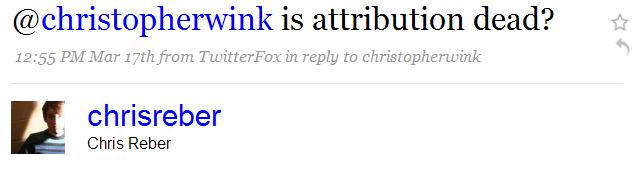
I got a tweet from my buddy and Reading Eagle designer Chris Reber a few weeks ago.

is attribution dead?

That came not long after, Vince Fumo, the embattled Pennsylvania state senator and legendary South Philly politician, was convicted on all 137 counts in his federal corruption trial.

In what was another great stand for an old friend, the Inquirer was all over the Fumo case (not long after another evergreen package on the city’s Please Touch Museum, which won it a national headliner award.

Beyond collecting all the Fumo history and details and using social media, reporter Bob Moran live blogged the March 16 pronouncement of guilt. Fox29 hack Steve Keeley thought the Inqy was doing such a good job that Keeley began reading Moran’s reports live on air, without attributing him or the Inqy.

[youtube http://www.youtube.com/watch?v=cMJXSeaKKmU]

A minor outrage followed, not the least led by Inqy freelancer Amy Quinn, who tweeted again and again and again on the subject. But what else is there to learn, in an age where some say attribution is falling to the wayside?

Continue reading Attribution is not dead if we don’t let it die

Success by association

We are no longer in a golden age of newspapers. This we know.

There was a time when newspapers carried greater weight and bigger staffs. Those left on big urban dailies are ideologues, clingers and the occasional innovator.

I met someone who in the 1980s worked at one of those newspapers that were still power brokers. The staff was almost triple the size what it is today. He had some stories, and he had collected and organized contacts and sources. He learned the game of newspapering and reporting at a time when newspapers had enough editors to truly pass on the details of the game.

Of course, old reporters don’t like to admit that in that way, they had it a lot easier: there were more mentors and editors to teach them the craft, while I don’t know who’s teaching journalists of today.

Other than this learning and the respect he held, this old head journalist didn’t strike me as deserving of the esteem he demanded. After all, he only happened to work in a field that was succeeding. He held success by association.

Continue reading Success by association