Imagine a kind of Community Criticism Readiness Index

Imagine a Community Criticism Readiness Index, a tool to assess whether residents have someone to turn to in times of uncertainty. When faced with questions of identity, impropriety, or anonymity, who would they contact, and how would they share information?

In the 20th century, news organizations were often that go-to ally. What I call “journalism thinking,” shaped by those institutions, proved particularly effective in bridging the gaps where laws, frameworks, or formal institutions fell short. Law enforcement, advocacy groups, government agencies, and attorneys all play critical roles in society—but humans didn’t evolve within legal systems. We evolved within stories.

Journalists, then, have long been storytellers in the service of justice. While their work famously uncovers high crimes, far more often they help communities make sense of their everyday lives. Journalists operate not as enforcers of the law but as mirrors and mediators. Their power comes from an audience relationship built on trust, consistency, and curation.

To construct a Community Criticism Readiness Index, we might survey hundreds of individuals across diverse circumstances:

  • What would you do if you observed something you perceived as immoral but not illegal?
  • Who would you tell if a neighbor uncovered a brilliant solution to a persistent problem?
  • How would you respond to evidence of regulatory capture?

The index would consider input from at-risk populations and privileged groups, spanning communities both traditional and web-based. These subcommunities—rapidly forming thanks to digital organizing tools—need critical eyes as much as any long-standing institution.

What I’ve observed from informal studies is that many communities no longer have the trusted outlet that once played this role: the local newsroom. While national journalism and advocacy at the highest levels have rallied to respond to crises in recent years, the decline of local journalism remains an unresolved and growing threat to civic society. It’s a problem akin to climate change: pervasive, systemic and requiring broad collaboration to address.

Over the past decade, more people have joined the effort to rebuild local journalism, but there is still so much work to be done. And like climate change, market factors will play an essential role in the solutions we find.

This is an essay about the future of local journalism and the approaches we’ll need to sustain it in the decade ahead. If we’re to protect our communities’ ability to criticize, reflect, and rebuild, we need tools like this index—and the local newsrooms that make those tools meaningful.

Spaces between words weren’t common until the 7th century

From the Economist:

A book seems such a simple structure that it feels less invented than self-evident, the innovations behind it hard to see. Yet every chapter in its progress was slow, bound on either side by centuries of sluggishness. Turnable pages didn’t really arrive until the first century bc; the book form didn’t take off properly until the fourth century ad. The separating of words with spaces didn’t get going until the seventh—verylateforsomethingsouseful. Finally things accelerated: first came the index, in the 13th century, then Gutenberg, then, in 1470, the first printed page number. You can still see it in a book in the Bodleian Library.

Nonprofit news models are important. We need others too

With new grantees announced earlier this year, I’m thrilled by the success of nonprofit local newsrooms, well represented by the American Journalism Project, rolling across the country. It seems clear that each U.S. state, and many regions around the country, will, and should, have some version of this model, sustained by local philanthropy and individual donors. This is a necessary, and exciting, layer to the future of local news ecosyinstems — it is also incomplete. As the founder of decade-plus-old, bootstrapped, niche multi-local newsroom, let me share why.

Back in 2009, I used two plastic containers as a couch and supplemented my meager freelance income by doing odd jobs in landscaping and plumbing. It was clear a true global economic crisis was hastening the decline of my trade. I was living in a crumbling, mouse-infested apartment in the Frankford section of Philadelphia. I scared, lonely and very sad.

Two friends I knew from my college newspaper days were also feeling quite stuck, falling through the cracks of a yawning fissure in how our economy worked and information gathering needs were met

From the start, we agreed that every local news organization still structured as an advertising model was on an irreversible path of decline. The web’s power was scale, anything that unnecessarily drew geographic boundaries was unnatural. None of us came from families with any business background but we were curious and frustrated. We felt very abandoned by those who should have been our mentors and advisors. If I’m being honest I still harbor a chip on my shoulder from those days, and likely will for the rest of my career.

Since then, I’ve become fixated on understanding how journalism creates value for communities. I’ve learned that journalism’s value—curating and verifying information to help people understand their world—remains immense. But too often, the ways we attempt to sustain journalism misalign with this value.

Nonprofit models are one such approach. They freeze the core principles of 20th-century accountability journalism and fund it with philanthropy and reader donations. This is a promising trend, and I believe these newsrooms will endure as a key part of the ecosystem. But they aren’t enough.

For one, nonprofit newsrooms must compete with other critical community needs—food banks, job training, and the arts. During times of crisis, it’s unclear whether journalism can consistently win that competition. More importantly, there are simply too many communities for nonprofit models to serve alone.

Instead, we need a broader range of experiments. Journalism shouldn’t limit itself to replicating legacy models under new funding structures. We should explore new business models that align journalism’s value with sustainable revenue. That means embracing entrepreneurship, commercializing ideas, and rethinking how we engage with audiences.

For-profit newsrooms have the potential to play a critical role here. Charging a lot of people a little—or a few people a lot—remains the foundation of any sustainable business. Yet, too often, journalists are uncomfortable or even dismissive of revenue generation. That mindset is dangerous if we want journalism to endure.

I don’t mean to suggest that my own company, Technical.ly, has cracked the code. If anything, my experience has taught me there is no “code.” There are only the slow, messy steps of experimentation. But I remain convinced that local news needs more than one model to survive.

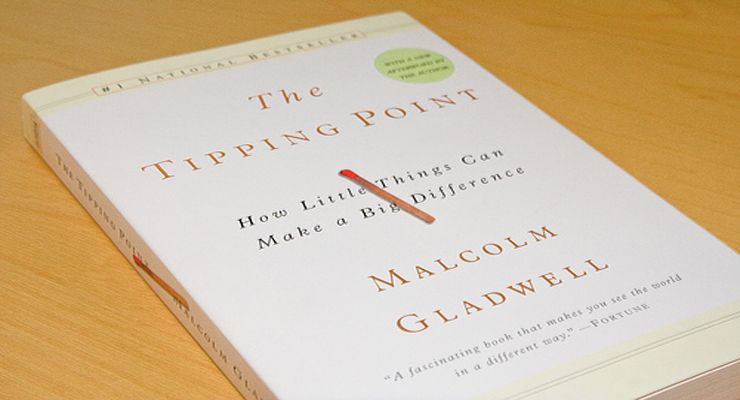
Notes on Malcolm Gladwell’s 2000 classic ‘Tipping Point’

Nothing more needs to be said on influential journalist Malcolm Gladwell’s first breakout book Tipping Point, which published 15 years ago. Like a lot of popular books, it has been aggressively criticized and dismissed.

Even if his theme is challenged, there are small points that are interesting. Though I read this several years ago, I just reread it and took down a few notes for my own future perusal. I’m sharing them here

Continue reading Notes on Malcolm Gladwell’s 2000 classic ‘Tipping Point’

Notes on “Revolutionary Networks: the Business and Politics of Printing the News, 1763–1789”

Colonial-era publishers in the United States were small, family-run businesses that spanned social classes, divided politics and drove forward discourse. Though tiny operations independently, they collectively shaped widespread opinion and developed into the fractured news environment we have today.

That’s one main theme from Revolutionary Networks: The Business and Politics of Printing the News, 1763–1789, an academic book published by Joseph M. Adelman earlier this year by Johns Hopkins University Press.

Adelman adds a lot to the literature on the details of how publishing houses worked in this era. In truth, I sought even greater detail on the real operations but I so appreciated his inclusion of basic finances and revenues, and much detail on the people behind it. I found myself scribbling many notes down on what I’d like to further research for my own understanding of the history of my trade. Much thanks to Adelman.

My friend Everett kindly bought me this as a gift, and I quickly read through it back in February. This is one of many publishing and journalism history books I’ve enjoyed the last several years. Below find notes for myself. I encourage you to buy the book and explore the topic yourself.

Continue reading Notes on “Revolutionary Networks: the Business and Politics of Printing the News, 1763–1789”

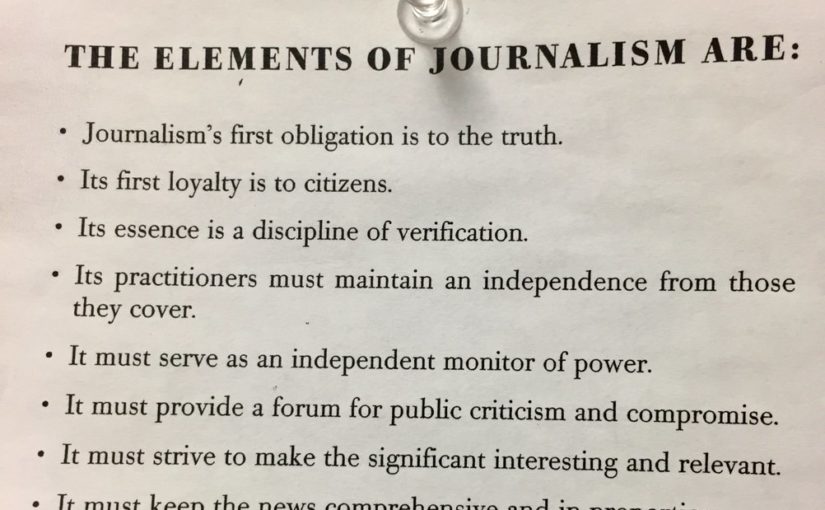
The “Elements of Journalism”

(Image source)

Journalism is a practice largely influenced by those who learn the craft on the job. Despite its well-established impact on communities, there’s a very old debate about whether or how much formal training should be required.

In 1988, ABC anchor Ted Koppel said that “”journalism schools are an absolute and total waste of time.”

Into that fray, the Elements of Journalism has served a breezy foundation for modern journalism. The book, written by Bill Kovach and Tom Rosenstiel, was first published in 2000, then revisited in 2007 and most recently in a third edition from 2014. I read it once many years ago. I returned to it again, after a conversation I had with Rosenstiel, and found it a helpful resource.

Below I share my own notes, though I strongly recommend it for anyone interested in journalism best practices. I bought copies for the editors at my own organization. It’s an easy and effective read.

Continue reading The “Elements of Journalism”

What is newsroom objectivity?

(This is an expansion of this thread)

When is a news organization being fair to a range of good-faith perspectives, and when is that newsroom retreating from a moral responsibility? When is a reporter taking a partisan stance and when is it a stance for justice?

With the rise of the social web in the last 20 years, this reevaluation of journalistic principle has been frequently described through the lens of newsroom objectivity. It reached a fever pitch in 2020, resulting in an important dialogue on objectivity and “moral clarity” in newsrooms.

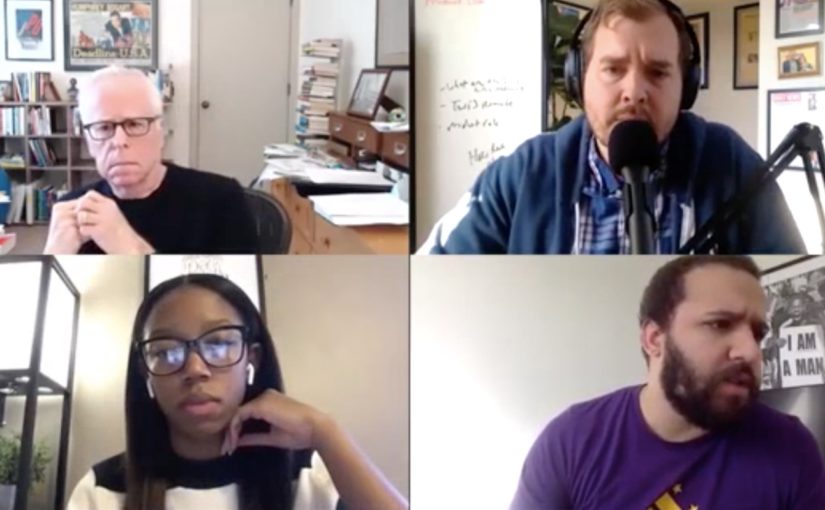
This concept was the topic of a session in November 2020 during the virtual 12th annual Klein News Innovation Camp unconference I help organize. I’ve revisited the conversation, and I want to share what I took away.

Continue reading What is newsroom objectivity?

Newsroom objectivity and “moral clarity” are not in opposition

(This is adapted from a Twitter thread)

No, newsrooms don’t need to throw out “objectivity’ as a principle. Yes “moral clarity” should mean something for news organizations.

This thread comes from my own experiences, plus this helpful conversation I had during Klein News Innovation Camp with Alexis Johnson, Tom Rosenstiel and Wes Lowery.

Continue reading Newsroom objectivity and “moral clarity” are not in opposition

Newsrooms should have and defend their ‘basic beliefs,’ not the tactics to get there

News organizations, at least here in the United States, operate with all sorts of assumptions underpinning their foundations. But it gets uncomfortable once you review them. I believe more news orgs should identify these.

Out of a reporting project, I found myself considering what those core beliefs are for Technical.ly. To identify these assumptions, we’re forced to address: what is the line between a newsroom becoming partisan and a newsroom defending justice? My divide is between the *tactics* to reach a given goal, and the goal itself, which might be understood as that organization’s *”basic beliefs.”*

From my perspective, a news organization today should hold firmly those *beliefs* about the world and the communities it serves. These can and likely should range by the organization. As an exercise, I wrote a few that I believe are basic beliefs of my own news org:

  • Representative democracy is our preferred form of government;
  • A free press that challenges its community in pursuit of the most true view of that community is at times inconvenient but beneficial;
  • Race is an immoral predictor for health and economic outcomes, and should be removed;
  • Invention is a means for solving collective problems and should be rewarded;
  • Economic mobility makes us all better off, and entrepreneurship and career opportunities help;
  • Group-based income inequality correlates to conflict and so should therefore be reduced;
  • Violence is rarely a justified act and so should therefore be reduced, etc.

News organizations should defend fiercely their core beliefs — and individual employees, including newsroom staff, should be allowed to do the same. This is why when we had a newsroom conversation, it felt easy to encourage Technical.ly’s D.C. reporter to protest personally and loudly at a Black Lives Matter protest.

In contrast, the *tactics* to reach those goals are where I view newsrooms must tread most cautiously. In tactics, we find politics and partisanship; it is easy to fall in love with one set of tactics and then therefore become a political actor. Debating and lobbying for tactics is not inherently bad — activists and advocates are crucial, but I believe that’s where journalistic approach ought not venture. I believe there are exceptions but news organizations should use those exceptions rarely.

A good example? Minimum wage research is mixed. Whether a federal $15 minimum wage will reduce income inequality is contested. In contrast, there’s more consensus around growing local minimum wages to fit prevailing wages, and we at Technical.ly have guardedly written in a more favorable light to a local increase than a federal one.

What is my news, media or content business worth?

As the web has brought down the upfront costs of launching a publishing business, there are plenty of them. This means I’ve been asked to join several conversations about how to decide how much one of these are worth.

I’ve been involved in several conversations over the last few years in which publishers (those with no full-time employees to those with several dozen) have sought advice or discussed the topic. I suspect I’ll have other conversations like them in the future, so I thought I’d just share some of the advice I most commonly give and have seen take place.

Continue reading What is my news, media or content business worth?