Local and national media: once no difference, and now the central difference of newsrooms

One of the many economic ripple effects of the global scaling of the web has been an enormous rift between place-based and place-less news organizations.

As recent as the early 1990s, the business fundamentals of the Washington Post, the New York Times and the Philadelphia Inquirer weren’t all that different. They were all advertising and subscription businesses that used a newspaper model as its strategy, leveraging thick newsrooms to gobble up a high comprehension of readers in its audience segmentation.

The web has transformed this into what seems very obvious to you today. Despite the geography in their names, the Washington Post is read globally for insight into U.S. government affairs; the New York Times is read globally by an affluent tribe that identifies with its brand and the Philadelphia Inquirer is read regionally by those who want to access that geography’s largest and most influential newsroom.

Continue reading Local and national media: once no difference, and now the central difference of newsrooms


Media Funders: Value the difference between Creation and Distribution

This post will draw a very bright line between the Creation and Distribution of verified information for communities, and argue for that distinction’s importance for understanding today’s news-gathering and journalism climate.

One of my favorite pieces of business-reporting conventional wisdom is that everything in the economy is cyclical. It just depends on how big the circle is this time.

That goes for business building. As early web entrepreneur Jim Barksdale famously put it, “there’s only two ways I know of to make money: bundling and unbundling.”

Information gathering (what we roughly call “journalism” today) has been a strategy for businesses for half a millennia. In its early commercial forms, the act of gathering that information and the act of distributing it were essentially two different businesses. In Barksdale’s parlance, they were “unbundled.”

Continue reading Media Funders: Value the difference between Creation and Distribution

Why we launched ADVANCE, a conference on smarter impact for nonprofit professionals

In 2015, my company began publishing a second brand: Generocity.org, which aimed to offer beat reporting on nonprofit and mission work in local communities, starting in Philadelphia.

We’ve learned plenty. Last week we hosted ADVANCE, a pilot one-day conference for Generocity’s audience of nonprofit professionals. The aim was to feature case studies and concepts that would help the 100 attendees advance their mission careers. Our keynote was Kickstarter cofounder and former CEO Yancey Strickler, who has a new book on a more just economy.

I helped introduce the day by setting up what our reporting has taught us about our audience, and this growing community of future-thinking impact leaders. Though a modest start, I think it’s important we piloted this conference.

Continue reading Why we launched ADVANCE, a conference on smarter impact for nonprofit professionals

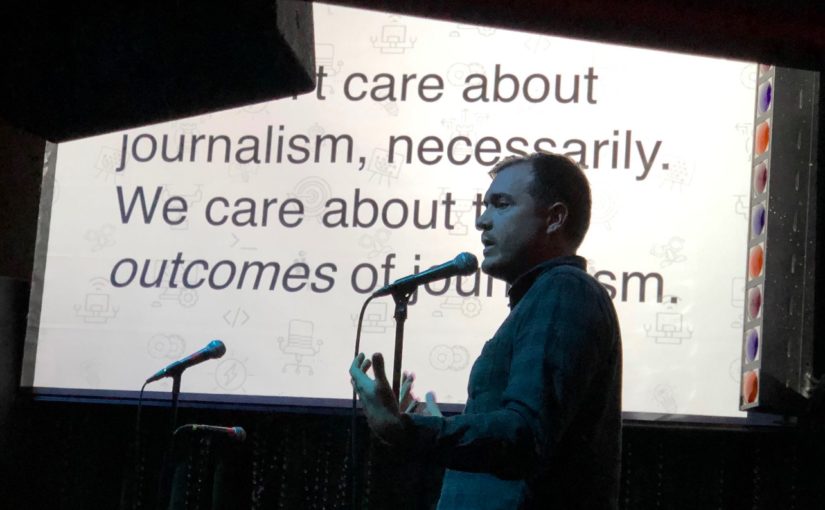
Journalism Thinking: a lightning talk at Ignite Philly

Geographically-focused acts of journalism are powerful. Professionals are increasingly rare because the business model that supported most of them has been supplanted. No one is doing the hard work of combating that. Let’s change it.

Following my journalism thinking essay, I’ve been looking to develop a more general-interest way to deliver the message. On Oct. 16, I gave my first try, at Ignite Philly, a local, volunteer-run outpost of a global confederation of big-idea events. (I spoke there in 2011 and 2013)

Find my notes and slides below, and I’ll add the video here when it’s eventually posted.

Continue reading Journalism Thinking: a lightning talk at Ignite Philly

Here’s what I’d do to ensure local journalism exists 20 years from now

Say the United States needs 50,000 full-time local journalists to maintain our distinct and robust discourse. That’s to have an independent voice to sniff out injustice and to put a mirror up to communities with professional rigor. (Despite our discourse, two-thirds of Americans trust their local media.)

Today there are just 37,000 working journalists in the United States, and falling. More alarmingly, even that number is increasingly made of non-local reporters, based primarily in New York City, Washington D.C. and California.

We may have half, or even fewer, the number of full-time local journalists this country may need for an informed public. (Yes, there may be more American coal miners than local U.S. reporters.)

That 50,000 number comes from a landmark report for the FCC by Steve Waldman, the editor who launched and is now running Report for America aimed at addressing just that issue. Confronting an enormous gap, his nonprofit crucially places reporters in local newsrooms (both nonprofit and for-profit) with identified coverage gaps.

The journalism practitioners among us are maybe too aware of how disrupted is the advertising model that defined our category for a couple hundred years. Frighteningly though, seven in 10 Americans still think their local news media are doing well financially.

Put another way: a central part of U.S. democracy and local civic dialogue has been broken for 20 years, we still haven’t addressed the core problem, and, apparently, the stakeholders we most need to participate (our readers) aren’t even aware of the problem. This essay is meant to outline why my professional work has focused where it has and what I hope that might offer others who care about acts of journalism.

Continue reading Here’s what I’d do to ensure local journalism exists 20 years from now

Real Life Local News Revenue Experiments: ONA19 session

Powered by a decade of pursuing local news revenue models, I got together a few friends doing similar work and hosted a session during the 20th annual Online News Association conference, in New Orleans, on Thursday.

The session was called Real Life Local News Revenue Experiments That Aren’t Advertising. Building on a 2016 lightning talk at the same conference, I published an essay a few days before the session to gather related thoughts and spark conversation.

My big takeaway: journalism is a strategy, not an industry. Or put another way, it is an approach to competing in any number of business models. For local journalism to thrive in the future, we need to find and experiment there.

Find notes, slides and more below.

Continue reading Real Life Local News Revenue Experiments: ONA19 session

‘Journalism Thinking’ doesn’t need a business model. It needs a call to arms

I originally posted this on Medium here. It received considerable endorsement, including here, here and here.

Early professional news networks in the 14th and 15th centuries were couriers on horseback, informing warlords and merchants. Even competitors saw the value in shared professional news gathering, when there wasn’t a state-owned alternative. Subscriptions, then, subsidized the first foreign affairs and business reporters.

Over the next 500 years, innovations in distribution and in printing and paper technology shaped professional news-gathering into the 20th century model we most recognize today: advertising revenue subsidized relatively low unit costs to ensure widely available mass media (albeit almost exclusively from a white male perspective, but that needs its own post entirely).

Today we’re well into the first generation of the digital transformation of news-gathering and distribution. Yet we as journalism practitioners are still managing to underestimate how dramatically things have changed.

Continue reading ‘Journalism Thinking’ doesn’t need a business model. It needs a call to arms

The importance of journalism’s double-sided marketplace

This is adapted from a recent tweet thread I shared.

Someone recently described to me the “dishonesty” of the two-sided marketplace business model of modern journalism — of selling both subscriptions and advertising.

The argument is that by having two “customers” (individual readers and company advertisers), a publisher can never do right by both at the same time. There was a reference to Chomsky’s “Manufacturing Consent.” I disagreed. Let me share why.

Continue reading The importance of journalism’s double-sided marketplace

Note on “Reporting the Revolutionary War” from 2012 by Todd Andrlik

As Mark Twain put it: “History is the pale and tranquil reflection” of news.

Before the patriotic tales of heroism, there was urgent, partisan and divided reporting about the relationship between American colonists and the British crown. In his 2012 book Reporting the Revolutionary War, Todd Andrlik gives us a chance at seeing the events when there was nothing predetermined.

The book is heavily reliant on scanned copies of original source newspapers (both from colonial and English accounts), with some contextual interpretation from 37 historians. I recommend the book for a visual look at the fast-paced beat reporting the era. Below I share just a few notes that stood out to me.

Continue reading Note on “Reporting the Revolutionary War” from 2012 by Todd Andrlik

The difference between developmental editing and copyediting

It’s a question of priority and need.

Though this runs across publishing and deeper in newsrooms, I’m speaking in a general sense about my own experiences, both in journalism and creative work.

Less about roles, I see two broad ways we approach editing: developmental editing and copyediting. One isn’t better or more important than the other. They’re just different tools in developing story. One supports the approach; one finalizes the landing.

Continue reading The difference between developmental editing and copyediting