Lakota Reflections from the Rosebud Reservation


By Christopher Wink | May 25, 2006 | Travel Reflection

I have proudly represented Temple University on service immersion trips before. I have had South Dakotan ground beneath my feet before, too. Moreover, I have been with Jason Riley in a rental car and with John Dimino on an airplane before. Still, it is easy to understand that some experiences, no matter the similarities, can never be fully replicated.

Our group of ten administrators and students flew into Rapid City, South Dakota in May 2006, destined to work on the Rosebud Reservation of the Lakota Nation. While nearing the airport from above, below me South Dakota appeared wrinkled and aged. As we further approached, her features took form: trees that survived passed generations of agricultural clearing and beef cattle that survived passed days of agricultural slaughter.

This region of Dakota’s limitless expansion is only interrupted by flurries of elevation change. Once on ground, the pavement of interstate 90 appeared to have tamed the land into a consumable table of gentle slopes and caressing ridges. All of which leads me to offer muddled explanations of the region’s geographical features: endless plains with small, yet punctuated elevation changes interjected regularly.

Continue reading Lakota Reflections from the Rosebud Reservation
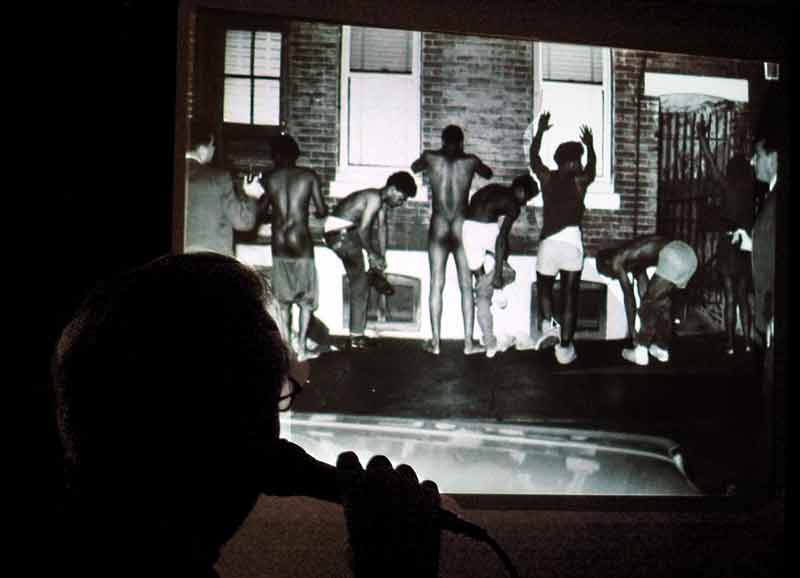
Elwood P. Smith

Elwood P. “Smitty” Smith retired two years ago last month.

http://www.phillynewmedia.com/smitty/

http://www.jimmacmillan.com/photoblog/2005/11/elwood-p-smith_17.html

http://www.citypaper.net/articles/2002-08-22/cb.shtml

http://www.nppa.org/news_and_events/news/2005/11/smith.html

Photo of Elwood P. Smith during a party to celebrate his 85th birthday in 2005, while talking about his famed photograph of Black Panthers being strip-searched during a raid by Philadelphia Police in 1970, courtesy of Philly News Media.

Ronald Reagan and racial politics

A central requisite of my paper is trying to disentangle national and local politics as best I can.

Racial politics, however present in both forms, have to be more important in a city like Philadelphia, so much more diverse racially than the United States as a whole.

Last month, Paul Krugman wrote a commentary piece for the New York Times, discussing the role Ronald Reagan played in today’s racial climate politically.

He wrote of Reagan’s adeptness at winning over the white male vote, particularly in the South. Krugman makes an important distinction that is valuable in my own research, understanding the natural complexities of sub-groups in racial voting blocs.

For example, everyone knows that white men have turned away from the Democrats over God, guns, national security and so on. But what everyone knows isn’t true once you exclude the South from the picture. As the political scientist Larry Bartels points out, in the 1952 presidential election 40 percent of non-Southern white men voted Democratic; in 2004, that figure was virtually unchanged, at 39 percent.

If I were to draw a comparison, it is that I should be wary in speaking too generally about the black voting population in Philadelphia. I am working on collecting ward racial data for Philadelphia, to be compared with those ward’s voting patterns in order that I can best determine racial voting forms in the city, but there is much to keep in mind.

Photo courtesy of MSNBC.

Interview: Dave Glancey, former Democratic City chairman

Dave Glancey

This morning I sat down with Dave Glancey, former chairman of Philadelphia’s Democratic City Committee.

Photo from Feb. 2007 while Dave Glancey was still chair of the city’s Board of Revision of Taxes. Here he was speaking at a conference held at Temple University. He was explaining how full-value reassessment could set proper home values. His suggestion was that elected officials lower tax rates so the city wouldn’t see increased revenue. Courtesy of Philadelphia Forward.