We’ve known that for, what, like 150 years or something? In the past quarter-century or so, as educated (mostly, but not entirely white) professionals moved back to neighborhoods that had populations that didn’t always resemble them — in race or class or culture or all and more — there were natural clashes.
Mostly, I feel like those clashes have mostly been put in three categories, one initiated by new residents, one from more native residents and one that both share:
Creating a bold and serious collaborative niche membership network with existing and emerging independent media should be a primary objective of WHYY, the Delaware Valley public media organization.
Highlighted by its six-month-old NewsWorks online news site and hyperlocal news experiment, WHYY has attempted to recast itself as something more than a stodgy PBS TV channel and NPR radio affiliate. While progress has surely been made, WHYY is short of being as fully integrated and networked as the ‘public media’ nomenclature might suggest.
A team of Temple University Fox School of Business MBA students who won a March 2011 innovation contest for improving the North Broad Street corridor in Philadelphia.
When re-purposing technology tools as solutions, the core problem and end user are often ignored and so little will be accomplished.
In short, nearly 100 Temple students from six different schools were broken into cross-disciplinary teams and given a week to conceive of plans to grow opportunity along the beleaguered North Broad Street corridor in Philadelphia. Community members, leaders and other thinkers on the subject were brought in, student teams were encouraged to take to the streets and employ what they already knew.
If all the timing was right on track, some time this month or next, a CEO might be named for a new collaborative nonprofit news and information project being initially funded by the William Penn Foundation.
(Full disclosure, yup, the William Penn Foundations funds the Technically Philly Transparencity open government coverage project and CPIJ was the title sponsor for this year’s BarCamp NewsInnovation, so let’s go ahead and assume that I have absolutely no objectivity about anything written here.)
Philly.com Vice President Wendy Warren, at left, and Philly.com producer Daniel Victor lead a BarCamp NewsInnovation session on the direction of the news site, on Saturday, April 30, 2011.
For Philly.com to maintain and expand upon its role as the dominant hub site in the Philadelphia region, it needs to become a comprehensive, collaborative and open source for all news, information and analysis that happens, reflects and impacts this metro area.
For 15 years, the now Philadelphia Media Network-owned news website has exclusively featured content from its sister newspapers, the Inquirer and Daily News (also owned by PMN), in addition to online exclusives and Philly.com-led multimedia content.
Contrary to what perhaps many at PMN may believe, the more than 200 combined editorial staff members are not, and likely cannot, currently produce that comprehension. Nor should they.
Philly.com’s reach will always be stilted — by other major, also growing online audiences for local TV news websites, suburban newspapers, a nascent, if not yet real, threat in the NewsWorks initiative from WHYY, and other community sites — until it realizes it shouldn’t be a newspaper landing page but the ultimate authority of regional content. That’s a problem for the future success of a brand with a business model predicated on more eyeballs.
Let me be clear here: I have many friends who work there. I think they do great work. This is not at all a criticism of the work done there, but rather, some thoughts for developing their Philly.com brand. I’m an outsider and a journalism geek, so it’s fun to brainstorm. OK, follow my thoughts below:
Here’s something completely unoriginal: you’re going to get flat-ass rejected, crushing whatever self-indulgent perspective you have on yourself, and then you will go some place magical and it will change you.
In 2003, I was an involved and eager high school senior who struggled to focus and was a lot more interested in creative side projects than studying or school work. I thought it made me unique and valuable. Turns out, it just made me a shitty student.
I grew up in rural northwest New Jersey, where the population was made up mostly of either generational residents or the extended foam of the New York City white flight wave. My parents were the latter and my family all lived in or around the 67th ward.
I wanted to go to college in a big city, without following the footsteps of my classmates or returning to ancestral roots, so I applied to colleges and universities throughout the Eastern Seaboard. I am wildly involved, have decent grades and, come on, I’m a total hoot, I thought, these freakin’ schools are going to be fighting over me.
Until the very thin envelopes from universities started to come in.
It gives us culture. It is a way to pay remembrance for those who came before. Yes, it’s a little bit fun.
In the world of news, there is a lot of tradition that needs to be lost. Unquestioned impartiality, balance without real context, an ignorance and distance of what funds it, a rigid belief in a strictly reactionary audience.
But, I’ve always felt, there is lot to be taken in from the past. I’ve been blessed to work alongside some talented and hungry older journalists who have imparted great wisdom on me. I thought some of that tradition was worth sharing as, in my own way, I try to preserve the best of it.
Below, find 25 pieces of advice about being a newsman that I take great value in.
Above, TED co-founder Chris Anderson talks about the impact of Youtube and other online video has on the world.
Youtube was a powerful part of moving forward content dissemination on the web. Suddenly there was a free place to host, distribute and embed easily video that drove traffic and audience.
About which time Youtube was overwhelmed with kitten videos, personal photos looped under copyrighted music and clips of everything in between.
But, through all the muck, there is brilliance. That much I’ve found since I first clicked on a Youtube link in an email in my college sophomore year apartment and shared with my roommate. Universities are beginning to share lectures online, and more teachers, lessons and ideas are spreading on Youtube. (Perhaps not as much as kitten videos)
To prove there is more than the nonsense, below, I share the 10 videos that have made the biggest impact on me and the lessons I took from them.
It came to mind that I toss around a handful of phrases with enough frequency and a long enough time that I feel they have sufficiently affected how I orient myself to what is around me.
Maybe some will have meaning to you.
Fifty percent of people are better off than you, and 50 percent are worse off — It’s one of the more powerful sentiments that my father instilled in me. While I am probably even more privileged than that, the value is limitless.
No judging in brainstorming — The worst thing for collaboration or friendship or teamwork or success or for anything is to question someone’s willingness to share an idea with condescension or criticism. Be kind to those who share their ideas and work with them.
Make a list and keep it — Keep yourself accountable by listing goals, resolutions, priorities and the like. And then stick to them. Promises made, forgotten and never kept are of no value.
Say ‘I don’t know’ and ask questions — If you don’t know something, admit it and ask the question that helps you find out.
In almost all cases, it’s not as serious as you think it is — Calm the Hell down.
Everything online is public — Yes, even e-mail or IM conversations. Consider anything you write or say today to be public. I picked up this logic in college and have tried to follow its underlying logic.
Relationships aren’t business, business is relationships — Get those priorities in order and treat people in a way that reflects this reality.
Never admit a big defeat when you can claim a smaller victory — Think creatively about what good can come of a situation, in lessons or experiences or something else.
Diversify everything: from your finances to your coverage — Don’t focus on one anything.
Lust isn’t about sex; it’s about how little we care about each other — It’s something I read somewhere, several years ago, and though I can’t remember the source, it has had a profound impact on my understanding of fidelity. That treatment goes far beyond the physical.
[Updated] Action is a virtue — There is always a reason to say no, so focus on why you ought to do something.
[Updated] Come with Solutions not just questions — Creativity can flow with conversation, but when bringing up a problem, concern or idea, come with a solution, even if it isn’t the best, have a suggested direction whenever in a meeting, particularly when dealing with other leaders.
[Updated] Be the nicest to the secretaries, assistants, garbage men, janitors and postmen because they really make it happen — My father would be dismayed when people seemed to have a strictly hierarchical sense of who is important and who isn’t, particularly because, when it comes right down to it, the supposed leaders are most often not the ones who actually do the work.
[Updated]Our worst qualities are often our best ones too, just described differently — So whether you’re manipulative or strategic; lazy or relaxed; high-strung or detail orientated all depends on perspective and what the end result is.
[Updated]Luck and opportunity are both about 75 percent found and 25 percent created — Good luck and opportunity certainly come our way, but we still need to earn a healthy portion of it.
[Updated]The only person responsible for your happiness is you. — Take ownership of what you want in your life and when the details are beyond your reach, find what you can grab.
[Updated]“When you realize nothing is lacking/the whole world belongs to you” — Wise words from Lao Tzu
[Updated]Fail fast or succeed big — A lesson from the startup world that teaches it’s worth giving it your all or moving on.
[Updated]You can’t think outside the box unless someone is thinking inside of it — A good reminder for anyone who strives to be different. Remember to not bash those who conform or follow normal practices, because without them, nothing you do would be original.
[Updated]You often don’t lose friends in a year, but you can certainly gain them — So travel, move, try new things and challenge, particularly when you’re young.
And, yes, the old Golden Rule is a good one, just try to treat others close-enough as you might want to be treated.
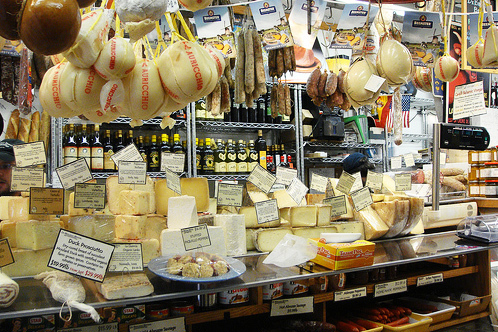
I was inside Di Bruno Bros., Philadelphia’s beloved, 70-year-old artisan cheese shop and gourmet delicatessen, when something very apparent sunk in for me.
They’ll sell me a block of Manchego sheep’s milk cheese for $5, or bratwurst or beef from the region for a few dollars a pound. It’s profitable and prominent.
But I’d bet Di Bruno Bros. makes a lot more money per minute of staff effort on its catering business than any retail experience it could create. Rather than having one person buying one block of cheese, any successful retail operation wants to use its economies of scale to up production and get more revenue for its effort by servicing tens or hundreds of people at the same time.
If you have a news site, then what is the back-end service that is really going to make the money needed to fund journalism?