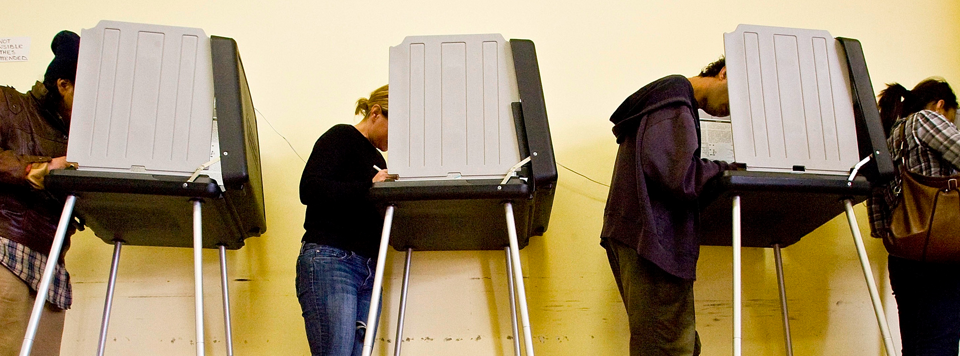
Imagine a kind of Community Criticism Readiness Index

Imagine a Community Criticism Readiness Index, a tool to assess whether residents have someone to turn to in times of uncertainty. When faced with questions of identity, impropriety, or anonymity, who would they contact, and how would they share information?

In the 20th century, news organizations were often that go-to ally. What I call “journalism thinking,” shaped by those institutions, proved particularly effective in bridging the gaps where laws, frameworks, or formal institutions fell short. Law enforcement, advocacy groups, government agencies, and attorneys all play critical roles in society—but humans didn’t evolve within legal systems. We evolved within stories.

Journalists, then, have long been storytellers in the service of justice. While their work famously uncovers high crimes, far more often they help communities make sense of their everyday lives. Journalists operate not as enforcers of the law but as mirrors and mediators. Their power comes from an audience relationship built on trust, consistency, and curation.

To construct a Community Criticism Readiness Index, we might survey hundreds of individuals across diverse circumstances:

  • What would you do if you observed something you perceived as immoral but not illegal?
  • Who would you tell if a neighbor uncovered a brilliant solution to a persistent problem?
  • How would you respond to evidence of regulatory capture?

The index would consider input from at-risk populations and privileged groups, spanning communities both traditional and web-based. These subcommunities—rapidly forming thanks to digital organizing tools—need critical eyes as much as any long-standing institution.

What I’ve observed from informal studies is that many communities no longer have the trusted outlet that once played this role: the local newsroom. While national journalism and advocacy at the highest levels have rallied to respond to crises in recent years, the decline of local journalism remains an unresolved and growing threat to civic society. It’s a problem akin to climate change: pervasive, systemic and requiring broad collaboration to address.

Over the past decade, more people have joined the effort to rebuild local journalism, but there is still so much work to be done. And like climate change, market factors will play an essential role in the solutions we find.

This is an essay about the future of local journalism and the approaches we’ll need to sustain it in the decade ahead. If we’re to protect our communities’ ability to criticize, reflect, and rebuild, we need tools like this index—and the local newsrooms that make those tools meaningful.

Newspapers were once the big tech platform companies everyone hated

This is adapted from a Twitter thread.

There are many parallels between early newspapers and today. Like then, today big tech platforms are vilified for taking creative destruction to a more harmful end to civic discourse.

Then partisanship and misinformation gave rise to the modern concept of editing. Perhaps something akin is happening again.

Continue reading Newspapers were once the big tech platform companies everyone hated

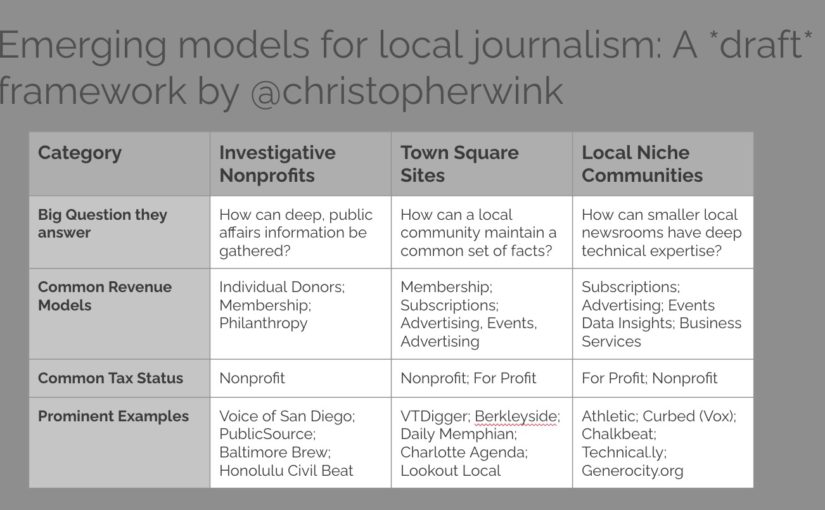
Three emerging approaches to local journalism

It’s no longer quite right to say journalism as a whole is imperiled by the internet-age. In the last decade, powerhouse national outlets have made the business model leaps. Other important and influential national and global organizations gather and produce valuable information for the civic good. Their concerns are now with truth and partisanship and objectivity. These are heady issues but they’re not directly revenue problems.

This is different from publishers with a geographic focus; previous business models don’t comport simply with web-powered scale. Local journalism is very much in crisis. I know this personally and professionally, so I follow trends closely with an applied viewpoint

I’ve long thought that we at the news organization I cofounded a decade ago are something of an outlier, trying to approach local reporting through a for-profit, multi-local strategy. (I wrote here about why Technically Media is not a nonprofit). Recently though I’ve noticed that we may fit into one of three broad approaches I see tackling local news.

This is made clear by the strengthening of the country’s superstar national commercial journalism providers as the collapse of the dominant local forms continues apace. Web-powered scale has laid bare that national and local outlets are in entirely different categories. 

Continue reading Three emerging approaches to local journalism

Media Funders: Value the difference between Creation and Distribution

This post will draw a very bright line between the Creation and Distribution of verified information for communities, and argue for that distinction’s importance for understanding today’s news-gathering and journalism climate.

One of my favorite pieces of business-reporting conventional wisdom is that everything in the economy is cyclical. It just depends on how big the circle is this time.

That goes for business building. As early web entrepreneur Jim Barksdale famously put it, “there’s only two ways I know of to make money: bundling and unbundling.”

Information gathering (what we roughly call “journalism” today) has been a strategy for businesses for half a millennia. In its early commercial forms, the act of gathering that information and the act of distributing it were essentially two different businesses. In Barksdale’s parlance, they were “unbundled.”

Continue reading Media Funders: Value the difference between Creation and Distribution

Here’s what I’d do to ensure local journalism exists 20 years from now

Say the United States needs 50,000 full-time local journalists to maintain our distinct and robust discourse. That’s to have an independent voice to sniff out injustice and to put a mirror up to communities with professional rigor. (Despite our discourse, two-thirds of Americans trust their local media.)

Today there are just 37,000 working journalists in the United States, and falling. More alarmingly, even that number is increasingly made of non-local reporters, based primarily in New York City, Washington D.C. and California.

We may have half, or even fewer, the number of full-time local journalists this country may need for an informed public. (Yes, there may be more American coal miners than local U.S. reporters.)

That 50,000 number comes from a landmark report for the FCC by Steve Waldman, the editor who launched and is now running Report for America aimed at addressing just that issue. Confronting an enormous gap, his nonprofit crucially places reporters in local newsrooms (both nonprofit and for-profit) with identified coverage gaps.

The journalism practitioners among us are maybe too aware of how disrupted is the advertising model that defined our category for a couple hundred years. Frighteningly though, seven in 10 Americans still think their local news media are doing well financially.

Put another way: a central part of U.S. democracy and local civic dialogue has been broken for 20 years, we still haven’t addressed the core problem, and, apparently, the stakeholders we most need to participate (our readers) aren’t even aware of the problem. This essay is meant to outline why my professional work has focused where it has and what I hope that might offer others who care about acts of journalism.

Continue reading Here’s what I’d do to ensure local journalism exists 20 years from now

This Knight Foundation report on Philly media skips us. Here’s why

A friend forwarded me the report first with a question: Where’s Technical.ly?

I’m a genuine fan of the Knight Foundation. It gets its knocks, but it’s one of the few consistent funders of journalistic change in the country. I’ve also spent more than a decade running Technical.ly, one of the few local news organizations that has gone all-in on using journalism to attract earned income—the very approach journalistic funders always talk about prioritizing. And I’ve been doing it from Philadelphia.

So when Knight published a report this month specifically highlighting bright spots in Philadelphia media, it felt a little strange to be overlooked entirely. [Report PDF]

To be clear, I understand why we’re not in there. Technical.ly looks different from most of the players in local journalism, even the smaller outlets cited in the report for their “ecosystem approach.” It even cites “nonprofit news” as its focus, which is mostly a way to discount TV stations. But for me, that’s exactly the point.

Years into this work, I keep encountering a pattern: Established leaders say they want more of a certain kind of innovation—let’s call it “XYZ”—but by their own definitions, anyone doing XYZ (serving a niche market to pursue independent sustainability) is dismissed as not “journalistic” enough to be part of the conversation. It’s a perfect recipe to ensure we never actually address the core problem these reports are meant to solve.

I do believe most large regions in the country will eventually end up with a philanthropically funded local news organization. In Philadelphia, thanks to Gerry Lenfest, that may well be the Inquirer. And other public-interest nonprofit news outlets will find their place too.

But I’ve bet my career on the idea that local news ecosystems need more than just legacy and nonprofit institutions. They need ethnic media, neighborhood weeklies, subject-matter-focused outlets like Technical.ly, and even individuals empowered by social platforms and new tech tools. (I like lessons from B2B publishing, though it’s different locally).

We’re not competing with the legacy players. We’re complementing them, filling gaps and addressing needs they can’t meet alone. I just hope more people in positions of influence and funding will recognize that role—and include it in conversations about the future of local journalism.

What the Committee of Seventy should teach other nonprofits about publishing

The Committee of Seventy is a 110-year-old local good government activist group known best in Philadelphia for its oversight of city elections. With the retirement of their popular newsman-turned-leader, the nonpartisan nonprofit is seeking a new Executive Director. This is also a unique opportunity for the group to update how it can best serve its mission to combat corruption. It has a clear alignment with public affairs journalism — something other mission groups should learn from.

For my undergraduate academic year 2004-2005, I was a policy intern at Seventy, spanning outgoing director Zack Stalberg and his predecessor Fred Voigt, whom I also interviewed for a college thesis project. From then through to my Election Day volunteering, I’ve long been inspired by their work.

But like Stalberg was meant to do when he replaced Voigt, Seventy is again in need of an updated look at how it can best accomplish their goals. If I were to launch an organization with the goals Seventy has today, in an era with newfound opportunities to build civic-orientated coalitions, web publishing for audience building would certainly be part of the strategy.

Continue reading What the Committee of Seventy should teach other nonprofits about publishing

The difference between a beat reporter and a features writer

Producing acts of journalism to inform a community can get done with different approaches. There are those who follow one community closely and those who offer the broader narrative to a wider audience.

In news parlance, it’s the beat reporter and the features writer, and it’s tied to the idea of choosing deeper impact or larger scale. I’ve developed a better understanding of the differences in these specialties over the last few years, in both hiring, following and familiarizing myself with the work of my peers.

Continue reading The difference between a beat reporter and a features writer

Journalism isn’t what we should try to save: Philly example

A couple times a year, someone in Philadelphia technology will say to me, what that community really needs to broaden its prominence is “its own Tech Crunch,” a reference to the established and influential tech business blog with Silicon Valley roots. The implication is, with all due respect to the maturity of Technical.ly Philly (relative to our newer, smaller markets) and its readership and regular events, that Philadelphia needs a megaphone to a global audience of investors and talent.

When someone says this, I hide my cringe and instead I politely nod, before changing the subject.

Of course, a statement like that shows a profound lack of understanding of audience, goals and impact in online media. Tech Crunch is established and influential because it covers big, well-funded tech business nationally, not a fledgling community in a non-traditional hub. Technical.ly Philly looks the way it does because of where it is. It doesn’t have national readership because it isn’t national in focus. The people who say “we need a Tech Crunch,” are confusing outcomes and solutions (Silicon Valley was the global tech leader first, then it spawned Tech Crunch, not the other way around).

Put another way: Media is a Mirror. This is a problem that happens elsewhere.

Continue reading Journalism isn’t what we should try to save: Philly example

Journalism DNA: Is Technical.ly a journalism outlet?

Acts of journalism are challenging and at times infrequent things for local news organizations. Pushing a community and seeking to find outcomes through difficult questions is the best of what media can do. Balancing that with the work tied to creating a sustainable news venture is a consuming one. Here’s where I am in my thinking about that process.

When we launched in 2009 what has since become Technical.ly, we always prepared for a content mixture that would include information and community journalism. We were trained in a newspaper worldview that put a type of ethical paradigm and professional standards that we embraced, even as we challenged its traditions.

Along the way, I found out that I want to build something that could have an impact. Pessimists are nothing but spectators and reporters are almost always pessimists.

Continue reading Journalism DNA: Is Technical.ly a journalism outlet?