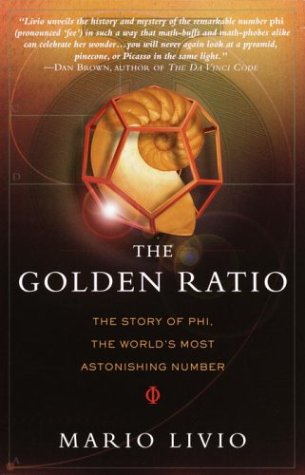
The Golden Ratio, the 2003 historical analysis of the irrational number phi (~1.62) by Mario Livio, reads more like a top level review of a few thousand years of mathematical history. And so, while I enjoyed the pursuit of phi in art throughout time, I was much more taken by the top-level review of the development of math. The development, or, well, the discovery of math.
Indeed, of the various historical storylines, one theme from the book that stuck out for me more than others, I was most taken bythe ongoing debate about whether math was invented or discovered, the former of which is my persuasion to date:
You ought to read the whole piece, but here are a couple of my favorite parts:
This system was never ideal—out of the crooked timber of humanity no straight thing was ever made—and long before Craig Newmark and Arianna Huffington began their reign of terror, Gannett and Scripps were pioneering debt-laden balance sheets, highly paid executives, and short-term profit-chasing. But even in their worst days, newspapers supported the minority of journalists reporting actual news, for the minority of citizens who cared. In return, the people who followed sports or celebrities, or clipped recipes and coupons, got to live in a town where the City Council was marginally less likely to be corrupt.
“There are only three things I’m sure of: News has to be subsidized, and it has to be cheap, and it has to be free.”
If we adopt the radical view that what seems to be happening is actually happening, then a crisis in reporting isn’t something that might take place in the future. A 30% reduction in newsroom staff, with more to come, means this is the crisis, right now. Any way of creating news that gets cost below income, however odd, is a good way, and any way that doesn’t, however hallowed, is bad.
I’m interested in moving to the next step, creating more compelling Facebook pages that keep people coming back, attract more eyeballs, develop brands, help create communication and, of course, help push eyeballs.
I’ve been moving through some conversations, trying to pull out the best lessons. I’m not behind anything compelling yet, but I’d love to do something fun with NEast Philly’s incredibly active Facebook page.
The FCC released a year-long study on the state of local accountability journalism and the view is pessimistic, as the Seattle Times reports.
A lot of conversation has come from it, and I hope to add some greater thoughts here on the 40-plus page document. Download it here [PDF]. Author Steven Waldman gave a short presentation at last Thursday’s Aspen Institute roundtable.
Technically Philly is mentioned briefly, but in a section lamenting that what modest successes the Philadelphia market has had in local journalism is having a relatively small numerical impact, in terms of traffic. The report’s premise was defining meaningful impact by those sites that account for at least one percent of a region’s overall traffic.
The broad comScore coverage also allows us to piggyback onto recent in?depth studies of local journalism in the digital age. First, the Institute for Interactive Journalism authored a recent study of the online news ecosystem in Philadelphia. They claim to have identified 260 local blogs, including “about 60 [with] some journalistic DNA in that they report news, not just comment on it” (Shafer 2010). While J?Lab does not provide a full listing of the sites, they single out several as particularly successful examples. Metropolis is an online news outlet staffed by professional journalists with experience in traditional media. TechnicallyPhilly.com focuses on the city’s tech community. Public School Notebook covers Philly schools and local education issues. PlanPhilly.com concentrates on planning and zoning. SeptaWatch.org provides coverage of local transportation. The Broad Street Review provides coverage of the local arts scene. The Philadelphia media market provides the fourth?largest panel in the sample, making it easier to find low?market?reach sites here than it is almost anywhere else. PlanPhilly.com shows up just in the February data, with 7 visitors out of 7967 panelists. None of the other online news sources show up at all.
Not a journalism-only report at all and backed by a year of conversation, outreach and testimony, I wanted to share my notes and thoughts on diving into the seminal report.
I finally dug into the 1951 American dystopian classic novel ‘Fahrenheit 451‘ by Ray Bradbury. It focuses on a world in the future in which firemen play a very different role, with a message of anti-censorship. If you need a refresher on the book, check out this wrap video here.
It quickly became one of my favorite novels. I wanted to share a few of my favorite lines and my favorite passage from the book.
The book does two very basic things: (1) outlines Gary’s general philosophy that the Internet offers an opportunity for anyone to make money off her passion and (2) gives very simple, early steps for doing so.
Here are my take aways from reading the book:
First, of course, I agree with much of his perspective and love his attitude, though, in building a business around news that now supports three people full-time, I read his chapter on journalism business with some degree of skepticism.
In being supportive, Gary may be offering some false hope — By looking at the two objectives this book hits (his passion and very basic steps to start following the same path) I’d picture his audience are those somewhat new to the web. His spirit — which is a noble one — is about persistence, but I don’t believe hard work wins out all the time. Businesses succeed with hard work, passion, and skill, of course, but personality, luck and timing play a big part, too, I believe, and I think Gary’s success has quite a bit to do with personality, luck and timing. I wonder how much of the audience building some of his readers have are, indeed, his other readers and how much is real business momentum.
Gary’s impact is for big brands first, but his book is sold to little brands — Part of that is marketing from Harper Collins, of course, but I’m always a little skeptical of the ‘you can do anything you put your mind to’ mantra, as there are real audience building challenges some small brands and individuals will have, as noted above.
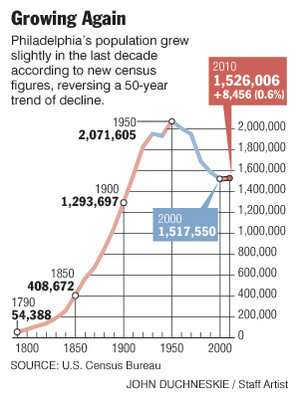
Three recently shared numbers stand out to me as being incredibly powerful, evocative and important for the future of Philadelphia:
8,456
The tiny, 0.6 increase in Philadelphia’s population from the 2000 to the 2010 U.S. Census, a small grow that halts an enormous trend: 50 years of population loss from a 1950 height of 2.1 million. MORE HERE
16,032
The gain from 2000 to 2009 of the number of 25 to 34 year-olds who have a four-year degree or higher and live within three miles of Center City, the third highest U.S. numerical total (beyond New York City and Boston) and one of the 10 highest percentage increases, 57 percent, in the country. MORE HERE And for broader perspective on youth and wealth growth in specific neighborhoods, despite citywide trends, check this Inquirer article out.
+17,000
The number of children born to Center City parents between 2000 and 2008, a total that was 300 in 1990 andmore than 2,000 in 2008. Moreover, “nearly three-quarters of kindergarten students in Center City schools are drawn from downtown neighborhoods….So, not only are Center City denizens birthing, they’re staying” MORE HERE
And for dessert, though admittedly not nearly as broadly impactful, I offer you news that again Philadelphia has more per capita bicycle commuters (like me, mostly) than any other of the 10 largest cities in the country:
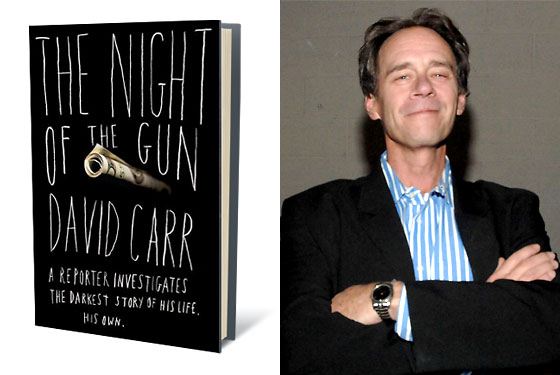
Our pasts are more fungible than we would ever imagine — Surely heightened by an ugly past of addiction and violence, the New York Times columnist had created a very different memory than what, it turned out actually happened. By reporting his own life, he found, indeed, he was the one that had the gun that night (story shared in video below), in addition to quite a few other stories about violence he said he couldn’t have imagined. Most might not have that kind of extreme, but his reporting his life story does bring up an interesting reality.
Stories are all about marketing — How you tell your story or another’s has everything to do with perception and direction and angle. As Carr wrote, and others took interest in, his story could either be a tidy tale of a father overcoming drugs and welfare to take custody of his twin girls, or abusive addict escaping his mistakes and misdeeds for the height of professional success. …You might have a very different take on those actually very similar stories.
I’ve been invited to the Hardly. Strictly. Young. conference on alternative ways to implement Knight Foundation recommendations at the Reynolds Journalism Institute at the University of Missouri [More on that later]. One of the fun precursors to the two-day event later this month has been participating in the Journalism Carnival of blogging, shepherded by conference organizer, Spot.Us founder and leather jacket-wearer David Cohn.
Fortunately, in being late, I can point to others who already did it better than I would. No, Cohn, this isn’t a cop out, this is cutting my losses. The undercurrent on both of these questions for me is that I’m not worried about the craft as much as I’m worried about sustaining the craft.