
The entrepreneur-boosters of Boulder were always adept at packaging their story.
Over my years organizing while reporting on startup communities in the U.S. mid-Atlantic via the news org I founded Technical.ly, I understood a cohort of entrepreneurs and investors told a compelling story for their swath of Colorado. They packaged processes (an ever-evolving accelerator program called Techstars) and developed an outsized stream of software companies, alongside that state’s evolving economy.
Among the messages coming from their work that I personally believe in: “Quantity based approaches operate on the assumption that averages, not outliers, drive system value. That is incorrect.”
A “more of everything approach doesn’t work. Instead, an economy that is more accessible and dynamic requires a complex system of overlapping networks that rewards emergence and expects low probability events that have outsized reruns. The trouble is that economies and local policies are typically run by people motivated by linear progress.
That message is neatly described and navigated in The Startup Community Way, a 2020 revision with researcher Ian Hathaway of a 2012 book initially written by Brad Feld, an investor-organizer most associated with that Boulder, Colorado startup community and Techstars. Feld’s initial book became a common starting place for “entrepreneur ecosystem builders,” and he is a prolific writer and speaker, introducing and crediting himself with concepts, including the phrase “startup communities.”
This edition is the right place to start, and I enjoyed it. Given Colorado’s statewide economic story in the Mountain West, and Feld’s position, this book has particular authority and insight. Keeping with his “give back” mentality, working with many hands, the book includes a dozen or so page-length essays from contributors and longtime collaborators across the United States. Hathaway injects the growing research on the importance of entrepreneurship.
Their success lifts a tide that helps many boats, including places and subjects important to my work. I thank them for it. As per usual, outside my own journalism and organizing, here on my personal blog, below I share my notes for future reference from a book I enjoyed.
Boulder thesis in his 2012 book
Entrepreneurs must lead the startup community
The leaders must have long-term commit commitment (now always 20 years or more)
The startup community must be inclusive of anyone who wants to participate in it
The startup community must have continual activities that engage the entire entrepreneurial stack
My notes:
- Leaders and feeders
- What was changing in 2012: Great Recession, digital (fast internet, smartphones and cloud); low interest rates and entrepreneurship interest (Obama Startup America)
- The lesson wasn’t that a place has to look like Boulder to do this but that the approach that worked in Boulder could work elsewhere
- “Complex adaptive systems” cannot be fully controlled; or understood. Must be viewed holistically, focused on interactions
- “Progress is uneven, slow and surprising”
His rules:
- Entrepreneurs must lead the startup community.
- The leaders must have a long-term commitment.
- Startup communities are complex adaptive systems that emerge from the interaction of the participants.
- Startup communities can be guided and influenced, but not controlled.
- Each startup community is unique and cannot be replicated.
- Startup communities are organized through networks of trust, not hierarchies.
- The startup community must be inclusive of anyone who wants to participate.
- Openness, support, and collaboration are critical behaviors in a startup community.
- The startup community must have continual activities that meaningfully engage the entire entrepreneurial stack.
- Startup communities must avoid the trap of letting demand for measurement drive flawed strategies.
- Putting founders first, giving before you get, and having an intense love of place are essential values in a startup community.
- Startup communities are propelled by entrepreneurial success and the recycling of those resources back into the next generation.
- The best startup communities are interconnected with other startup communities.
- The primary purpose of a startup community is to help entrepreneurs succeed.
Other notes:
- Quotes Steve Blank: “A startup is a temporary organization formed to search for a repeatable and scalable business model”
- Brad Feld with Sean Wise wrote In Startup Opportunities that the differences between local businesses (SMEs) and high-growth startups are based on their focus, growth rate, and ambition, specifically noting that while both are entrepreneurial endeavors, they are rarely the same thing.
- “Entrepreneurs are essential for converting knowledge into economic value, as they act on opportunities that others failed to see, or are unable to execute on”
- Authors call AnnaLee Saxenian’s 1996 Regional Advantage “probably the most important writing in the modern era on what makes a particular region consistently more innovative and entrepreneurial than another”= Networks (Valley) over hierarchies (Boston)
- Dense co location lowers transaction costs and improves matching; and results in knowledge spillover
- Agglomeration effects (which date to at least the 1890s and Alfred Marshall)
- There’s a high decay rate for knowledge sharing over distances
- Knowledge sharing in software industry within 1 miles is 10 times greater than 2-5 miles
- Maryanne Feldman: Chance for unexpected outcomes drops with distance
- Smokestack chasing economic development: Amazon HQ2 and Wisconsin for Foxconn
- Richard Florida’s network effect
- Endeavor research on quality of place: entrepreneurs choose quality of life factors and personal connections before their business starts
- In Ross Baird’s 2009 book Innovation Blind Spot, Former Colorado Governor John Hickenlooper and author Ross Baird discuss “topophilia”—defined as “love of place”—as a vital antidote to the “innovation blind spot”.
- Nicholas Colin of The Family holdings: ecosystems need knowledge, capital and “ spirit of rebellion”
- Ben Wiener told New Zealand: instead of investing in 200 startups, first invest in 200 rock bands
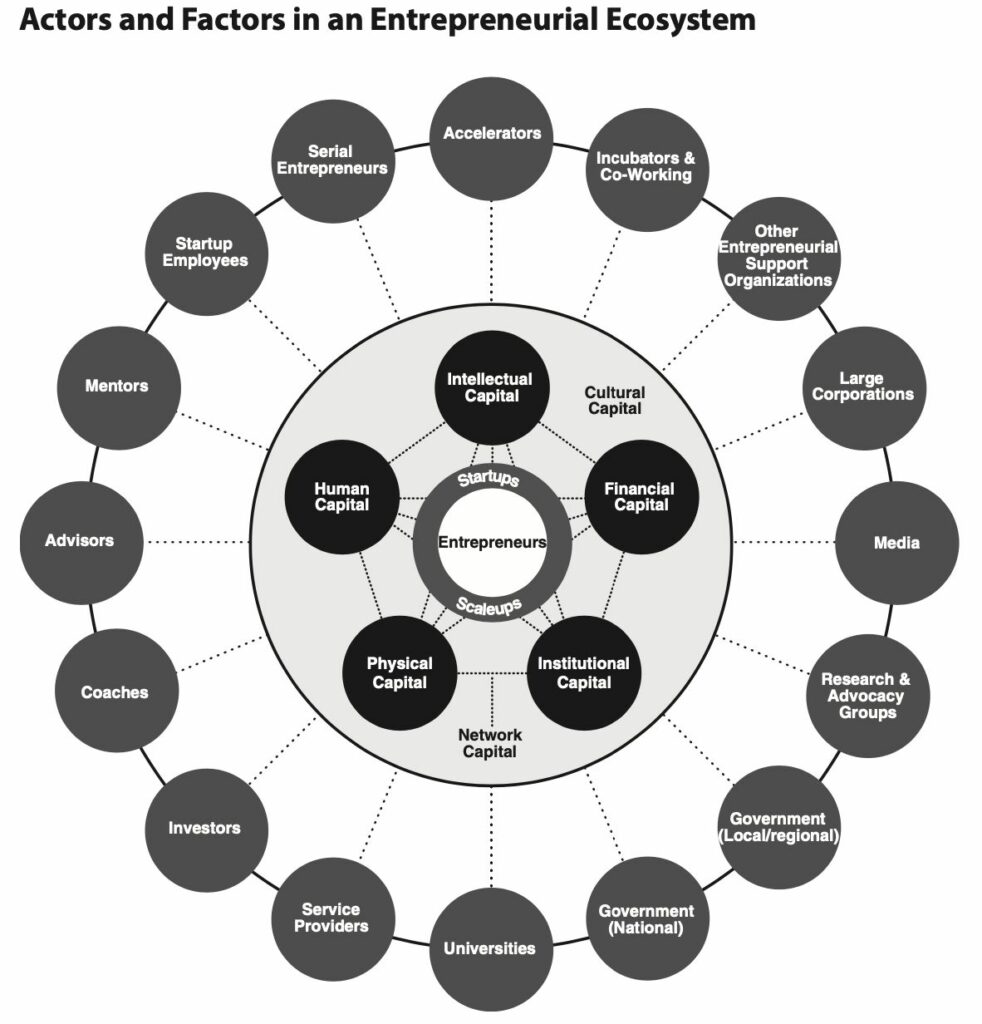
- Its actors and factors in an ecosystem
- Actors: leaders, feeders, instigators
- “A healthy startup community is a densely connected, open, trusting network were the most influential notes of the network are entrepreneurs”
- His “Give First” model
- Authors shoutout “entrepreneurial support orgs” (ESOs)
- Investor Arlan Hamilton contributes a callout about her firm
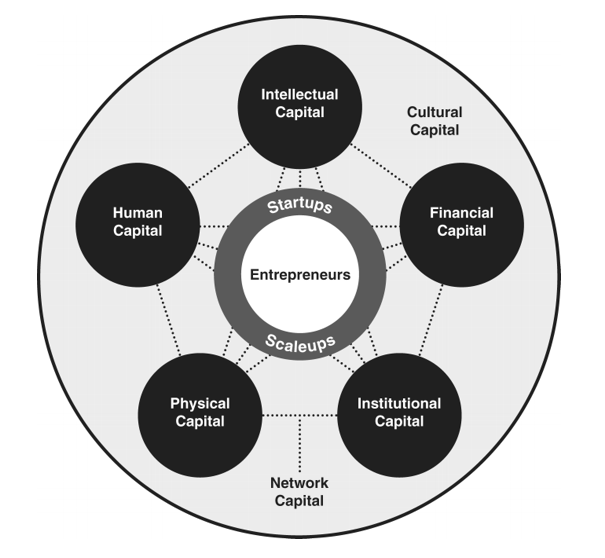
Their Seven capitals in “the factors”
- Intellectual capital: ideas, information, technologies, stories, educational activities
- Human capital: talent, knowledge, skills, experience, diversity
- Financial capital: revenue, debt, equity, or grant financing
- Network capital: connectedness, relationships, bondedness
- Cultural capital: attitudes, mindset, behaviors, history, inclusive-ness, love of place
- Physical capital: density, quality of place, fluidity, infrastructure
- Institutional capital: system of laws, functioning public sector, markets, stability
More notes:
- “ Storytelling should go far beyond cheerleading, with a focus on learning in the startup community”
- Startland News founder Bobby Burch also. contributes an essay: Says their “primary investors” were Becky and Mike Wrenn, and Kauffman Foundation (“stories are the fuel”, and for their success, he cites 16 jobs placed from their job board and driving others media coverage, and one story of an investor joining a startup’s seed round.
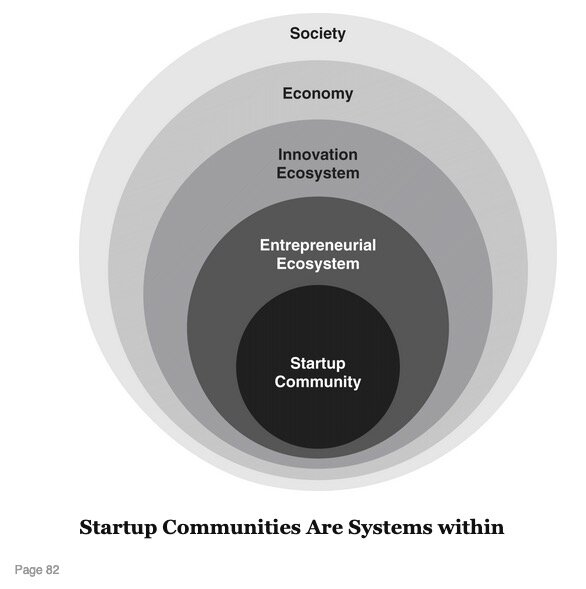
- Startup communities (shared narrative and identity) and entrepreneurial ecosystems relate but are different: “the startup community is the beating heart of entrepreneurship in a city and sits at the core of an entrepreneurial ecosystem”
- Johannes M. Pennings, in his 1982 paper “The Urban Quality of Life and Entrepreneurship” (published in the Academy of Management Journal), argues that entrepreneurial success in a particular place is heavily influenced by environmental factors that are “beyond the realm” or control of the individual entrepreneurs.
- Business ecosystem metaphor grew into this narrower use
- Daniel Isenberg at Babson and other academics used “ecosystem” for entrepreneurship
- “Like an ecological system, a system of entrepreneurship is adaptive, interconnected and importantly, highly localized. It is self organizing, self-governing, and self-sustaining.”
Notes continued:
- Community/ecosystem fit like product market fit
- Rick Nason’s 2017 book It’s Not Complicated distinguishes between complexity and complicated: making coffee (simple), financial reports (complicated) and sales call (complex) examples
- Warren Weaver compex systems have emergence
- Eric von Hippel (Brad feld PhD adviser at MIT) : user driven innovation
- Self organizing and dense
- Rick Turoczy of PIE (Portland Incubator Experiment) essay
- Madison, Wisconsin’s Startup Blocks founder Scott Resnick essay
- Since startup communities are nonlinear and complex, increasing actors (investors) and factors (programs) won’t necessarily get more outputs (startups) and outcomes (jobs and exits)
- “Quantity based approaches operate on the assumption that averages, not outliers, drive system value. That is incorrect.” (More of Everything approach doesn’t work)
- Hwang and Horowitt book The Rainforest: “Attempts to foster in innovation that do not focus on changing human behavior are doomed to fail”
- Entrepreneurial recycling
- Chris Schroeder 2013 book Startup Rising describes “wasta” culture in the Middle East
- Maryann Feldman and Ted Zoller deal makers better predict outcomes than investors
- “The quality of the network is more important than the size of it”
- Hwang/Horowitz call these people “keystones”
- Israel-focused Start-up Nation. 2009 book by Dan Senor and Saul Singer: bitzu’ist is an active pragmatist (same as keystone)
- Scott Dorsey exact target
- Be feeders not gatekeepers; let go and avoid being a single node (familiar concept)
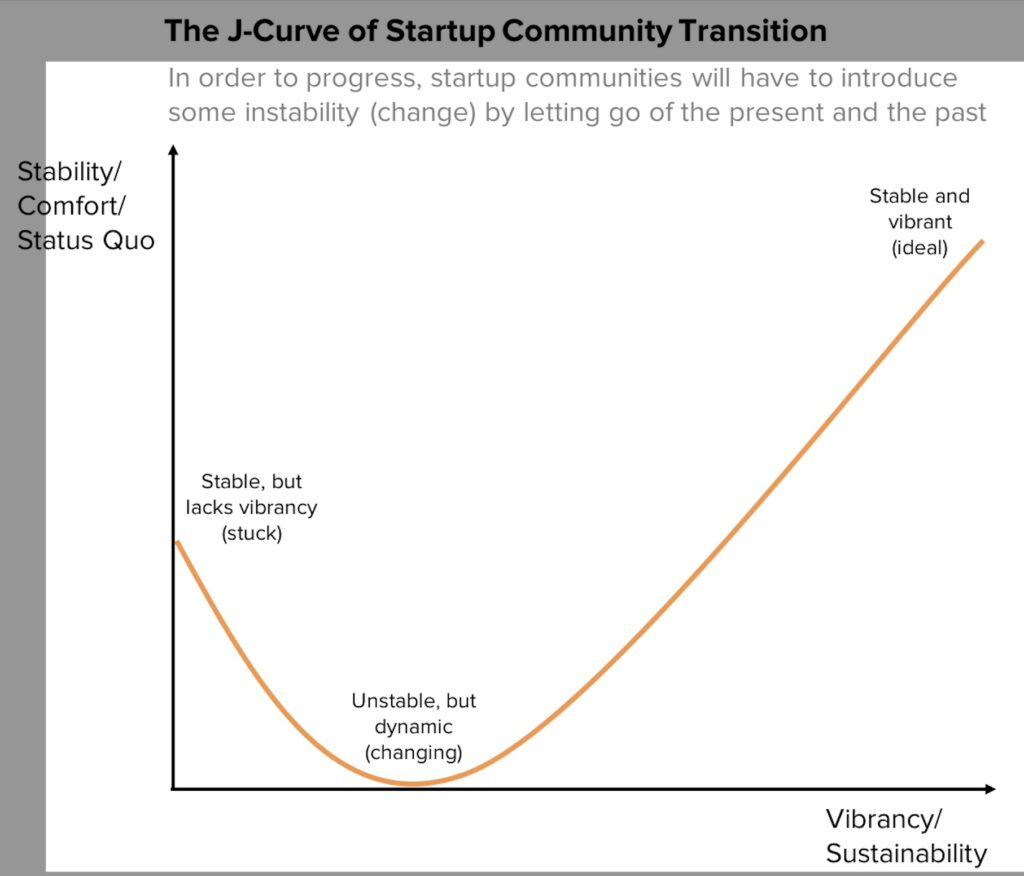
- In 2012, Antifragile: Things That Gain from Disorder by Nassim Nicholas Taleb introduces the concept of “antifragility,” a quality beyond robustness where things benefit from stress, volatility, and disorder, much like bones get stronger from stress.
- “Basins of attraction” that cause lock-in effect
- We assign meaning to complex systems (Kahneman: what you see is all there is)
- Taleb’s black swan: even after the big event we don’t entirely understand them but we create narrative around them
- “The measurement trap”
- Simon Caulkin: “ what gets measured gets managed – even when it’s pointless to measure and manage it, and even if it harms the purpose of the organization to do so”
- Ecosystem mapping is useful, they argue
Notes continued:
- Use data and mapping and surveys in service of gathering support for entrepreneurship
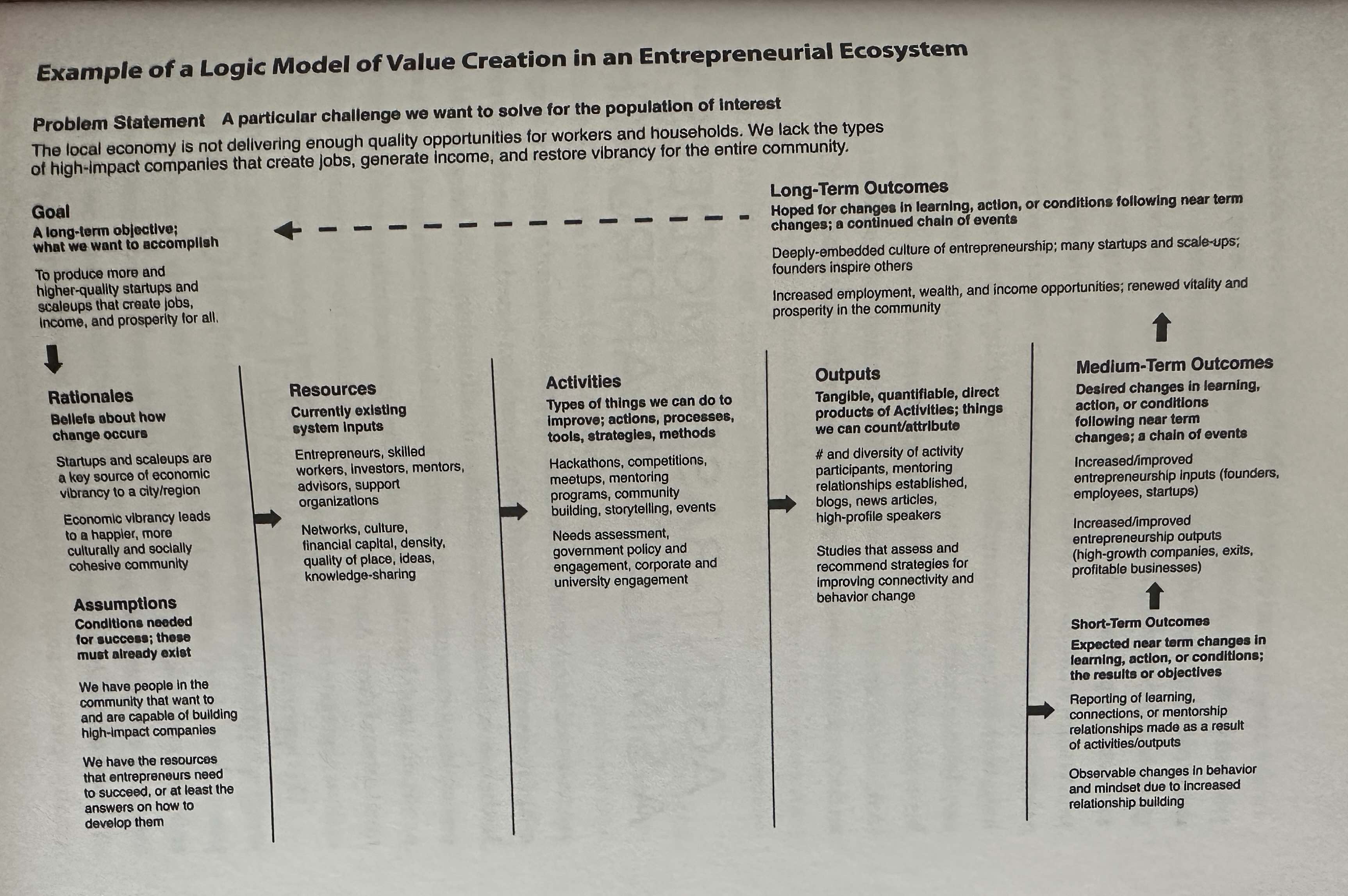
- They share a logic model for entrepreneurial ecosystems, and there are oodles of others online (And research on their role in developing strategy)
- Job tracking is nearly impossible so if /then logic models is one way to defend entrepreneurship
- another way is “agent based” models
- Nobel laureate Thomas Schelling demonstrated that even mild, individual preferences for neighbors of the same race can cause extreme residential segregation. His “chessboard model” shows that when residents move to avoid being in the minority, this tiny action creates a “tipping point,” turning integrated neighborhoods into segregated ones. (Authors: Can this go in reverse?)
- [[I am reminded that Feld’s “Boulder thesis” was among the “ecosystem models” put on display in June 2025 at the Global Entrepreneurship Congress held in Indianapolis. See below.
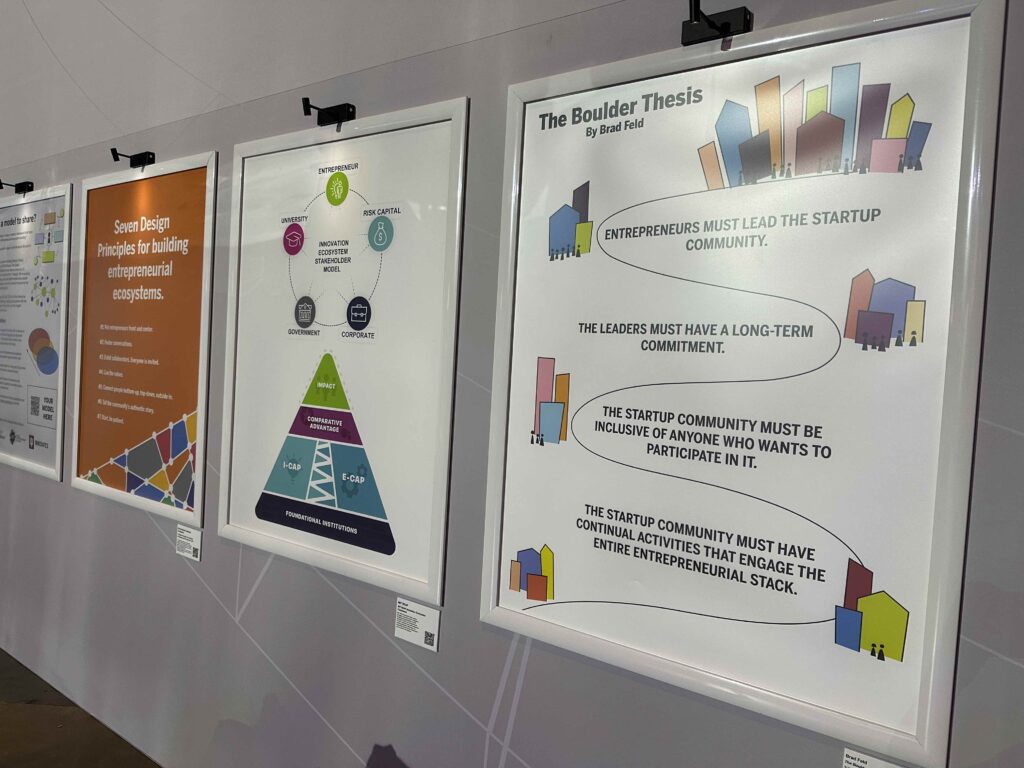
- Author says “Boulder thesis” and “the rainforest” are “the only significant frameworks on the subject of entrepreneurial ecisystems” from founders and ecosystem builders — and very different than economic development
- In 1990 Peter Senge’s“Fifth discipline” on systems thinking introduced the now-ubiquitous iceberg metaphor. (My note: Though the “theory of omission” is credited with Hemingway, and Freud used the metaphor and many others to boot)
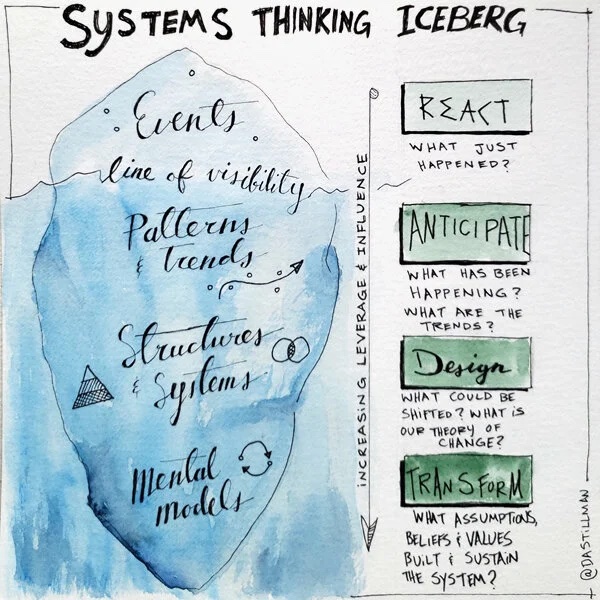
- Jay Wright Forrester’s leverage points
- Authors simplify Donella Meadows leverage points down to four of increasing difficult and impact: physical lever (resources); information lever (data and insight); social lever (systems and rules); conscious lever (culture and values)
- “The bitter founder problem”
- Advisor has economic tie to company; mentor doesn’t
- “Think in generations”
- My friend Chris Heivily is mentioned, contributes essay on development of the Research Triangle brand
- Scott Page’s research: diversity outperform talent (diversity bonus)