Apple and Amazon are valued by public markets far in excess of their tangible assets, because of their “intangibles” in R&D and brand recognition. By historic standards, they own very little.
In contrast, AerCap and Prologis are among the world’s largest owners of the “means of production.” One leases aircraft to most large airlines. The other is the world’s largest industrial real estate company, leasing warehouses and data centers. They own the stuff.
Both “are nevertheless rather unimportant intermediaries in the modern economy” that now reflect “a long chain of intermediation” that means the system is more distributed. Yet our view and language about how companies fit into our world hasn’t changed.
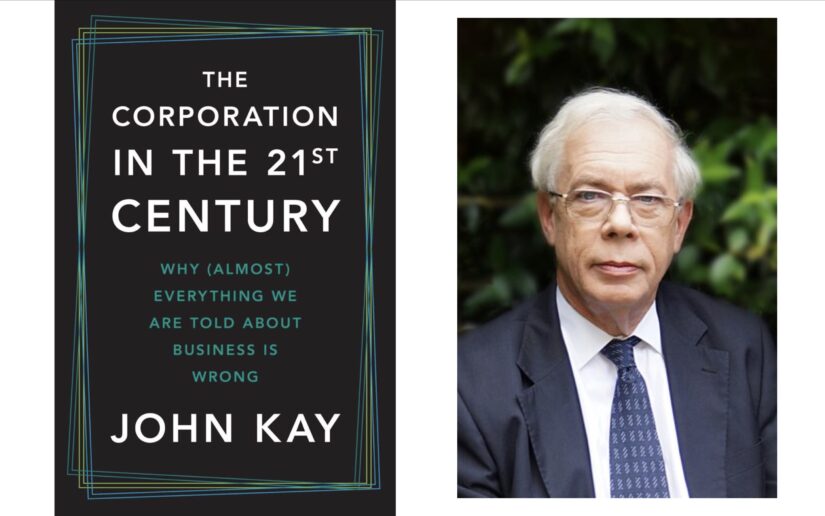
That’s from The Corporation in the Twenty-First Century: Why (Almost) Everything We Are Told About Business Is Wrong, a 2024 book by knighted economist John Kay.
The old industrial meaning of “capital” meant the owned means of production — mills, railways, steel plants, assembly lines. In many modern firms, Kay argues, those assets are fungible, often rented, and less important than the firm’s collective capabilities.
Among his criticisms is how today’s shareholder priority has distracted from the corporation’s origins as a device of the state. Executives can extract value in the short term, but this narrow-mindedness is provably harmful to corporations in the medium term. Business and economics thought has become far too self interested. Its champions treat “collective action” and “collective knowledge” as accidental overflow rather than our truly natural state. The book is thoughtful and important, given that its from among its closest insiders.
Below I have my notes for future reference.
My notes:
- Alfred Chandler’s 1962 Strategy and Structure: Chapters in the History of the Industrial Enterprise: only Exxon Mobil (Standard Oil) remains influential and even that faces energy transition.
- “The workers are the means of production” for the FAANG and Mag 7
- Firms don’t necessarily own their means of production (buildings, data centers), but instead specialize by managing “collective Intelligence of people.” Business has changed but our language for it hasn’t
- “No one knows everything about anything or much about everything“
- What we call profit is now “economic rent”, monopoles from “being their impressively differentiated selves”
- “Promote the rents that arise from innovative differentiation and eliminate ones that are the result of the abuse of political institutions“
- “Economic advance” occurs when people organize to do better. If that’s capitalism then fine but instead this is a “market economy” “pluralist economy” wherein people try things without a central authority
- Capitalism was used to describe a bourgeois elite but the term is still being derided though more pluralistic
- “Today the public hates the producers even as it laps up the products”
- The Modern Corporation and Private Property, by Adolf A. Berle and Gardiner Means (1932): robber baron transition to managerial class
- Drucker’s concept of the corporation made him famous though Sloan didn’t like it —- invented the modern business book
- Stakeholder Capitalism versus shareholder, which has shifted short term gain to eroding support and even long term profit
- Drug regulation began in 1906: Bayer trademarked Aspirin In 1899, which cwas then confiscated by British and Americans in World War I — this regulation brought down worst excesses of snake oil and elixirs
- Fleming’s penicillin discovery in 1928 was ignored for a decade and then found to have commercial value too, jumpstarting innovation, commerce and science
- George Merck: “we try never to forget that medicine is for the people. It is not for the profits.”
- In 1987, Merck & Co. committed to donating Mectizan (ivermectin) free of charge, for as long as needed, to eliminate river blindness (onchocerciasis) in sub-Saharan Africa and other endemic regions — and was featured in Jim Collins’s 1994 book Built to Last. By 2000 the Merck CEO Ray Gilmartin said in an annual letter “As a company, Merck is totally focused on growth,” and subsequently was revisited in Collins’s 2009 book How the Mighty Fall
- Alec Burlakoff, former Vice President of Sales at Insys Therapeutics, pleaded guilty to racketeering conspiracy for his role in a scheme to bribe physicians into prescribing a fentanyl-based spray (Subsys) to non-terminal patients to boost sales. The marketing tactics included hiring former strippers as sales representatives. He told the Financial Times he did not have “morals, ethics and values”
- Muzafer Sherif’s iconic 1954 Robber’s Cave experiment in Oklahoma involving teenage boy rivalry at camp: we create in-groups by way of out-groups (affective polarization) — because we do more as organizations than individuals
- Mihaly Csikszentmihalyi (1934–2021) was a Hungarian-American psychologist known as the “father of flow,” a concept describing a state of complete immersion, deep concentration, and enjoyment in an activity: more people get that from work than personal, but frequently overlook the “flow state’ they get into, though it drives why many stay in work they otherwise complain about socially (complete engagement in a task)
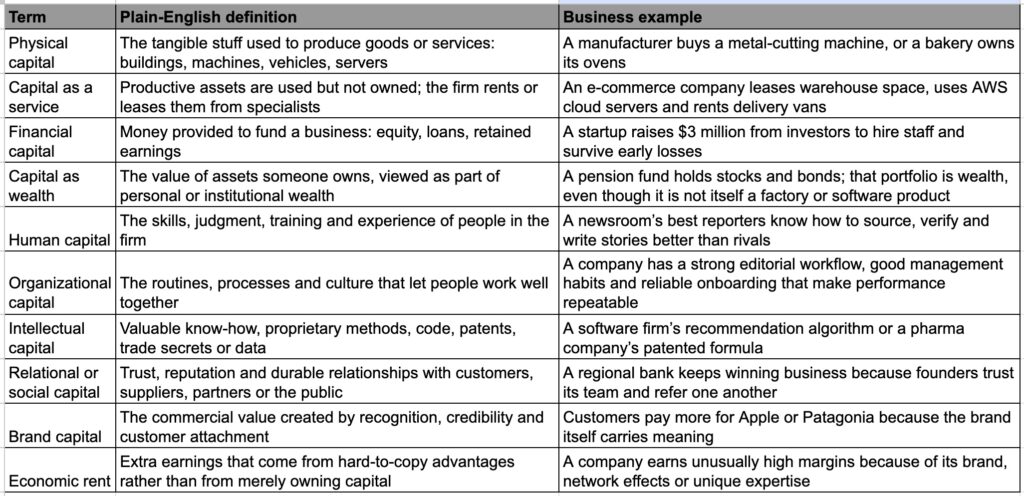
- Many uses of the term “capital” today, author says repeatedly. (I made the chart below)
- Rawls’ A Theory of Justice proposes that rational actors under a “veil of ignorance” would choose principles guaranteeing equal basic liberties and maximizing the well-being of the least advantaged (difference principle). Conversely, Nozick’s Anarchy, State, and Utopia argues for an “entitlement theory,” where any distribution arising from “just acquisition” or voluntary transfer is just, strictly limiting the state to protecting property rights.
- Michael C. Jensen and William H. Meckling’s 1976 paper, “Theory of the Firm: Managerial Behavior, Agency Costs and Ownership Structure,” is one of the most cited academic business articles of all time, with estimates exceeding 100,000 citations. It revolutionized the understanding of business organizations by challenging the view of the firm as a single, unified entity maximizing profit. Instead, they proposed that the firm is a “nexus of contracts” (or nexus of contracting relationships)
- Oxford Law Blogs a nexus of contracts tethering people together
- Author’s 1993 book Foundations of Corporate Success was sympathetic to this “nexus of contracts” argument but author says he didn’t realize then that others assumed those relationships were transactional rather than social
- “By excessive emphasis on the transactional nature of business relations, we have undermined not only the relationship between business and society but also the effectiveness of business, even in transactional terms”
- Solow: “If God wanted more than two factors of production he would have made it easier for us to draw three dimensional diagrams.”
- Philip Wicksteed (1894) introduced the foundational economics concept that the factors of production are capital and labor. Later Alfred Marshall added “land” as a third factor (though that gets debated)
- The Cobb-Douglas production function is the most common model used in economics to represent the relationship between output and inputs—typically labor and capital. Developed by Charles Cobb and Paul Douglas, it is popular because of its simplicity, ease of estimation, and ability to model constant returns to scale
- John Hicks, Roy Harrod and then Solow: technology could change production function and later Paul Romer argued technical change wasn’t “manna from heaven” but was “endogenous” the result of prior investment
- Frederick Taylor developed scientific management (or “Taylorism”) primarily through observations at Pennsylvania steel factories in the late 19th century. Working at Midvale Steel (in Philadelphia’s Nicetown neighborhood) and later Bethlehem Steel, Taylor used stopwatches to conduct time-and-motion studies, replacing “rule-of-thumb” methods with standardized, efficient tasks that maximized productivity
- “This transactional account of business is not just repellent, but mistaken. It does not describe how successful business works -or could work – in the modern society.”
- Carron Works and John Kay inventions enjoyed widespread copying and little trade protection: their ideas spread but they did not get rich
- Francis Cabot Lowell (1775–1817) is a pivotal figure in the American Industrial Revolution, known for his industrial espionage trip to Great Britain in 1810–1811, where he memorized the designs of advanced textile machinery to circumvent strict British export bans.
- Katrine Marcal: Adam Smith didn’t only get his dinner because of the butcher’s self love — but also because his mother prepared it and put it on his plate (Adam lived with her)
- In 1775, inventor James Watt partnered with manufacturer Matthew Boulton, who provided the necessary capital and business expertise to commercialize Watt’s improved steam engine. Based in Birmingham, the Boulton & Watt firm revolutionized industry by creating efficient engines, moving beyond mining to power factories, mills, and expanding the Industrial Revolution.
- Karl Marx described the enclosure of common land as a violent “primitive accumulation” process that effectively functioned as theft, ripping away the means of production from peasants to create a landless working class. This historical process,, which began in the late 15th century and intensified later, transformed shared agricultural land into private property, forcing millions into wage labor.
- Carron Ironworks was a canonical example: Feudal agricultural wealth was used to fund an emerging technology (an iron works), fed by the tripartite of deploying personal wealth, the ownership of the plant and machinery and the exercise of managerial authority over workers (and controlling the distribution of the value added by the enterprise)
- The city of London corporation got a charter from William the conqueror in 1067 but had already existed dating to at least Edward te confessor (given a royal monopoly to manage services)
- Company a group of people, corporation got some legal status
- The President and Fellows of Harvard College, known as the Harvard Corporation, was chartered on May 30/June 9, 1650, by the Massachusetts Bay General Court, making it the oldest corporation in the Western Hemisphere. It serves as the primary governing board for Harvard University, managing its assets and operations.
- Following the era of the South Sea Bubble (1720), the Mississippi Company fallout (1720), and the subsequent Railway Mania (1840s), British legislation finally introduced a,,straightforward, system of incorporation with limited liability that did not require a Royal Charter or a special Act of Parliament. (France and several US states had already done so)
- The Economist’s Walter Bagheot’s term “lender of last resort”
- The phrase “This time is different” is famously cited by Sir John Templeton as the “four most dangerous words in investing”. In contrast after the Lehman Brothers collapsed in 2008, former CEO Dick Fuld founded a new firm, Matrix Advisors, a private wealth management firm, around 2009–2010. Fuld reportedly hung a framed print in his new office with the message: “That Was Then This Is Now”.
- EU public interest entity (though little meaning)
- Marketable securities and maturity transformation acted as crucial financial “inventions” that unlocked the massive capital needed for the Industrial Revolution, railroads, and infrastructure development. By transforming localized, illiquid savings into liquid, tradable investments, these financial innovations enabled railroads to scale rapidly—from 23 miles of track in 1830 to over 30,000 miles in 1860—and facilitated the creation of a national market by linking regional economies.
- The American Gilded Age was defined by the robber barrons of John Rockefeller in oil, Cornelius Vanderbilt in railroads, Andrew Carnegie in Steel and James Duke in tobacco — who consolidated their industries buying up competitors to create monopoly, financed by EH Herman and J Gould
- British nationalization program of 1940s was for consolidation more than public control, author writes, but the three principal achievements of IRC were consolidating cars (British Leyland), computing (ICL) and electrical (General Electric Company) — domestic scale rather than international competition. All failed
- “Large organizations develop entrenched interest which inhibit the development of collective intelligence and the adoption of new business methods in innovative products.” Microsoft not IBM for laptops, Apple not AT&T for smartphones, tesla not gm for electric vehicles
- Boethius in 524 while awaiting execution: “All fortune is good fortune; for it either rewards, disciplines, amends, or punishes, and so is either useful or just.”
- In October 1988, Alan Greenspan articulated that the “weight” of GDP was declining, referring to a fundamental structural shift in the economy.
- See below the author’s table of “new product” by price per kg, like Carronade cannon
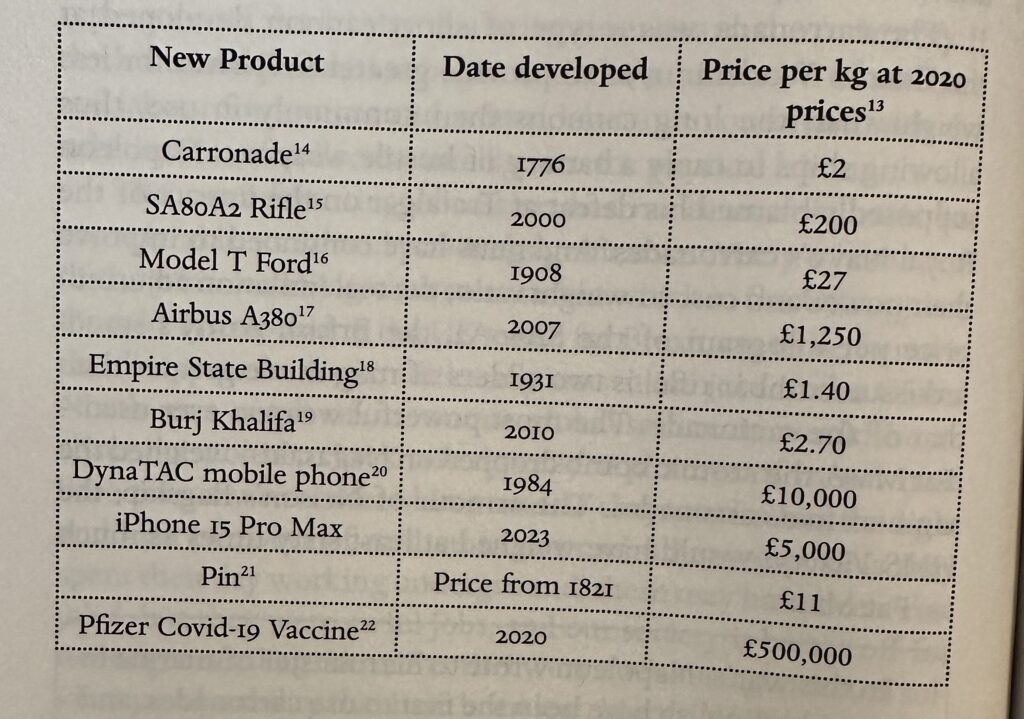
- Counter to degrowth, our rich global north economy is now tied to better-quality products, not more
- William Nordhaus’s “insufficiently seminal paper” from 1996 showing the cost of light over millennia
- “All physical resources have finite limits but human ingenuity does not”
- “Humans have become better at almost everything as a result of the steady creation of collective knowledge, and it’s transformation into collective intelligence”
- Cognitive Gadgets: The Cultural Evolution of Thinking (2018) by Cecilia Heyes argues that distinctively human cognitive abilities like language, theory of mind, and imitation are not innate instincts but “cognitive gadgets” built by cultural evolution, not just genes
- Joseph Henrich: collective intelligence is the “secret of our success” as a species (social learning)
- Accumulation of knowledge by scientists made into collective intelligence by engineers , “business people” combine technical capabilities with organizational capabilities
- The idea of a “learning curve” comes from Adam Smith in his supposed pin factory; “experience curve” is documented in manufacturing — it gets easier to produce with collective experience
- In his 2004 book The Wisdom of Crowds, James Surowiecki uses Francis Galton’s 1906 ox-weight competition to demonstrate that collective intelligence often outperforms individuals. When 787 people guessed the weight of an ox, the median guess was within 1% of the actual
- weight. This highlights that diverse, independent inputs, when averaged, cancel out individual errors
- Benjamin Graham’s famous analogy states that in the short run, the market is a voting machine (driven by emotion, popularity, and sentiment), but in the long run, it is a weighing machine (reflecting fundamental intrinsic value, earnings, and assets). This concept emphasizes patience, ignoring volatility, and focusing on long-term value over popular opinion.
- Irving Fisher (not Thomas Carlyle) in 1907 writes: “Catch a parrot and teach him to say supply and demand, and you have an excellent economist”
- he debate over whether value is shaped by utility (consumer desire) or cost of production (labor input) is a fundamental divide between classical and modern economics. The Labor Theory of Value (LTV), developed by thinkers like Smith, Ricardo, and Marx, proposes that the value of a commodity is determined by the socially necessary labor time spent producing it.
- Adam Smith’s diamond-water paradox highlights that essential goods (water) are cheap, while non-essential luxury items (diamonds) are expensive. He distinguished between use value (utility) and exchange value (price), noting water has high utility but low price, while diamonds have low utility but high price. This was later resolved by marginal utility
- Jevons (1863), Carl Menger (1871) and Leon Walras (1874) combined subjective perception (desireable) and objective effort (scarce) of a product, and the average and margin value (first liter of water is priceless, but the extra liter for your shower has lower value)
- Elizabeth Anderson and Michael Sandel write critically of how transactional nature destroys social relationships — but little doubt that “value is the joint product of utility and cost”
- “In a market economy, price is a source of information about values and costs.”
- Incentive compatibility: consumers ask “does the value to me of this good or service exceed the price,” whereas producers ask themselves “is the cost to me of providing this good service less than the market price?” Together they meet on price if the product is to sustain
- Whatever “should the cost of a rare pharmaceutical be,” and “who should pay” are different questions
- Professor Colin Mayer: companies that should solve social problems instead are indifferent to creating them
- Alfred Marshall (1842-1924) “scissors” analogy explains that price is determined by the intersection of supply (cost of production) and demand (consumer utility). Neither blade works alone; cost determines the minimum price in the long run, while utility determines the maximum price consumers will pay
- “The rationale of economic activities is to add value: to create utility in excess of cost” and economic rent is the difference
- James Anderson and David Ricardo: “outside the margin of cultivation “ — poorly fertile land or even an aspiring athlete not good enough to invest in
- The biggest companies were once big in all ways — employees, assets, revenue. But now these things are not linked. Apple and Amazon do not have the most employees or assets
- “The division of rents and the extent of the market before the land of Scotland was enclosed, there were significant differences between the earnings of the fortunate peasants who tilled the fertile soil of the common land of East Lothian and those less lucky tillers of soil who worked the barren land by the Clyde. Enclosure enabled landowners to appropriate for their own benefit the superior returns from superior land, the phenomenon Anderson and Ricardo observed at the end of the eighteenth century. The development of canals and then railways, which tended to equalise grain prices in the two regions, benefited workers in the west, who enjoyed cheaper grain, and landowners in the east, who encountered increased demand for their produce. These gains were secured at the (lesser) expense of workers in the east, who experienced a rise in food costs but did not earn commensurately higher wages, and land land owners in the west, whose crops were no longer in such scare supply. Lesser expense because the relative expansion of production on the fertile lands of the east made Scottish agriculture as a whole more efficient. This process is an early example of globalization at work, and a precursor of the changes, and re-distribution of income incomes, that leader globalization would bring. The greater the extent of the market, the greater the rents accruing to those who still have distinctive capabilities in the larger market.”
- JK Galbraith: countervailing power and corporate hold
- Charles Reich’s 1970 bestseller, The Greening of America, famously argued that the 1960s counterculture (“Consciousness III”) was an “unstoppable force” that would inevitably transform the United States into a more humane, non-materialistic society without violence— it wasn’t
- Friedman’s NYTM shareholder responsibility essay that same year emblematic of the push back
- THe. 19731 Powell memo was similar to Friedman, if more balanced (supported education as a worthwhile investment)
- Rudi Dutschke’s “long march through the institutions” (langsamer Marsch durch die Institutionen) is a 1960s strategy calling on New Left radicals to transform capitalist society by infiltrating and changing key institutions—universities, media, education, and unions—from within, rather than through violent revolution.
- While UL and USA went rightward, politically, in the 1980s, Mitterrand took France toward last major gasp of socialism
- Ronald Coase’s theory of the firm explains that firms emerge to minimize transaction costs—such as searching for suppliers, negotiating contracts, and enforcement—that exist when using the open market. Instead of relying on external market contracts for every exchange, firms use internal hierarchical coordination (fiat) to direct resources efficiently, expanding until the cost of internal organization equals the cost of market transactions.
- Coase credited Ely Devon’s saying that if economists studied horses they’d sit in their studies and say to themselves “why would I do if I were a horse”
- Igor Ansoff at CMU took more scientific approach to business than the Harvard case study approach — together they formed modern MBA management
- Michael Porter’s 5 Forces (1979/1980) is an operationalized, manager-friendly translation of the industrial organization Structure-Conduct-Performance (SCP) paradigm. It translates theoretical academic concepts—specifically, that market structure dictates firm behavior and profitability—into a practical tool for analyzing industry attractiveness and competitive positioning.
- Robert Hall: freshwater v saltwater economics
- Jensen and Meckling part of “law and economics” movement , their nexus was heavily transactional (self interested actors, and so no room for collective action and collective knowledge)
- Edmund Burke: “little platoons” were “the first principle of public affections”
- Modern principal-agent problem solutions for the firm has focused on ever more firm oversight (surveillance)
- Short Brothers case: English common law separate shareholder ownership of shares, but not assets of the company
- Pharma researcher James Black: beta blocker and anti ulcer drug gave author the word “obliquity” to describe achieving something while trying to do something else
- In 1973, Sears Roebuck opened its Sears Tower, as Walmart newly publicly traded. Rather than compete with Walmart on international supply chains and inventory management, Sears diversified In real estate, financial services, insurance (Allstate) and credit cards (Discover). They failed.
- Alfred Sloan transition to Jack Welch: wide range of stakeholders down to shareholder capitalism: this worked throughout the early 1990s, by primarily extracting value created by those before (in 1995, Sears, ICI, GE and GEC would have been considered safe choices but their financial services focus eventually flopped) . They leveraged trust from the past and possible earnings in the future to squeeze out profit in the short term while ignoring longterm threats and weaknesses
- Fast moving consumer goods (FMCG ) like Coca Cola and Nestle and Unilever were more responsive to customers and led by marketers who kept adapting and survived
- “Few 21st century corporations can be run as traditional hierarchies,” he wrote: “Stakeholders mostly deal with each other in the context of ongoing relationships rather than formal contracts.”
- Alfred Marshall: “Great are the advantages which people following the same skilled trade get from near neighborhood to one another.”
- Land once mattered for raw materials and weather, now “land is valuable because it offers proximity to commercially valuable collective intelligence”
- “Modern firm is a community rather than an office or a factory. It is defined not by its plant and machinery, but by its capabilities. The successful businesses characterized by the distinctive nature of its collection of capabilities and the match between these capabilities and the needs if it’s a customers – and other stakeholders.”
- “The claim that George W. Bush told Tony Blair that ‘the problem with the French is that they don’t have a word for entrepreneur’ is, sadly, apocryphal.’ But the French origin of the word is revealing- from entre, between’, and preneur, ‘taker’. The original meaning of the term ‘entrepreneur’ describes a coordinator, someone who brings things together. Modern American usage represents the entrepreneur as a heroic individual who sees what others do not and takes bold risks. While there is some truth in such a description, it understates the essential cooperative and evolutionary character of economic progress. The business founders we identify as legendary modern entrepreneurs – Jeff Bezos, Bill Gates, Steve Jobs – rode the wave of evolving collective intelligence. Online retailing and the personal computer revolution would have happened even if Bezos, Gates and Jobs had never been born. These developments occurred around the end of the twentieth century because all the necessary Pieces of collective knowledge and collective intelligence were then developed. These individuals and their associates pieced together relevant capabilities. When innovative firms succeed, as Amazon, Microsoft and Apple did but most new firms do not, it is because of the distinctive character of the capabilities of their organisation and the combinations they put together.”
- Schumpeter’s creative destruction: “it is the carrying out of new combinations that constitutes the entrepreneur”
- Edith Penrose (once of Johns Hopkins University) wrote in 1959 of the boundaries of the firm and its limits to growth: the firms limits are of its capabilities and its ability to deploy those capabilities In productive services (resource based theory of the firm)
- David Teece: dynamic capabilities
- Taylor’s manufacturing and industrial firms looked similar (machines), but now the same firms in the same industry operate differently because of people
- Both the East India Company (EIC) and the Great Western Railway (GWR) implemented strict, hierarchical uniforms to project authority and order, mimicking military structures. The EIC, particularly the Bengal Army, mandated uniforms that often surpassed British Army formality, while early GWR (by 1848) and other railways adopted rigid, branded uniforms with specific caps for staff like engine crews and stationmasters.
- Rule based Hierarchy and Weber’s bureaucracy were tended as improvements over the traditional authoritarian and charismatic leaders
- In 1944, OSS (pre CIA) gave advice for internal sabatoge and slowing things down by following the rules
- Meetings are to exchange information and inform a responsible party to make decisions — not to slow things down and distribute blame. Decisions should already be developed before decisions come
- The American losses in Vietnam, Afghanistan and Iraq: “It is hard to imagine a more compelling demonstration that the scale of an organization is less important than the match between the capabilities of the organization and the problems it has asked to solve.”
- Toyota introduced the andon cord, injecting personal responsibility into the hierarchy of GM
- Frederick Thayer 1974: an end to hierarchy
- Andy Grove high output management 1983: especially in high tech power based on knowledge vs title diverges quickly because it evolves
- Margaret Blair and Lynn Stout: modern business is a mediating hierarchy
- Hirschmnan: voice and exit are ways to respond to organizational failure
- Ian MacNeil and Stewart Macaulay (of “law and society” movement, not “law and economics”) wrote contracts are familial in context — continuing an existing relationship which is itself the primary substance
- Joseph Henrich argues that broad social trust—the ability to trust strangers and cooperate within large, impersonal societies—is not a universal human trait, but rather a product of specific cultural shifts that began with the dismantling of intensive kinship networks. His thesis, heavily developed in The WEIRDest People in the World, contends that the Western Catholic Church accidentally triggered this shift beginning in the 4th century by enforcing prohibitions against marrying close relatives, including cousins, and banning polygyny. ((are Americans doing less of that now by class?))
- Archbishop Whately “honesty may be the best policy but he who adopts that policy is not an honest man”
- Max Weber’s Protestant work ethic was religious and turned cultural: Protestant even over Catholic (with culture of indulgences, in modern day Sacklers)
- The GM and fisher auto body case study that every business student gets
- Norman jones in business week in 1986: the “hollow corporation” to describe an outsourcing focus — in contrast to the control of Henry ford and William Morris
- The 1911 Triangle Shirtwaist Factory fire in NYC and the 2012 (not 2015, as the book reports) Tazreen Fashions factory fire in Bangladesh share haunting similarities, as both resulted in massive casualties due to locked emergency exits and poor safety standards, echoing a failure to protect workers a century apart. Over 100 garment workers died in each, highlighting persistent negligence in global apparel supply chains.
- Thomas Friedman’s initial Golden Arches theory (and later Dell theory) said no two countries with McDonald’s would go to war together — finally refuted in 2022 in Russia Ukraine
- “To collect much of the economic rent you need only control the source of your competitive advantage” — William Morris printed its own user manuals, which is different than its core strengths (and therefore distracting)
- Time Warner didn’t need to own AOL to distribute Casablanca, author notes
- Richard Lanois: market supporting institutions (a defining 21st century business modelike the assembly line was of 20th
- “In a modern business capital and labor are purchased services: like accounting and marketing; like electricity and water. It is correct to describe Apple products as the output of the combination of capital and labor, just as it is correct to describe Apple products as the output of the combination of silicone and glass. But these descriptions are of a little help and understanding the organization that is Apple, nor do they explain why people queue to buy its products.”
- “The ingredients list is not the recipe.”
- Famous writing that I referenced earlier on agglomeration effects in these notes but I forget who it is “mysteries of the trade in the air”
- Jonathan Haskel and Stian Westlake 2017 book Capitalism without the Capital: Amazon owns very few things in comparisons to Ford or Cardin Works at peak
- “The shift from the provision of goods to the provision of services was increasingly widespread and often gave both buyer and seller greater predictability of costs and revenues”. Xerox selling the copies not the machine; rent and leasing cars to companies, all predated the Software as service category
- Amazon and Apple haven’t raised money from shareholders since their IPOs: Now “the objective of listing on a stock exchange is not to put money into the business, but to make it possible to take money out of the business”
- Gordon growth model assumed stock prices were built on future dividends — but the shift had been away from dividends and toward rising stock prices
- Karl Marx wrote Engels in 1868 that his mother Henrietta Pressburg would say “If only Karl had made Capital, instead of just writing about it.”
- Capital as wealth vs factor of production
- A.M. Honoré’s 1961 analysis of ownership, often called the “bundle of rights” theory, defines ownership not as a single right, but as a collection of 11 distinct “incidents” or components that, together, represent the greatest possible interest in a thing under a mature legal system.
- Harvard business school case study on Morgan Stanley’s performance in NYC on Sept. 11, 2011 that focused on them being able to resume trading an hour later – but no mention of Its head of security Rick Rescorla who ordered evacuation (against port authority ) and so only a dozen died, including himself as he went back in
- Berle and Means 1932: divorce of ownership and control” to describe the rise of the professional manager
- Human capital: Gary Becker
- Social capital: Robert Putnam
- “Wealth is today more widely distributed than ever before. This is not the same as saying wealth is more equally distributed. But more people have some wealth than in the past.” (Owner occupied housing, the invention of retirement And some savings)