News needs to make more money on the popcorn

A friend recently told me that everyone should have at least one good analogy every few months.

He’s already heard my Journalism needs a catering business spiel, in which I suggest meaningful, public affairs reporting needs to be an audience or reputation grower for something more profitable. That is, if journalism is the low yield equivalent to a coffee shop, to really succeed, it needs a back-end catering service that really supports sustainability.

So I returned to another I tried passing: movie theaters don’t necessarily need more people in the seats, they need more people in the seats buying snacks. Because, the thinking goes (though hell if I actually know this to be true) that snacks and soda are much more profitable than your movie ticket. News needs to make more on the popcorn.

Meaning, simply chasing more eyeballs for more advertising hasn’t felt like a real strategy to me for at least a couple years now. Instead, we should be curating audiences of greater value, who are more engaged and, one way or another, help fund our work.

Technically Philly does about 22,000 unique monthly visitors, which is a fine number but nothing any big player would take notice of. But in that raw number, we are cultivating a community that comes to events [that attract sponsors], hires people within the community [and pays to use our jobs board] and, we think, will be interested in some form of membership that will offer free access to these and other opportunities [that help support the service we provide our engaged community]. In turn, we even fine haven’t an engaged and connected community has brought in some passive advertising [and resulted in actually successful campaigns] and other related funds.

Getting more people in our theater is great — and as we build community that is happening — but a bigger audience isn’t as interesting to us as a more loyal, more engaged audience, preferably one with popcorn.


Fifteen businesses Philadelphia should poach from the suburbs and how they might

In a Technically Philly Entrance Exam back in March, Wil Reynolds called for reminding suburban companies of the value of being in the city: transit, regional hub, talent, quality of life, innovation and the like.

In truth, large companies followed their employees to the suburbs in the 20th century for many of those same reasons, in addition to space and taxes. I wonder if these companies would ever follow their employees back into cities. It’s tricky as Mayor Michael Nutter has repeatedly said during his tenure that he won’t compete with the region for business, and organizations like the Chamber of Commerce and the Economy League have been built up around lobbying for the region, not for the city in particular.

I, too, believe in the strength of the region, but I think it’s disingenuous to ignore that Philly is both the region’s face to the world and its driving force, so Philly is the hub and everything after is ancillary. Fundamentally, I believe a strong region starts with a vibrant city. That means jobs to me. (Philly and Pittsburgh each have five Fortune 500 businesses headquartered there)

When I look at Philadelphia regional employers of large size, I can’t help but think of courting them for Philadelphia locations. It makes my blood curdle when I think of Philadelphia leaders who transplanted from homes in, say, New York but upon relocating here, they go to the ‘burbs. Admittedly, there are a lot of cultural and perception issues that go along with that, but I think jobs and high-profile businesses is a big part of that. So I got to thinking how you’d pitch these companies… and why it might never work.

Below is my list of businesses to chase and dissection of how.

Continue reading Fifteen businesses Philadelphia should poach from the suburbs and how they might

How to choose a credit card for my small business

Over at Technically Media, I had a bear of a problem for a few days trying to figure out how we could get a company credit card.

We had no credit. We were a new business. Plus, there were three of us, and we wanted all to have equal footing. What was more, I struggled to find good, meaningful information about credit cards online, instead I found spam.

I took to social media and was repeatedly recommended American Express and other cards that had credit limits that precluded our new business.

I did a little reading — tried BillShrink, this BusinessWeek story and a Business.com option — but in the end, I went to the bank where we have our business account.

In the end, all three of us became guarantors — putting our personal credit on the line — to get a business credit card with a small starting balance. We’ll be able to wean off of our personal reliance, I’m told, and continue to build business credit, which is our goal.

Crush It by Gary Vaynerchuk: take aways and thoughts

The basic philosophy of one of those early web pioneers, Gary Vaynerchuk, was the subject of his buzzy, well-selling book ‘Crush It’ back in 2009. I’ve only gotten to it now that the second in his famed 10-book deal is coming out.

The book does two very basic things: (1) outlines Gary’s general philosophy that the Internet offers an opportunity for anyone to make money off her passion and (2) gives very simple, early steps for doing so.

Here are my take aways from reading the book:

  • First, of course, I agree with much of his perspective and love his attitude, though, in building a business around news that now supports three people full-time, I read his chapter on journalism business with some degree of skepticism. 
  • In being supportive, Gary may be offering some false hope — By looking at the two objectives this book hits (his passion and very basic steps to start following the same path) I’d picture his audience are those somewhat new to the web. His spirit — which is a noble one — is about persistence, but I don’t believe hard work wins out all the time. Businesses succeed with hard work, passion, and skill, of course, but personality, luck and timing play a big part, too, I believe, and I think Gary’s success has quite a bit to do with personality, luck and timing. I wonder how much of the audience building some of his readers have are, indeed, his other readers and how much is real business momentum.
  • Gary’s impact is for big brands first, but his book is sold to little brands — Part of that is marketing from Harper Collins, of course, but I’m always a little skeptical of the ‘you can do anything you put your mind to’ mantra, as there are real audience building challenges some small brands and individuals will have, as noted above.

Continue reading Crush It by Gary Vaynerchuk: take aways and thoughts

WHYY: NewsWorks and other thoughts on what the public media org should be

Creating a bold and serious collaborative niche membership network with existing and emerging independent media should be a primary objective of WHYY, the Delaware Valley public media organization.

Highlighted by its six-month-old NewsWorks online news site and hyperlocal news experiment, WHYY has attempted to recast itself as something more than a stodgy PBS TV channel and NPR radio affiliate. While progress has surely been made, WHYY is short of being as fully integrated and networked as the ‘public media’ nomenclature might suggest.

Whereas Philly.com is driven primarily by eyeballs and so its strategy should reflect that by becoming a truly comprehensive portal for the region, WHYY is ‘member-supported public media,’ so its driving focus (and its relationship with Philly.com) should reflect that. I’m not entirely sure that’s the case just yet.

Continue reading WHYY: NewsWorks and other thoughts on what the public media org should be

So I guess Philly.com is going to launch a South Philly hyperlocal site

Last week I saw Mike Topel got a ‘digital content’ promotion over at Philly.com.

Then he tweeted he was “starting a hyperlocal project,” and followed that up by calling for South Philly activists.

It’s worth noting that I’d bet a lot of old head Inquirer folks will remind others that the paper tried something not unlike hyperlocal with its Neighborhoods initiative, dropping Inqy staffers to every gosh darn civic meeting around. It didn’t take, from what I hear.

That said, this is surely part of what Dan Victor and company are doing over there, and I’m always excited to experimentation. I support people doing anything with a plan. Maybe it’ll fit into my vision for what Philly.com should become.

Do news orgs have a responsibility for action?: Notes from BarCamp NewsInnovation 2011

Do news organizations have responsibility for their outcome?

That became the final and, I think, as yet unanswered close to a discussion I led during the final session of the third national BarCamp NewsInnovation, held Saturday April 30 at Temple University and rounding out the inaugural Philly Tech Week. [See past BCNI write ups here.]

Overall I felt this BCNI, with some 150 attendees from startup shops and some serious brands, featured more sessions that embodied that unconference spirit in being less presentation and more dialogue, something I don’t think I felt in the past. I was also interested to see the true step forward past social media and other tools and into sustainability, which I find to be a far more important place to be.

To that end and coming off Philly Tech Week, without preparation, I proposed a session in the day’s final hour: “A conversation on news as a convener.”

Continue reading Do news orgs have a responsibility for action?: Notes from BarCamp NewsInnovation 2011

How to dissolve a partnership and what to do next

The three of us who founded Technically Philly dissolved our partnership at the end of last year. But it was good news.

Moving away from the general partnership we launched in early  2009, we’ve incorporated as an S-Corporation in the Commonwealth of Pennsylvania, for better protection against liability, losses and for better treatment by the federal government (though, as I understand it, if we were to ever sell this thing, it’s a less desirable designation).

That means we closed a bank account, tossed out our partnership agreement in lieu of an operation agreement and started anew of sorts. In our case, dissolving our partnership coincided with our new, dusted off business plan for Technically Media Inc., our parent publishing consultancy that oversees TP.

I put considerable thought into the organization of our business so as to make this inevitable step forward as painless as possible. For others it might be obvious, but if it isn’t for you, below I share some lessons and the steps we took.

Continue reading How to dissolve a partnership and what to do next

Philly Tech Week Signature event: video of my address and take aways

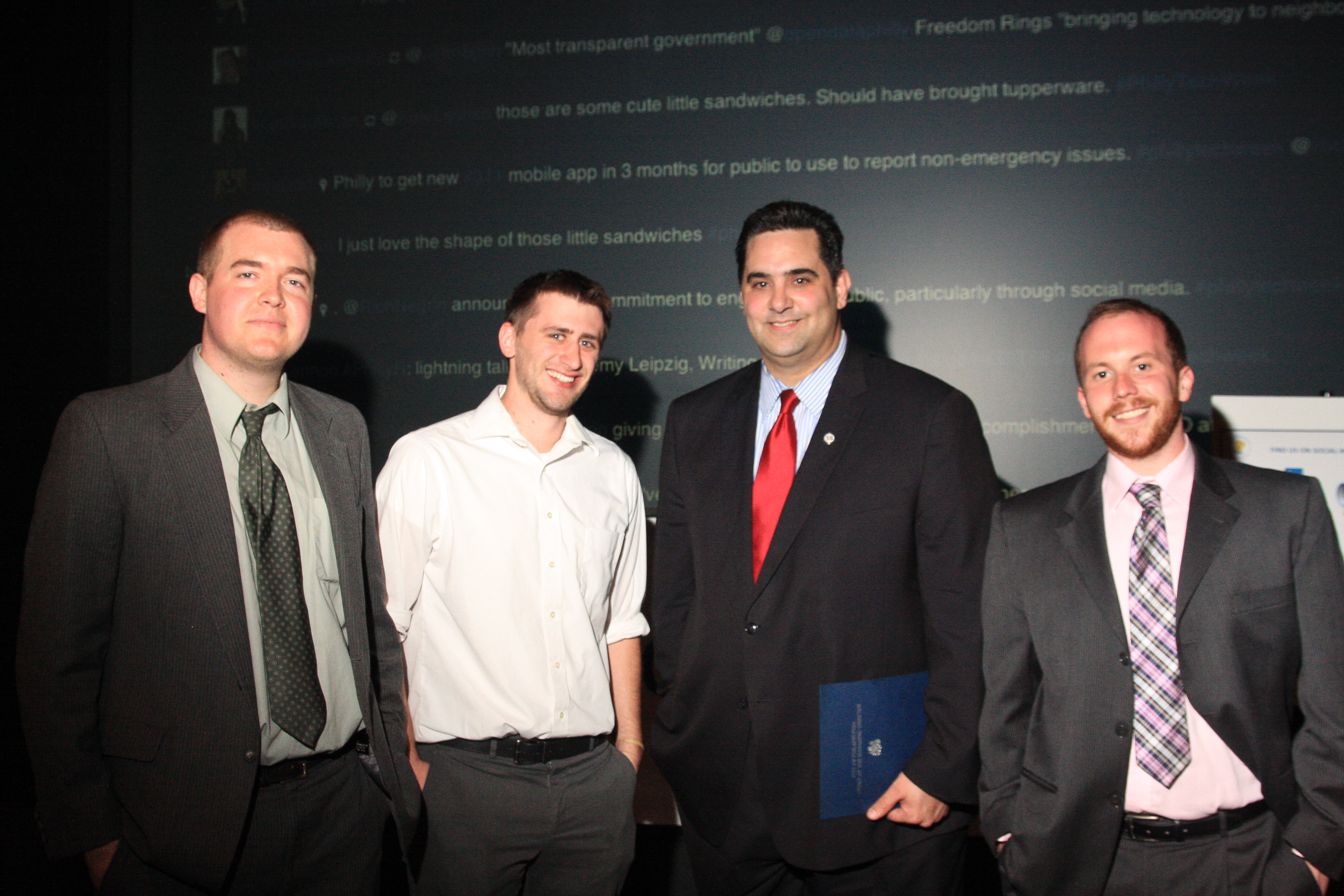
Standing with my colleague Sean Blanda, City Managing Director Rich Negrin and my colleague Brian James Kirk at Signature Event. Photo by Rachel Playe.

The inaugural Philly Tech Week has passed, and I shared a roundup of the entire week, but I wanted to focus in on one of the larger events.

As I noted, my Technically Philly colleagues and fellow PTW organizers each took hold of a portion of the nine of the week’s 65 events that we organized. Among what I handled was taking the lead on our Friday night Signature Event, featuring a 150-person, catered cocktail reception at WHYY in Old City, featuring keynote speaker Rich Negrin, the City of Philadelphia Managing Director who discussed good government initiatives.

I have some take aways below, which I hope to add to, in addition to the text of the quick address I gave to kick off the evening and video, showing that I’m not very good at actually listening to what I write.

Continue reading Philly Tech Week Signature event: video of my address and take aways