Philly Tech Week presented by AT&T: the second annual celebration of innovation

More than 80 events celebrating technology and innovation in the Delaware Valley are taking place over the next few days as part of the second annual Philly Tech Week presented by AT&T and organized by Technically Philly.

We first introduced this second year last fall. I am enormously proud to follow the work we managed last year.

Ph.ly: the Philly URL shortener and weekly email that will make you a better Philadelphian

Meet Ph.ly, the local URL shortener and the curated weekly email that will make you a better Philadelphian.

Try the tool and add your email here.

Last week, we at Technically Media announced that we launched Ph.ly, which has two primary features.

  1. URL shortener with a Philly focus — Try ph.ly/connect to see how domains can be shortened more beautifully and more relevantly.
  2. Weekly curated email of the three biggest pieces of local journalism — If enough people add their emails to the list, we will curate the three most meaningful pieces of local news and information to allow more Philadelphians to more easily consume the best of all the region’s content creators. It’s a hope to create a common set of facts for Philadelphians. Perhaps it’s a model for other markets.

Connect Philly: tool to locate free wireless hotspots in Philadelphia launched by Technically Philly

Find the nearest free wireless internet hotspot in Philadelphia by using Connect Philly, a new mapping and text message tool we at Technically Philly released last week.

The tool, which can also be reached by ph.ly/connect,

The tool, which is meant to be a part of the digital access conversation, was unveiled formally with an event in City Hall, featuring Mayor Nutter and a panel discussion I moderated on improving access and literacy online for low-income Philadelphians.

Continue reading Connect Philly: tool to locate free wireless hotspots in Philadelphia launched by Technically Philly

7 projects I started before Technically Media and why they failed

The home page of SussexToday.com, a proposed hyperlocal for Sussex County, N.J. as Patch.com was being expanded by Aol in mid-2009.

For any venture or project that reaches any remote level of success, there are surely failures that surround it.

By any standard, Technically Media is no more than a very small success, but before building that small business, I’ve had more than my fair share of failures. Being no stranger to rejection, I’ve tried my best to learn something from the handful of efforts (mostly other niche sites) that I helped launch around the beginning of 2009 in the hopes of finding a media venture of success — underemployed and without many opportunities.

Below, I share seven projects I tried launching before Technically Media, why they failed and what I learned.

Continue reading 7 projects I started before Technically Media and why they failed

How to get a reporter to care about your business: a Lean Startup presenation

Editor’s Note: I’ve given this presentation several times, so it’s been updated through the years. I’ve also written on this subject here and here — and here.

When pitching your venture or product, send a business or technology reporter a three sentence email, explaining in super simple language (a) what your project is, (b) why it matters and (b) who you are.

That was one of the better received recommendations I made while presenting for the Lean Startup seminar held at the Venturef0rth incubator in Callowhill, Philadelphia this weekend.

See my presentation slides above or find it here and past writing on the subject here and here. My colleague Sean Blanda has a post giving broad advice here, which includes a great list of questions to be prepated for, though I was a bit more specific to the 30 entrepreneurs in the room on starting the conversation. Details on my slide below.

Continue reading How to get a reporter to care about your business: a Lean Startup presenation

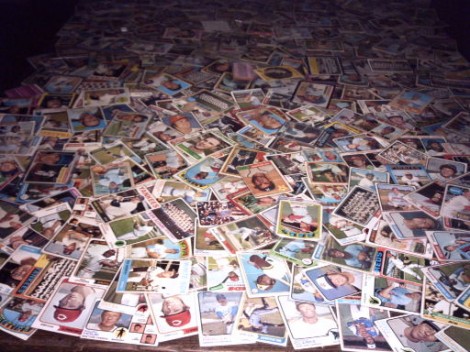
Baseball cards: 10 business lessons from my time in the sports memorabilla bubble

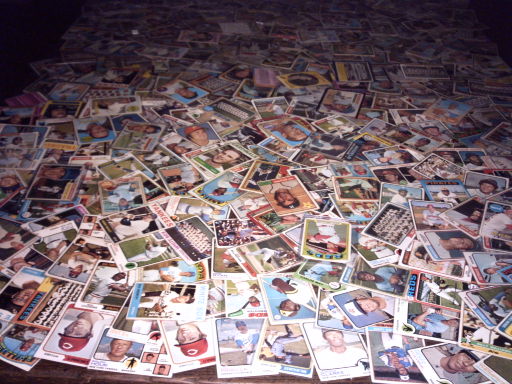
In middle school, I collected baseball cards. A lot of baseball cards.

In third grade, I tried pogs before they were outlawed in class when it was found we were effectively gambling with them. In a naive, youthful pursuit of seeing every movie ever made, I amassed piles of them on VHS and DVD. My grandparents gave me some collector coin sets, somehow I ended up with a few beanie babies and, being a recovering pack rat, I ended up with little collections of Simpsons merchandise and sports jerseys as a pre-teen, political campaign signs and pro sports team paraphernalia in high school and old books and vinyl records through college. Yes, as a kid, I’ve collected a lot — Lincoln logs, Legos and inherited stamps, too, fill my basement.

But, in truth, the largest collection I ever amassed was little pieces of printed cardboard, baseball cards, and to a lesser extent, other sports cards. In my memory, anything I didn’t save, I spent on them, starting with the occasional checkout-line pack purchase at the former Shelby’s dime store.

Of course, I’m not alone among the youth of the 1980s and 1990s. Entire books have been written about the baseball card bubble that came from an over-saturated market, so much so that many think error cards were created to fuel demand.

In love with sports and trading and playing with friends, I dove headlong into the hobby bubble. More specifically, from about the age nine in 3rd grade to about 14 in 8th grade, I likely spent less than $1,000, and, if I was able to more accurately estimate, it might likely be much less. In truth, my time was spent more on trading the cards with friends. Before high school, I had mostly set aside the indulgence, though I’d still sometimes take out that collection to marvel at my investment.

Still, my sports card collection was the first foray into business I made, and so I learned plenty. Here’s my sharing some of that.

Continue reading Baseball cards: 10 business lessons from my time in the sports memorabilla bubble

15 things I learned three years after launching Technically Philly

First, let’s acknowledge that three years is not a terribly long time.

Still, I’m proud that three years ago last month, Brian James Kirk, Sean Blanda and I launched a blog to cover the technology community of Philadelphia. Three years later, we are full-time employees of a growing business with a good reputation.

In that time, we’ve had some accomplishments that are worth being proud of. It’s been a learning experience to be sure.

First, our organization is changing in lots of ways.

Continue reading 15 things I learned three years after launching Technically Philly

Balancing legacy and money in professional sports has lessons for the rest of us

The legacy of your work has a value harder to compare with pure money, so we should try our best to incorporate that in our professional decision making.

I’m not a professional athlete. That may surprise many of you.

Still, without any real awareness of the experience, I find myself scratching my head whenever a big name, well-paid professional athlete chooses more money over legacy. In most cases, it seems ill-advised.

I understand that with injuries threatening livelihood, athletes are smartly coached to get what upfront money they can as soon as they can. And I understand that there is often a mind-boggling amount of money on the table, but they seem to be facing on only one axis of success.

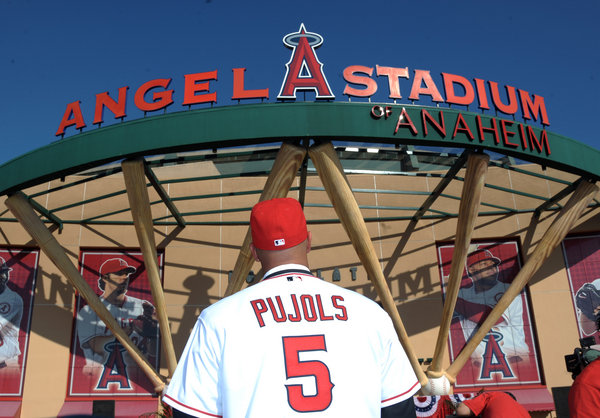
When Albert Pujols signed a quarter of a billion dollar, 10-year contract with the major market Los Angeles Angels, leaving the devoted St. Louis Cardinals after 11 seasons, I wasn’t surprised. (In fact, the Pujols’s wife seems more surprised, saying they had never wanted to leave St. Louis but the club wouldn’t offer a long enough, guaranteed deal.)

But if the celebrated and beloved Pujols becomes a target for boos and taunts, he’ll have to assess how much money an attack to his legacy is worth.

Continue reading Balancing legacy and money in professional sports has lessons for the rest of us

Social entrepreneurship: how Philadelphia could have a regional distinction for startups

Philadelphia, like any other city that wants to compete in a global marketplace, needs a regional distinction that sets it apart, and in this place, nothing makes more sense than for Philadelphia to define itself as the hub for social entrepreneurship and urban renewal.

Around the world, our hubs of innovation and culture, of education and community are densest and most alive in cities. All of the truly great problems of our time — war and crime and poverty and disease and education and violence and racism and hunger and employment — are either exacerbated by or housed most primarily in our cities.

As a country, if the United States intends to continue to play some form of a major role in the future, the sense seems to be that we will need to do that by continuing to be smarter. Adaptability, industrial might and military strength have served us well, but we need to look for the next train.

Entrepreneurship and the spirit that came out of World War II federal funding (largely in Philadelphia first) helped define the last quarter century of American cultural impact. At a time of high unemployment and a sluggish economy, high technology and scale is meant to be that next train.

So cities do a lot of hand wringing about how to replace widgets with gadgets.

The trouble is that, as a friend put it, if Silicon Valley represents the overwhelming majority of investment in the country, and New York City is in second place, then just about every other city that is even trying is in third place.

How should Philadelphia (like any other big city) try to stand out?

Continue reading Social entrepreneurship: how Philadelphia could have a regional distinction for startups

When you buy something, you are voting for its existence

Most of us (myself included) could do a better job of more often recognizing that when we buy something, we are also, in a way, voting for it. Cost analysis should include an awareness of what message you’re sending when buying something or going somewhere (I want this beer/farm/news site/bar/zoo/restauant, etc. to exist.)

Purchase power has always been a way to show support, but when we increasingly buy that which is not tangible, it may be even more important to incorporate that support into the price point.

As the music industry has fought online pirating, it has seemed to have the most success in arguing to consumers that buying music (an mp3, a CD, etc.) not only ensures a better experience, but purchasing also is a way to support, and tacitly “vote,” for a favorite musician — whether they are getting the biggest cut of the pie or not.

For local, small businesses (yes, niche media too), the pitch has to be the same. We need to offer value to consumers, yes, but ultimately the audience needs to also see any purchase — whatever that is — as a sign of support.

Continue reading When you buy something, you are voting for its existence