I can only pray that this video isn’t the last remnant of our culture thousands of years from now.
A 1:32 news piece on a 10-year-old boy who puts on 215 pairs of underwear to break a world record. Two shots of parents expressing their praise and then an afterthought at the end: a paralyzed marine.
It was a big piece riddled with stories of a handful of struggling entrepreneurs and a few buzz-y sites that haven’t prospered, but three paragraphs interested me most.
Most usually, when I’m speaking on an issue related to media convergence or the future of news or other fun related topics, the subject of mobile technology comes up.
In poorer rural and urban communities where the first wave of household IT infrastructure passed by, the notion that smart phones and other Web-capable handheld devices — which are cheaper, more ubiquitous and often more socially and culturally prized than a home PC — just may transform the so-called digital divide is hot conversation.
But it’s worth revisiting the depths of why that is.
I did it for just a year and did so out of college, so I don’t pretend to be any sort of expert. Yet, as writing — like publishing — as a commodity falls in value (and the prices that come with them), I sure feel like it’s worth making clear my experience.
I shared the rough curriculum I had established for working with a journalism club at a neighborhood school before my time there was cut short.
Just a week after I took a full-time job and told the club’s adviser that I’d have to take a bit of a sabbatical from my time there, I wanted to give a primer to have a conversation about the basics of journalism with her students.
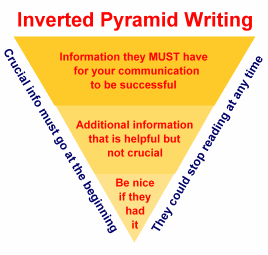
In fewer than ten minutes, I tried to bottle an entire journalism degree into five bullet points. Clearly I missed plenty.
Below, see what I shared. Let me know what giant holes these high school kids will have in their foundation because of my failures!
We may lose someday newspapers in their traditional form, but we’re seeing a flourishing of alternatives fill those lost pieces of pie.
Some are more skeptical of how quickly we’ll be able to bring back the creation of that news, but through variation, experimentation and loyalty, it my well be done.
I very much see a future of journalism handled by an endless collection of small niche, targeted news sites, big investigative work done by nonprofits and foundation-funded, independents, in addition to a handful of big news organizations finding their own niche — the NPR network and modified newspaper businesses like the New York Times owning international, the Wall Street Journal owning business (though they’re competing), USA Today and the Washington Post focusing on the national.
Below, I offer a hastily put together, rough breakdown of that.
As these things tend to do, it became a rambling collections of do’s and don’ts, but it was interesting nonetheless. Ten stuck with me as among the most important.
Strive for context rather than information. Information is plentiful, context is scarce. (@rsm4lsu)
Journalists should be skeptical, not cynical. (@jmestepa)
Always make your last question “Is there anything else I should have asked?” (@jamessaft)
A journalist should never be a friendly dog when reporting and then go snake at the keyboard. ABC. Always Be Congruent. (@carr2n)
Always be willing to let any answer — including one on deadline — completely change the story’s direction.
Journalists should be available. Let people know how to e-mail you, call, IM, DM or otherwise get in touch.
Journalists should be active community members. If you aren’t of the people, you aren’t by the people or for the people.
Journalists should be comfortable with silence during interviews. You’ll hear & learn more if you’re not talking.
Journalists should never plead ignorance about the business of news, who pays, how & why. It’s not purist, it’s irresponsible.
“Look for stories people might miss, even standing next to you. Be curious about seemingly ordinary lives.” http://ow.ly/IS94
So, I’m surprised to say I haven’t been able to find is a comprehensive list of already existing products. This isn’t going to be that list, but let’s give it a start. Help me highlight the existing, active hyperlocal news sites worth following.
Watch video below and be reminded why Shirky — who doesn’t necessarily have any traditional line-item journalism resume builders — gets a seat at the serious discussion of where news is going.
Community newspapers in Philadelphia remain wary of the Web, if any stock is to be paid to a morning panel from a journalism innovation conference held this month at Temple University.
Technically Philly was a partner in hosting PhIJI
Their thoughts just might be relevant to community-focused news gathers across the country.
Hosted by Temple’s journalism department, the Philadelphia Initiative for Journalistic Innovation was a day’s worth of smaller sessions focusing far less about the plight of big newspapers and more about smaller, more entrepreneurial ventures. Yes, the future of news just might be a series of conferences about the future of news, but I was happy to see a greater focus on the business side of the industry.
With the help of supportive chair Andy Mendelson, Temple journalism professor George Miller put together one of the first future of news conferences I’ve seen that tried to really pay attention to sustainability through profit. There’s incredible value in that, so I was thrilled to be a part of it.
Along with my two fellow co-founders of Technically Philly, I presented twice a session called ‘Be a Publisher Now’ on free tools that news-organizations and bloggers could make use of to create become more efficient and better prepared. See our presentation slides here.
I also got the opportunity to sit in on a session focused how community newspapers were dealing with the 21st-century’s dramatic paradigm shift in news-gathering. That’s where I was left more than a little puzzled.