Moravec’s Paradox

This was original a social video post

I want AI to do my dishes and laundry so that I can do art and writing, not for AI to do my art and writing so I can do more dishes and laundry.

That 2024 tweet went viral. And there’s a name for this: Moravec’s Paradox, and it dates back to 1988, from a machine learning researcher.

Continue reading Moravec’s Paradox

“If Anyone Builds It, Everyone Dies”

The alchemist who takes on the king’s trial to attempt to turn lead into gold. If he does so he gets fabulous wealth for all around him. If he doesn’t, everyone dies.

Believing it impractical to stop everyone else’s from trying, he decides that he is the best shot because he has the most discipline. His sister begs him not to, but he goes anyway.

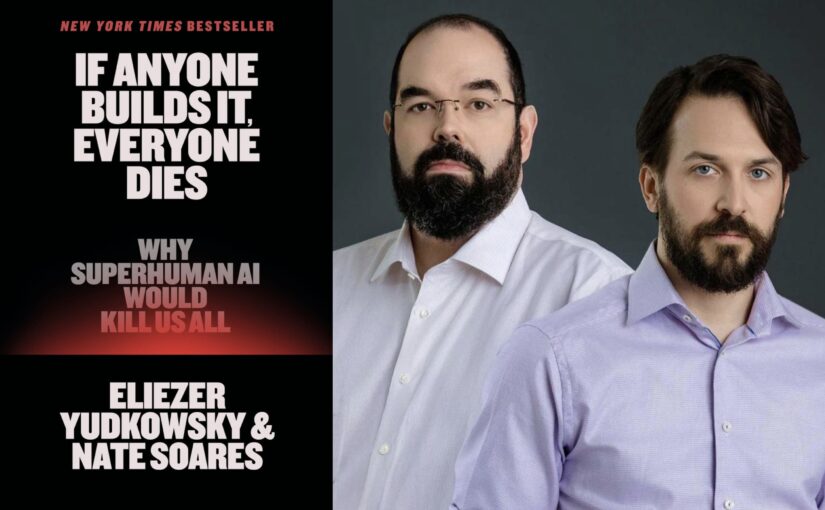
That fable opens the 11th chapter of the comfortingly named “If Anyone Builds It, Everyone Dies,” the fall 2025 book by Eliezer Yudkowsky (“the prophet of AI doom”) and Nate Soares.

To their credit, the book is more reasoned than the title might suggest (I actually think it’s a great book title). They say again and again that they do not know the timeline: AI research, then, they say is a ladder on which each rung is billions of dollars but if anyone reaches the top everything explodes — and no one knows how long the ladder is.

Their argument is competition between China and the United States is silly Nobody “has” ASI (or AGI ), only it has itself, is their argument

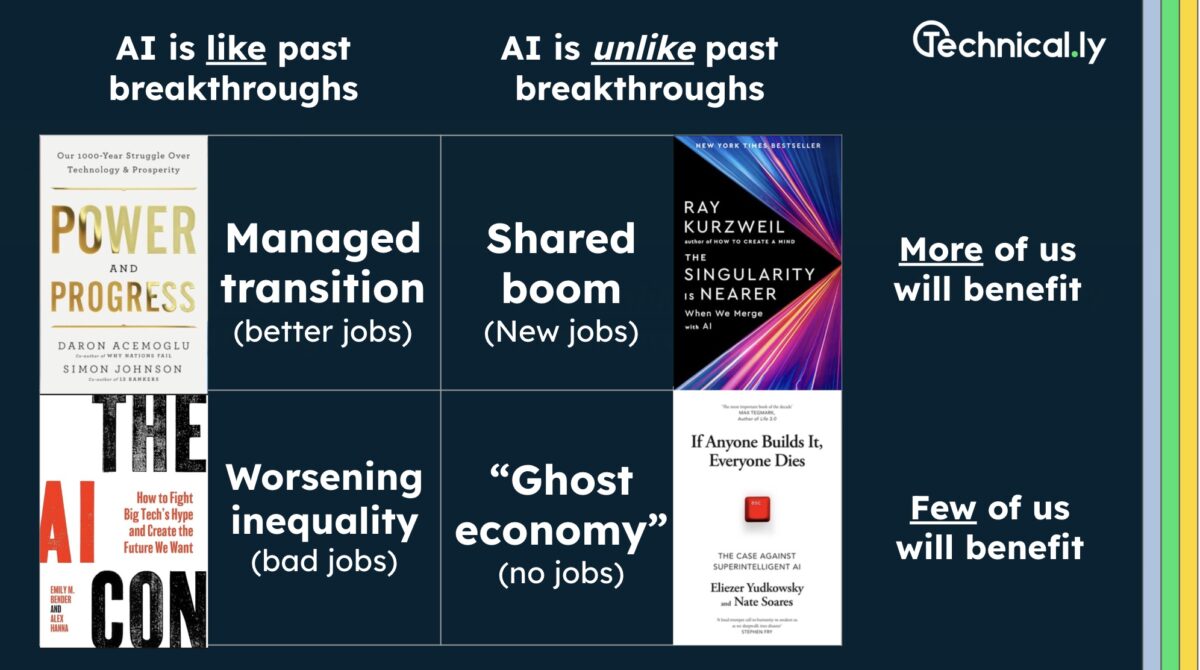
Their argument, and this book in particular, helped refine my own framework for interpreting the moment, and my own AI philosophy, distilled in the chart below as a two-by-two axis depending on what your best guess is on the technology.

Below I have my notes for future reference.

Continue reading “If Anyone Builds It, Everyone Dies”

To navigate AI, journalists must know the technology, and their job

To navigate AI, journalists need to break it down: What the technology is, and what the job is.

I was thrilled to keynote this weekend’s New Mexico Local News Fund’s local news summit in Albuquerque. My talk: Risks, Ethics and Opportunities for AI in Local Newsrooms.

To an audience of 100 local journalists and publishers in New Mexico, and supporters from around the conutry, I walked through a simplified framework for understanding what we call artificical intelligence — and I shared Technical.ly’s ethics for AI in storytelling.

Find my full slides here.

Enormous credit to Rashad Mahmood and Denise Zubizarreta.

Make it illegal to use a photo for an AI-generated video

This was originally produced as a social video. Below is a script version.

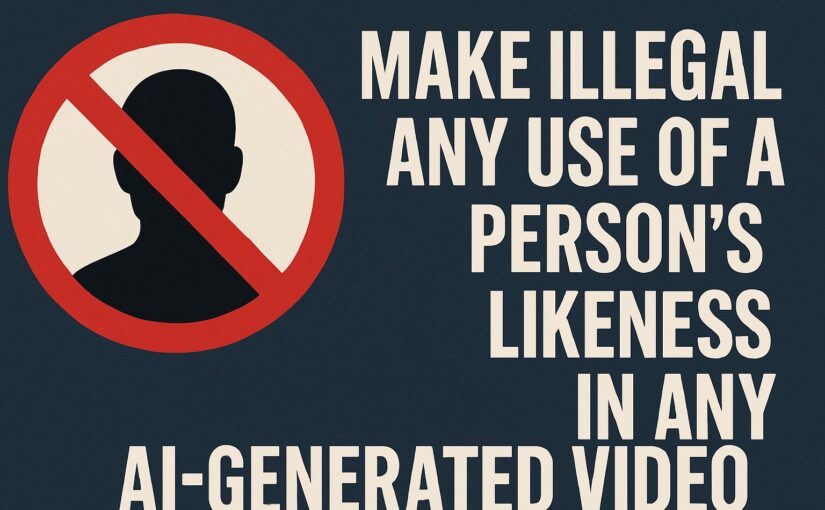
Make illegal any use of a person’s likeness in any AI-generated video. Do it now.

Here’s why.

For 150 years, courts have recognized something called the right of publicity — the idea that your face, your voice, your identity belongs to you. Not to a tech company, not to a political campaign, not to a creepy ex. You.

Continue reading Make it illegal to use a photo for an AI-generated video

Empire of AI

If there’s even a small chance of a really big thing happening, should you do it?

“The need to be first or to perish” is what set in motion the explosion of consumer use of artificial intelligence. That argument raised billions of dollars, set off one of the largest infrastructure investments in American history and set off a global arms race.

The company that set off the arms race is OpenAI, and its cofounder and public face Sam Altman. Altman wielded this argument widely: If OpenAI doesn’t race toward the possibility of superintelligence than an existing incumbent like Google will, or China will. But no one else, nowhere else, could have done this. At least not now.

Or so the argument goes in Empire of AI: Dreams and Nightmares in Sam Altman’s OpenAI published this year and written by journalist Karen Hao.

One Chinese researcher told Hao that no one would have been funded outside Silicon Valley with over $1 billion without a clear purpose, so we created the risk and the solution. As she writes: “everything OpenAI did was the opposite of inevitable.”

Altman shares a birthday with the legendary physicist Robert Oppenheimer (“father of the atomic bomb”). Altman loves the comparison of OpenAI to the Manhattan project, though Hao notes that “he never seemed to add that Oppenheimer spent the second half of his life plagued by regret and campaigning against the spread of his own creation.”

At an industry event in December 2024, Altman’s cofounder and one-time chief scientist Ilya Sutskever said that “we have but one internet,” in referring to the source material that the AI industry has already primarily digested. Having consumed all of us, they seek more, Hao argues, in preferring the “empire” metaphor of the AI industry. The book is exhaustive and critical. A very worthwhile read for those following the industry, even though it goes into even greater detail on internal politics than I needed. It reads as authoritative.

Below I share my notes for future reference.

Continue reading Empire of AI

Philosophy or Computer Science: Who Has Higher Unemployment?

Who do you think has a higher unemployment rate right now—recent college graduates with a philosophy degree or those with a computer science degree?

Yikes: it’s computer science, per the Federal Reserve Bank. It’s part of a massive change I’ve written about.

Continue reading Philosophy or Computer Science: Who Has Higher Unemployment?