The world would be better of if the United States would give engineers more influence, and if China would defer more to lawyers.
The Americans have built a lawyerly society, and the Chinese have an engineering one. The two nations have more in common than they might realize, and so they’d both do well to learn more from one another.
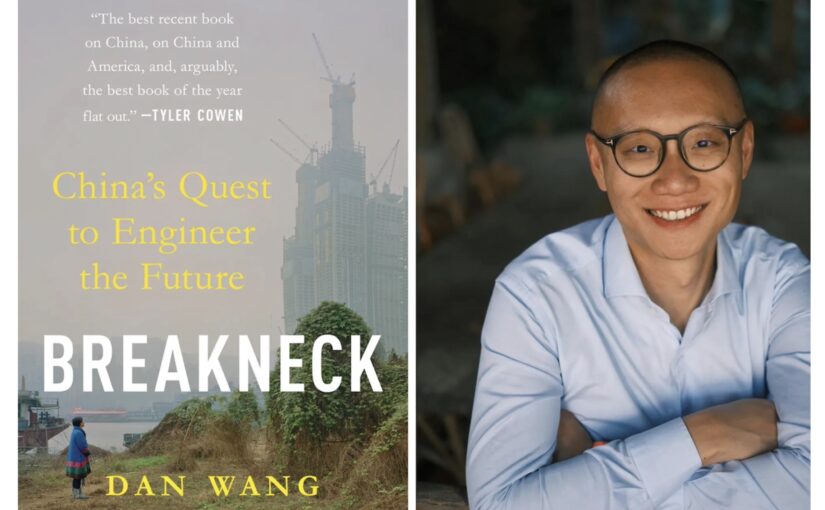
That’s from the 2025 book “Breakneck: China’s Quest to Engineer the Future” by technology analyst Dany Wang.
It’s one of my favorite books of the year: Fun, fast-moving and authoritative. At the heart of the world’s two-state superpower battle, the author argues: “This contest will be won by the country that works best for the people living in it.”
In the greedy late 20th century, American policymakers and executives failed to grasp the importance of “process knowledge.” Boeing and GE traded engineering knowledge for shorter-term Wall Street gain. By 1992, Michael Boskin, an influential economic adviser to the first President Bush, famously said: “Potato chips, computer chips—what’s the difference?” They got it.
Below I share my notes for future reference.
My notes:
- “I am sure that no two people’s are more alike than Americans and Chinese”
- Author grew up in Philadelphia suburbs
- Engineering state vs lawyerly society
- Detroit at its peak is Shenzhen today (Shenzhen is the famous manufacturing hub adjacent to Hong Kong on China’s southern coast)
- “Capitalist America intrudes upon the free market with a dense program of regulation and taxation while providing substantial (albeit imperfect) redistributive policies. Socialist China detains union organizers, levies heavy taxes and provides a threadbare social safety net. The greatest trick that the Communist Party ever pulled off is masquerading as leftist.”
- In 2008, California started its San Francisco to Los Angeles high speed line. In 2011 China opened the $36b project and moved 1.35 billion people in its first decade— the latest California estimate is $128b and still not built (targeting 2030-2033, which means the margin of error is as Long as it took China to build)
- The procedure fetish by Nicholas Bagley
- “Lawyers have much more scope with the law to stop something rather than create something.”
- A 1991 paper by three economists: “our evidence shows that countries with a higher proportion of engineering college majors grow faster; whereas countries with a higher proportion of law concentrators grow more slowly.”
- Lawyers are often protecting entrenched and rich interests. It’s the poor who suffer most from less housing, poor transit and difficult SNAP benefits
- The author’s bicycle trip 400 miles to Chongqing, In Guizhou, as poor as Botswana but with advanced infrastructure (socialism with Chinese characteristics)
- Li zaiyong case study, as he was made an example (For over-building)
- Tianjin has third tallest skyscraper but no one in it, and among the most photogenic libraries but no books in it
- Chinese over capacity means industrial domination in solar grows GDP but not necessarily company stocks
- Some Chinese buildings are so frail that parents called collapsed schools in Sichuan “tofu houses”; move Tibetans from ancestral lands to dense apartment blocks against their wishes
- The 2025 book Abundance and other supply-side progressives are a response to U.S. being more demand focused (while China has only focused on supply)
- Cape wind case study, a stalled American offshore wind project
- Shenzhen once known for oysters, new they’ve been removed by industrialization: 300k population in 1980 to 7m in 2000 to 17m in 2020
- A billboard; “You’re a Shenzhen local the moment you’re here” unlike Beijing and Shanghai, which culturally require rootedness
- “In China technology is not represented by shiny objects; rather, it is embodied by communities of engineering practice like Shenzen, where technology lives inside the heads and in the hands of its workforce”

- The suicide nets in Foxconn
- In 2016, FT reported high school “interns” were forced in Henan to assemble iPhones to receive diplomas
- Factories with “five lacks”: no design, drawings, permits, supervision or registration
- In Shenzhen they will get a business idea and executive the next day, in Beijing there would be liquor shots and boasts of high ranking connections
- United Airlines wrote about Apple booking 50 business class seats daily from SF to Shanghai
- Chris Anderson: “peace dividends of the smartphone wars” (EVs and drones advanced because of apple and Chinese supply chains)
- In 2007, China reflected 4% of the iPhone value (assembling only), by 2017 iPhone X it was over 25% (acoustic parts) and growing
- Technology is three things: the tools, the recipe and “process knowledge”
- The Hall of Uselessness, a collection of Samuel Leys essays: On the Chinese attitude to building with wood and even paper: “eternity should not inhabit the building. It should inhabit the builder” (think of Japan’s Ise Jingu temple made of hay, rebuilt every 20 years to transfer generational knowledge) rebuilding since 690AD, the staff have a 200-years plan to grow enough cypress’s trees nearby
- To be self sufficient
- The National Nuclear Security Administration (NNSA) spent $69 million in cost overruns (and $92 million total) to relearn how to manufacture “Fogbank,” a highly classified material essential for the W76 thermonuclear warheads used on U.S. Navy submarines
- Andy Grove we need to focus beyond “the mythical moment of creation”
- Silva Lindtner: Michigan professor (and author wife) the lesson from Shenzen is not inventions by ecosystem (which Silicon Valley once had but lost manufacturing portion)
- In 1992, Michael Boskin, chairman of the Council of Economic Advisers under President George H.W. Bush, famously said: “Potato chips, computer chips—what’s the difference? A hundred dollars of one or a hundred dollars of the other is still a hundred dollars.”
- “Every US factory closure represents a likely permanent loss of production skill and knowledge”.. “ The problem lies with American policy makers and executives who failed to grasp the importance of process knowledge.” Boeing and GE traded engineering Knowledge and leadership for shorter-term Wall Street gain
- China was OK to import German, Japanese and American goods as its economic and industrial base strengthened — but Japan only wanted to export Japanese products
- Xi Jinping thinks the West was foolish to let even low-end manufacturing leave their countries because that creates chokepoints
- Industrial Party in China: nation-states compete, science and technology is how you win and the CCP is best at it (I’ve written about this legacy)
- The Morning Star of Lingao (simplified Chinese: ????; pinyin: Língáo Q?míng), also known as Illumine Lingao, is a massive, crowdsourced Chinese time-travel (chuanyue) and alternate history web novel. Launched in 2009, the crowdsourced novel writes of
- over 500 modern-day Chinese citizens—largely engineers, technicians, programmers, and military enthusiasts—being transported via a wormhole back in time to 17th-century China during the late Ming dynasty to start their own Industrial Revolution.
- “There is, I submit, more glory in having big firms making a product rather than a science lab claiming its invention”
- Qian Xuesen was a pioneering Chinese aerospace engineer and rocket scientist who was accused of communist sympathies in the U.S. during the Red Scare, placed under house arrest, and deported to China in 1955. Then he developed China’s nuclear weapons program.
- In 2022, Xi’s Politburo removed the one seat held by woman
- Susan Greenhalgh in Just One Child (2008): Song Jian led a group of military scientists who used computers to present the implication of confidence in population growing and food production not, whereas their opponents used simpler systems and hand drawn charts. (Esteem for math and science made cruder criticism look silly)
- 1980 one child policy: urban fertility was already trending to 1, but Rural was still 2.5; reporting of the brutal methods of hitting quotas including forced third term abortions
- In 1991, the “Childless Hundred Days” (Chinese: ????), also known locally as the “Slaughter of the Lambs”, was an extreme local campaign of mass forced abortions and sterilizations in Guan County and Shen County
- 40m “missing” women from China because of female infanticide and self selective abortion from the era
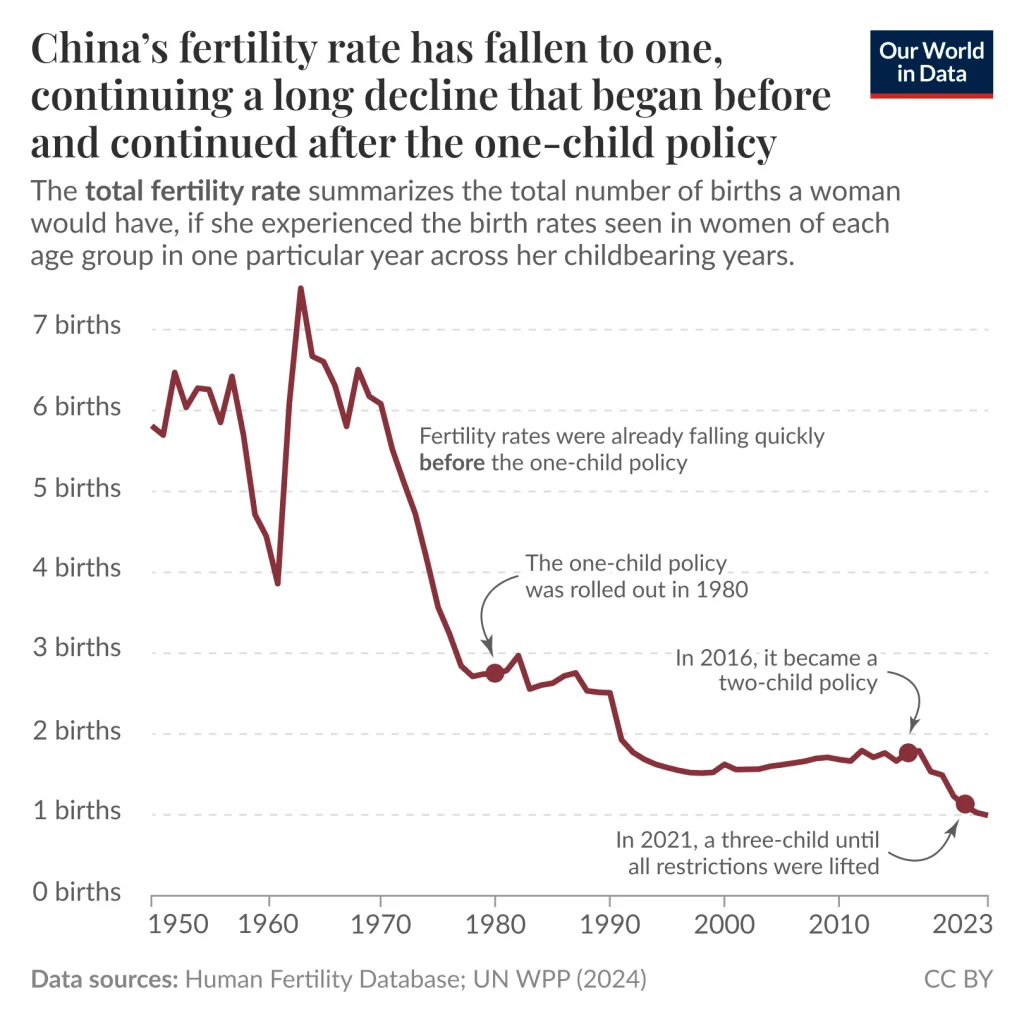
- Only the 2010 census showing population collapse truly ended the policy: 321m abortions, 108m women sterilized and 26m men
- A missile scientist (Song) designed demographic policy —whereas the lawyerly society debated and economists roundly rejected the 1968 book The Population Bomb, it was never taken all that seriously
- Churchill: scientists should be on tap, not on top
- In April 2022, Shanghai police drones flew over apartment complexes broadcasting a robotic voice that commanded residents: “Please comply with Covid restrictions. Control your soul’s desire for freedom. Do not open the window or sing.”
- Abrupt end of zero COVID: China believed “the science,” too much even — it needed more lawyers
- Author shares that after six years in China he missed Amercian pluralism, less invasive government and being able to order whatever books he so choose — his own personal website was blocked by the Chinese firewall
- “The trouble with Xi Jinping is that he is perhaps 60% correct on everything,” like Deng said Mao was 70%
- “Engineers can’t take a joke”: On May 13, 2023, during a stand-up set in Beijing, Li Haoshi (“House”) described watching his two adopted stray dogs chase a squirrel. He remarked that their behavior reminded him of a well-known military slogan: “Forge exemplary conduct, fight to win”. This comparison to dogs got him banned and major fines.
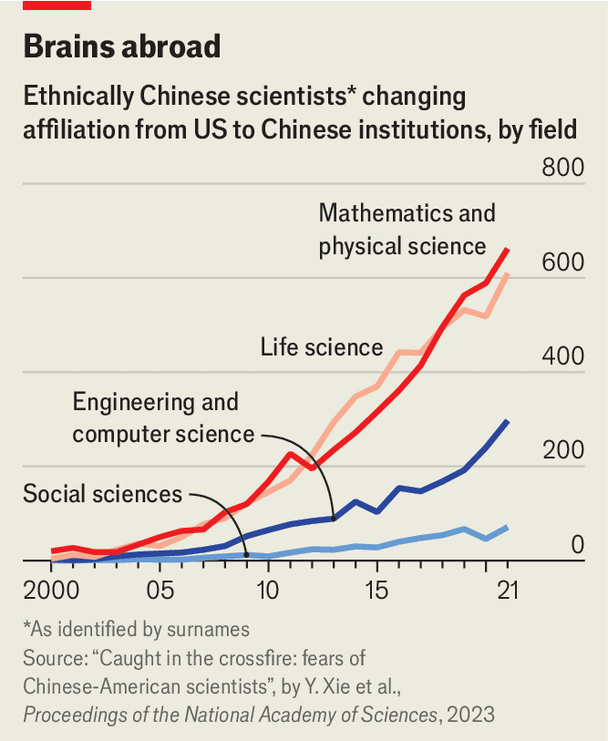
- “Fewer than 1,000 scientists of Chinese descent moved from the United States to China in 2010; more than 2500 did in 2021”
- Autocratic Prussia formed the first research universities around chemicals, and Nazi Germany won Nobel prizes because the hard sciences require abundant funds more than free speech. Social sciences and art require openness and so autocratic systems rarely deliver there
- In 2022, China had 1800 ships under construction; the U.S. had 5. In a war, would you rather hardware or software?
- Nick Bagley on proceduralism: lawyers should ask if they can do more by stepping away
- Robert Caro’s influential 1974 book The Power Broker about Robert Moses helped to turn Americans against engineers, entrench the lawyerly society — like The Silent Spring (1962) and Unsafe at Any Speed (1965)
- The political left must reckon with Robert Moses (1888-1981), who aggressively developed, and the right must grapple with Admiral Hyman Rickover (1900-1986), who built using government power
- “The problem with the American right is not its desire to make the government more efficient. Their problem is that they diagnose the causes of inefficiency as a lazy workforce rather than the mountains of procedure that civil servant labor under. DOGE would be more effective if it targeted regulation and process rather than personnel.”
- U.S. vs China: “This contest will be won by the country that works best for the people living in it.”
- It costs 5x to build a kilometer of subway in NYC than Paris
- American legal scholar Grant Gilmore (1910-2008): “In hell there will be nothing but law, and due process will be meticulously observed”
- In 2023, communist party propaganda rejected World Bank projections of China becoming a high income country and instead said “China will always be a developing country” leave “developed” to the European mausoleum, author says: “ I hope one day that America will declare itself to be a developing country too”
- Author says Deng Xiaoping (1904-1997) opened up when he visited a Texas supermarket with choice and a Japanese Nissan car plant and knew this was modernity — (In 1989 Boris Yeltsin visited a Texas supermarket not Deng)