
A certain approach to risk and decision-making spans Wall Street, Las Vegas, Silicon Valley and, yes, even cryptocurrency libertarianism. Not all of it’s good, but some is.
It’s important to understand this community and worldview. That’s from On the Edge: The Art of Risking Everything, a 2025 book by popular statistician Nate Silver.
The book is at least 150 pages too long, and needed a more disciplined edit. The author says he had three book proposals: gambling, AI and game theory. As far as I can tell, he combined them all. The bloated book has detailed poker gossip, historical passages about Las Vegas and biography of Steve Wynn. Lengthy passages detail how LLMs work and the personalities behind game theory. It’s all moderately interesting but bizarrely off focus of his book, in my read.
I happen to like the stuff, but I kept finding myself circling passages that could have been edited away. Regardless, I took away plenty of charming little details.
Below I share my notes for future reference.
My notes:
- He calls his community of risk-takers “The river,” and illustrates a line between Wall Street to Las Vegas and Silicon Valley
- Upriver: Silicon Valley and effective altruism
- Midriver: Wall Street
- Downriver: Las Vegas
- Archipelago: crypto land

- Left professional poker after Congress passed the Unlawful Internet Gambling Enforcement Act (UIGEA) in late 2006; he started his statistics website 538 and hit a moment of post poker buzz
- His 2016 model correctly handicapped the US Presidential race (to widespread attention), with its expected value, so that became how he viewed who understood probabilities and who didn’t
- “The vital point of my first book the Signal and the Noise is that probabilistic forecast is a sign of humility not hubris”
- Von Neumann in 1944 developed game theory used poker
- Blaise Pascal and Fermat developed probability theory inspired by dice games
- Cognitive cluster of the Rver: analytical (break complex things into small), abstract (take small insights to build bigger models) and decoupling (two things can be true, separate person from action); the personality cluster is competitive, critical, independent minded and contrarian and risk tolerant
- His opposite camp of The River is The Village: Author says to think of them as the average Washington DC or Boston left of center person who won’t decouple subjective and objective (what they feel of something, colors how likely they think it will happen)
- The river loves a steel man arguement, he says (opposite of straw man, when you give your opposition its best possible argument)
- Super/system (1979 book by Doyle Bruson) is poker’s bible
- As an average-looking accountant by day who won big in a poker tournament, Chris Moneymaker changed the game (same year as Michael Lewis’s Moneyball book on stats in baseball)
- Nash equilibrium : game theory concept where an agent can no longer improve situation unilaterally
- Nash equilibrium in of poker includes some random play between calling, rising and folding
- Nash equilibrium of baseball: mixed strategy of randomly assigning pitches (like Greg Maddux sometimes did), or swinging, or pure strategy of exploitative strategy are all possibly determined with algebra
- “We often spend the most time debating the least important decisions”
- Game theory teaches a mixed strategy of some random options is often the best
- Game theory optimal vs Exploitative play
- The Hour Between Dog and Wolf: How Risk Taking Transforms Us, Body and Mind, a 2012 book by John M. Coates: we don’t risk enough, so traders who win get more testosterone and then risk more to higher performance — until it goes to far, a theory for why bubbles occur
- Annie Duke: poker players instinctively feel a 52/48 moment over a 50/50 one
- Richard Wisensn 2003 self help book the Luck Factor may be over the top but he makes these points:
- Lucky people “constantly encounter chance opportunities” and try out new things.
- Lucky people “make good decisions without knowing why.” They listen to their intuition.
- Lucky people have positive expectations so their “dreams, ambitions and goals have an uncanny knack of coming true.”
- Lucky people “have an ability to turn their bad luck into good fortune” because of their resilience.
- Why so few women in poker? Culture, and starting pots but author says no reason aggression and empathy means only men should win
- Gambling often arises at borders where the externalities of addiction passs on through tourism — Nevada part of a gold rush borderland
- Wynn flipped Las Vegas into experience and the blackjack tables are “just furniture” — but Atlantic City stuck to gambling too long (Vegas fully won in mid 1990s)

- Schull: Slot players don’t want to win: it’s breaks the flow state and the escape — little overlap between slots and table games. Compulsive Slot players know they’ll Iose, they’re there for the escape not for the winnings (smoother ride down to zero. With modest wins, only brief interruptions). One addicted gambler told her about losing in slots compared to the chaotic world: “ this is the one place I can go where I know exactly what is going to happen”
- Erving Goffman where the action is in 1967: table games wanted thrill in post war war prosperity
- Casinos “have few right angles”
- A bet is a tax on bullshit: economist Alex Tabarrok introduced this writing about the author about Scarborough bet for 2012 presidential election
- Sportbook: moneyline is who wins/loses with a favorite; spread gives underdog a range and the over-under is total score — prop bets come from 1990s lopsided super bowls
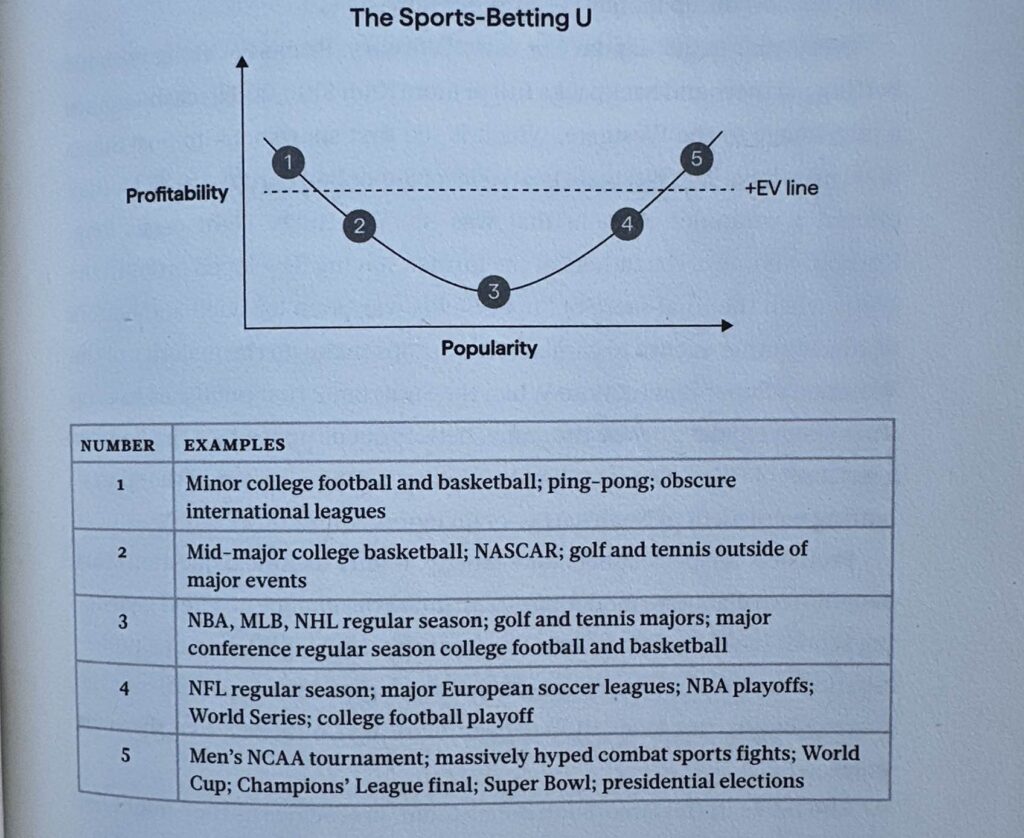
- Silver’s sports betting u: The best places to bet are obscure sports (with limited data) and super major sports (with lots of dumb money), the best chances for EV
- Sports book are either retail (Draft Kings) or market makers (which tolerate more “sharp” betting because they seek more accurate information)
- “For as much as sports books and sharp betters have an adversarial relationship, they also share a common interest: they’re both dependent on recreational vetters to make their profits. In the long run, the size of the industry is dictated by how much money people are willing to make bad bets.”
- “If a sports book known to aggressively limit winning players is taking your action, you should ask yourself why – they are basically telling you they think you’re a loser”
- Sports books are still more manual than you might think, not all algorithms shifting numbers
- After spending $1.8m betting on NBA in the 2022-2023 season, the author writes: “ if winning 55% of your bets makes you a huge winner and 50% makes you a fish, even a full season’s worth of bets won’t necessarily tell you which category you belong in”
- There’s also a random 13th chapter about 5 risk takers that he calls a “lost third part” of the book — including Katalin Kariko
- Silicon Valley needs both probabilistic thinkers (VC portfolio says it takes a lot of bets to make one), and determinists, the founders who have their livelihood tied to one company (Thiel and the author discussed this)
- Silicon Valley’s Traitorous 8 cultural founding story of creative destruction and self ownership
- Long time horizon and asymmetric odds of Silicon Valley

- Venture capital j curve (for both portfolio of companies, and individual startups themselves): companies fail before they succeed
- 5% likelihood of a 100x event means the focus to avoid is omission rather commission
- VCs are foxes, founders are hedgehogs; risk tolerant investors and risk ignorant founders
- Investor Mike Moritz was journalist but turned VC when Sequoia Capital gave him a chance
- Bill Gurley’s 2023 “2,851 miles” speech about the distance between Sand hill Road and DC, arguing regulatory capture is good for incumbents
- Marc Andressen’s techno optimistic manifesto specifically calls out monopolies as an enemy
- In his 2023 book “What’s Our Problem? A Self-Help Book for Societies,” Tim Urban outlines the Silicon Valley-style concept of the “Idea Lab” as an ideal intellectual culture. It operates on high-rung, truth-seeking thinking where ideas are separate from personal identity, and disagreement is actively welcomed.
- 2023 Forbes 400: 70% are self made (on a scale of 0-10, they are 6 or above) — in 1982, only 40% were
- Josh Wolfe of Lux Capital: chips on the shoulder put chips in pockets (trauma that ok average is bad can create an alchemy at the edges of outcomes)
- In Silver’s hypothetical all-in poker tournament, a “degen” goes broke and wins more often than prudent poker player (see below)

- Andreessen Horowitz (a16z) heavily publicized their continued investments in Adam Neumann’s real estate venture, Flow, to signal their commitment to bold, contrarian founders and to cement their status as an iconoclastic VC firm.Prominent venture capitalists like Benchmark’s Bill Gurley have pointed out that these contrarian, high-variance bets allow a16z to stand out. By proudly backing a polarizing, larger-than-life figure like Neumann—whose previous company WeWork imploded—a16z advertises that they are willing to take massive, unconventional risks to find outliers, even if the investments draw intense public skepticism
- VC is like a Keynesian beauty contest: first contrarian but then betting on where consensus will go (herd building while collectively orthogonal to rest of the economy) so Jean Brownhill story of the investor who said he would invest in her but didn’t believe other investors would which is what early stage investing requires
- Marc Andressen of a16z: it’s self fulfilling once a brand gets established in a recruiting business (it’s like elite universities). “90% of the deal is won upon contact because the network effects are powerful”
- Andersson cited numbers for portfolio of a “top-deciles firm:
- 25 percent of investments make zero return.
- 25 percent produce a return greater than 0 but less than 1x.
- 25 percent produce a return between 1x and 3x.
- The next 15 percent produce a return between 3x and 10x.
- Finally, the top 10 percent produce a return of 10x or greater.
- VC Targeting IRR of 20-30%
- Author had repeated SBF interviews
- You never hear about first rate investment advice until it’s too late (it’s already been betted — your best option is to have good friends to get second rate advice
- Schelling grand central terminal meeting place because famous and so self fulfilling as a destination (focal point) this In Bitcoin and Art
- Schelling Strategy of conflict: leaderless mobs are prone to subtle signals
- In betting, if you can’t spot the fish you are the fish (inspired by Rounders)
- Author gives long explanations of EA philosophy
- Why wouldn’t congress allocate more toward pandemics after Covid when the EV is so high?
- Brooklyn poodle that became real life trolly problem of delaying trains: In February 2018, a poodle named Dakota spooked and escaped from a dog walker, dashing into Brooklyn’s York Street station. Running onto the active F train tracks, the ensuing rescue ground subway service to a halt. Power was cut to save the dog, delaying thousands of commuters for over an hour
- William Mcauskill we could value life by number of neurons: chicken is 1/300th of human, dog is 1/30 but elephant would be more
- Emily Oster argued covid needed cost benefit analysis
- Value of a statistical life is teased out from revealed preferences from things like hazard pay — it became $10m led by Kip Visuci in the 1980s when it was previously just the cost of death (lost earnings) at $300k
- Yudkowsky’s rationalism (developed in his 2006-2009 blog posts The Sequences) has related to EA
- Bayesian reasoning: probability and updating your priors
- EA vs. Rationalists table below

- Peter singer 1972 essay famine, affluence and morality
- Author has to repeatedly say things like “why this long detour into moral philosophy jn a book about gambling and risk?”
- Various strains of utilitarianism vs deontology (duty bound, like Kant), and Rawls theory of justice (liberalism) requires blending. Nick Bostrom has argued for a “moral parliament” to weigh and balance
- Tony Orb’s p(doom) is 1 in 6
- Instrumental rationality (using the right tools for your ends) vs epistemic rationality (that your ends are consistent with the world)
- Irony that Mcauskill and EAs didn’t effectively price the risk of SBF fraud
- Bill Perkins, a hedge fund manager and high stakes poker player, won hundreds of thousands of dollars betting on a Biden presidency, *after* Biden was already declared the winner because so many Trump boosters were banking on the election being overturned. Given so much money was put up, he was nervous he was missing something. In the end though, it was just an example of when and how a market really can remain irrational
- EA has become Democrat coded whereas rationalists are more libertarian and Silicon Valley
- Hanson’s The Age of Em 2016 book (Hanson has low pdoom so had falling out with high pdoom Yodowsky
- Timnit Gebru: TESCREAL acronym to device EA coalition
- Emile Torres who left EA: “ if the ends can at least sometimes justify the means and the ends are literal paradise… Then like what’s off the table?
- Kelly Criterion for betting: often seen as too aggressive but some view it as too limited, like SBF. Author runs an NFL betting sample comparing a Kelly form of betting versus a 5x Kelly, which primarily fails but wins spectacularly in a few rare cases, profitable just 1 in 10 times but by bonkers margins that pulls up the whole average (screenshot NFL Betting Simulated results)
- Cromwell: never be 100% sure
- Orthogonality thesis: tools and goals don’t align
- Revised Baysian probability: 0.35% annual probability of nuclear attack (more than likely over next 200 yesrs) — but early on scientists expected much higher includdd von Neumann
- “We’ve never invented a machine that worked so well but known so little about how it worked” on AI
- And lengthy passages on how LLMs work, all moderately interesting but bizarrely off focus of his book
- Philip Tetlock AI existential risk persuasion tournament: domain experts put pdoom (5k humans left by 2100) at 8.8%, generalists put it at 0.7%, a major swing
- AI analogies are “reference classes” and spark plenty of debate (just math, like Andressen says, or the internet or an entirely new species)
- Richter scale is logarithmic and frequency is inversely related (a 7 is 10 times as powerful and 10 times as rare as. 6)
Author’s technological Richter scale
- thought in the shower
- not distributed (your family recipe)
- patent or prototype
- commercially successful IP
- category creator (Cool Ranch Doritos)
- technology of the year (post it notes up to the VCR)
- invention of the decade (credit cards to social media)
- technology of the century (automobiles, electricity, internet)
- inventions of all time (fire, wheel, agriculture, printing press- he says nuclear weapons
- new epoch
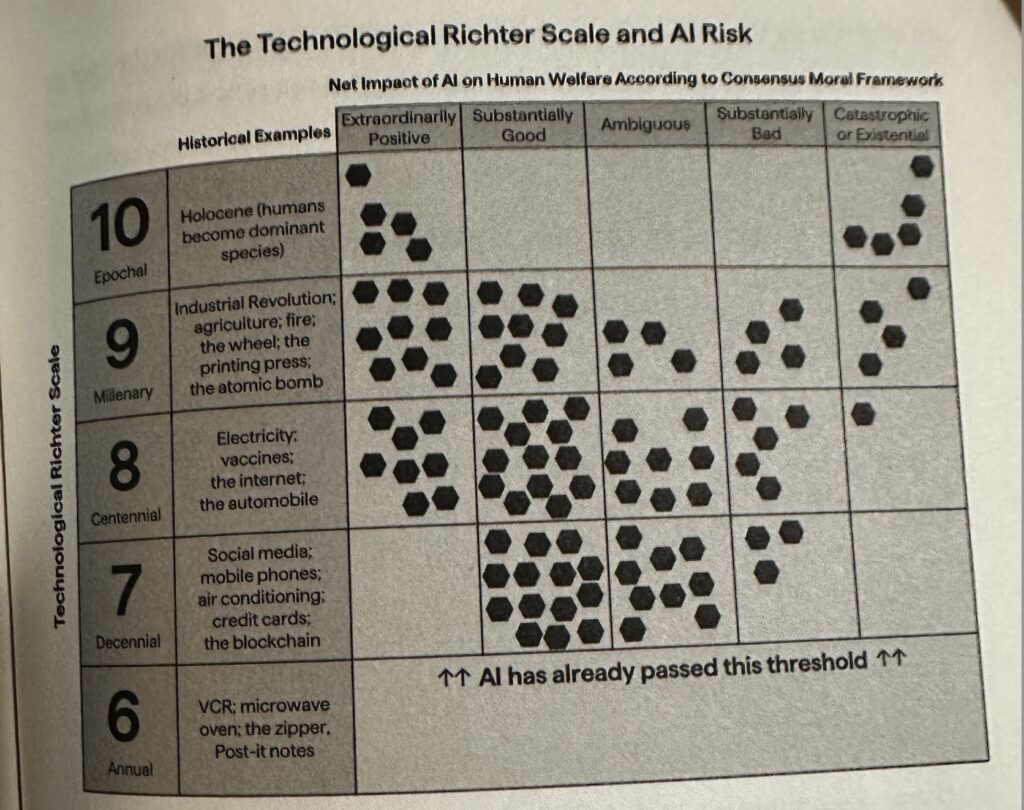
- Roon twitter user catalog of AI outcomes
- “Utopia always leaves somebody out” Emilie Torres told author
- The ideology of liberalism and enlightenment shaped the technology of the industrial revolution— what’s this moments new ideology (EAs?)
- Deidre McCloske: private property rights on upside and social safety net on the downsides helped fuel Industrial Revolution to let more people “have a go”
- Agency. Plurality, reciprocity; his ideals for our age
- Author’s three proposed book pitches: gambling, Ai and gam theory