Does technology advanced by the American military make the world a better place? Or a worse one?
The last century has made those complicated questions. It’s difficult to interpret American involvement in the 20th century’s first two world wars as resulting in anything but a freer, safer, happier world. The track record has been murkier since.
The ascendant uses of artificial intelligence has awakened the debate. Whether the “neo-prime” military contractors like Palantir give the world’s most powerful democracy an edge to maintain that freer world, or fuels a morally vacant oligarchy, is a hot debate in American culture. At the heart is the US-China rivalry. It’s important then to understand the origins of the American military embracing AI.
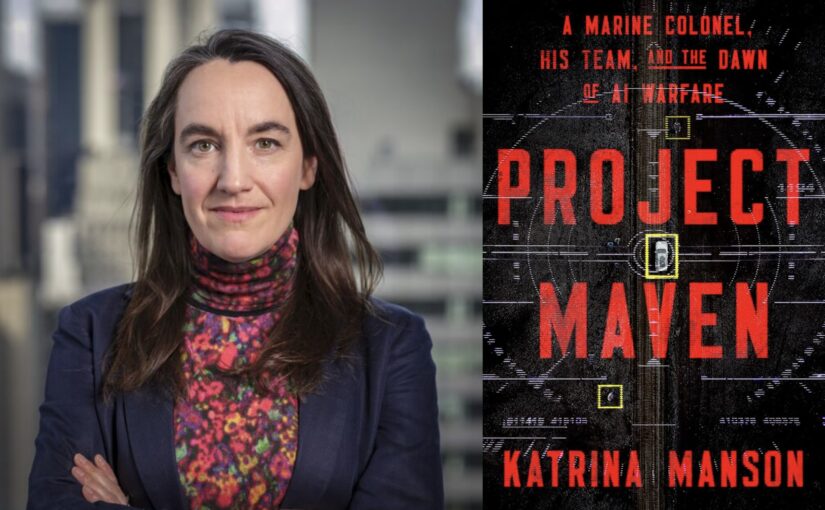
That’s the focus of British journalist Katrina Manson’s 2026 book Project Maven: A Marine Colonel, His Team, and the Dawn of AI Warfare.
She tells of the tale of Drew Cukor, who more than almost anyone dragged a hardware-focused Pentagon toward the data-science and autonomy that was sprouting out of Silicon Valley. When he began his leadership before 9/11, intelligence was viewed to military leaders as secondary, “like a flower in the room.” That has changed.
Below I share my notes for future use.
My notes:
- Drew Cukor was part of Task Force 58 charged with making inroads with the Taliban two months after 9/11, using Microsoft Word, Power Point, Google Earth and military software they liked even less than those consumer applications
- Of the use of Microsoft software to attempt to cross reference information, an army officer said “we’ve killed more people on Office than you’d ever imagine”
- In the late 1990s, before 9/11, tensions were rising between China and U.S. — that became a secondary concern for decades
- Global War of Terror: Americans struggled to solve IEDs which killed two-thirds of American casualties
- Story of Cukor’s career-long focus on information being the gap
- 2010: Cukor identified Palantir for its Pentagon role
- Kathleen Carley of CMU (automating CIA intelligence) was a Cukor co-author on a paper arguing for mix human and machine model of analyzing data
- The line was that the U.S. had fought the war in Afghanistan 20 times over because of lost institutional memory when new units came in
- A Palantir competitor was Analysts’s notebook i2, that IBM later owned and was much reviled within military users
- Data concerns developed even before the Edward Snowden 2013 release
- Colonel Kurilla: sports stars aren’t heroes, the military is
- O’Callaghan paper on MAVEN and early supporter
- Cukor: intelligence was viewed to military leaders as secondary, “like a flower in the room”
- Robert Work In 2015: “I’m telling you right now 10 years from now if the first person threw a breach isn’t a fricking robot, shame on us… we can do this”
- Cukor had fought wars, was technically savvy and knew pentagon operations
- Cukor: department of defense needed to be more like a software firm managing data than a weapons manufacturer (to avoid incidents that look predictable but were not predicted)
- Cukor visited Silicon Balley and the Uber plant in Pittsburgh — where camera on cars could process data
- April 26, 2017: Robert Work signed memo and scope for Project Maven that was its chief
- Commander’s intent: goal not tactics
- Maven said to be responsible for multiple divorces — one former member compared to the Apollo space program in that regard. One pregnant applicant for a role came and the male interviewer asked if he even had to conduct the interview, because the roles were too demanding for anyone with a family
- Matt Zeiler on Clarifai: Cukor hired four AI firms and unusually paid all a license fee for their models so the military could use privately on their data and let the four compete
- Joe Redman was one AI researcher the military pursued. He eventually declined writing in June 2025 “the US is the largest state sponsor of terrorism in the world… Don’t work on tech for the military.”
- Cukor: “operate to know” thesis evolved into “field to learn” a reading
- Within a few months of Maven launching, Cukor got AI tools testing with teams, using real data. JSOC in Somalia was most eager early deployment of AI in real world in 2017
- The first time Maven ran rest for Somalia was at army’s Fort AP Hill training center near Fredericksburg, Virginia in December 2017 — flew scaneagle drones, pushed data through TIPs and ran models against the footage. It didn’t all work but they accidentally brought down the JSOC network — 8 months since launch of Maven and by Cukor’s Christmas 2017 deadline.. but it was underwhelming: misidentifying clouds as a bus in the sky
- Previously staff spent 14 hour shifts staring at full motion video (FMV) and identifying signals themselves in the small movements of terrorist group — by 2014, after suicides, culture shifted and psychiatrists were made available
- In July 2015, Demis Hassabis and dozens of researchers from Google DeepMind joined hundreds of scientists, technologists, and AI leaders in signing an open letter warning against the dangers of autonomous weapons and calling for a ban
- 2012 Stop Killer Robots campaign
- 2015 Pentagon establishes defense innovation unit experimental, Ashton Carter among its leaders
- At Google, Aileen Black was a champion of Project Maven — the rule was no autonomous weapons but Maven now had been
- 2018 project Maven Google News breaks and backlash means they don’t renew — but Xnor maintained the algorithms for DOD and Microsoft and AWS joined, bringing about the reversal of Silicon Valley in military
- Colin Carroll: “we kill the wrong people all the time… the machine can’t be worse than a human” — of the first drone strike to mistakenly kill their own men in April 2011 in Afghanistan
- Elsa Kania: despite what Chinese leaders say of peaceful AI, in November 2017 report she laid out their military plans
- In June 2018 pentagon announced new Joint AI Center and advanced use of the phrase “responsible AI” after the Google pullout as it courted big tech support — arguing China could simply coerce its industry (after Google Maven went quiet, getting a FOIA exemption)
- “Alex Karp, the 21st-century AI arms dealer” [notes on his book here]
- Palantir’s Karp referenced Einstein in a 2023 NYT op ed because Einstein called for FDR to speed the bomb — but later Einstein said it was “one great mistake” which Karp didn’t mention
- The Finish by Mark Bowden: 2012 book implies Palantir helped find Bin Laden but this author could not corroborate
- Karp at a national defense conference: “Safe means that the other person is scared” America’s adversaries “need to wake up, scared, and go to bed scared”
- In his farewell address to the nation, President Joe Biden warned against the potential rise of a “tech industrial complex” and an emerging oligarchy of ultra-wealthy individuals.
- Palantir Sankar liked a Vannuever Bush quote: “The coming war is going to be a technology war… We believe the US is wholly, unprepared and ilequipped for a war driven by advanced technology. The only solution is to outsource advanced weapons systems development outside of the traditional services and government ecosystems and hand the development to civilians.”
- Palantir and Shield AI as merger of software and hardware in battlefield — to follow consumer applications
- Bagdadhi killing in October 2019 partly used Maven
- Many in military were skeptical of Palantir as soaking up annual recurring contracts, and that Maven was grooming them to take over after Cukor hit retirement mandatory age
- Cukor largely battled internal pentagon culture; he was out in late 2021
- Kurilla called on Maven in Ukraine (feeding them targets, three times as many as five years earlier in Iraq (the kill chain)
- Joey Temple: approving 80 target approvals in an hour with Maven, just 30 without it — but still the man in the loop
- Sierra Leone among those opposed to autonomous warfare
- Common to compare autonomous warfare to land mine ban that didn’t initially in include U.S. Russia or China either
- Replicator and goalkeeper drones and other programs with autonomous
- Cukor wanted AI in military to save lives ((like other military advances??)) because he came to understand “AI would not only distance fighters from the active killing, but it would also potentially distance them from the decision to kill as well… Removing fighters from direct physical harm, also didn’t guarantee that they’re psyche would be saved”
- Israeli using AI against Palestinians