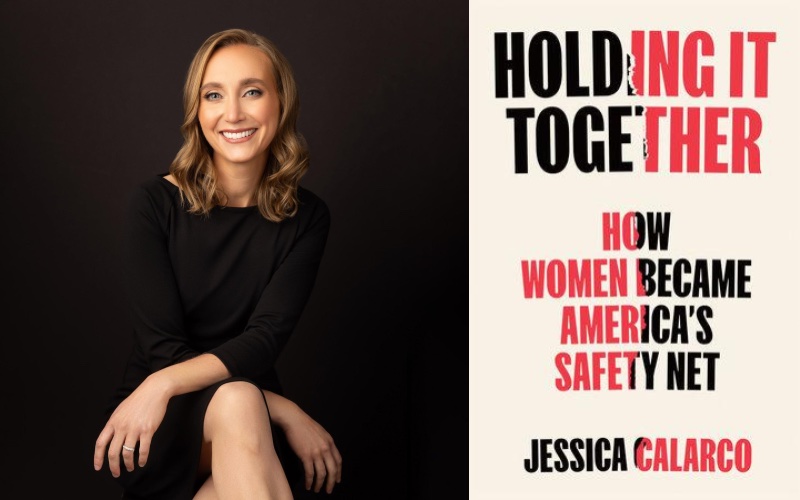
“Other countries have social safety nets. The US has women.”

The pervading myth of gender differences encourages men and women to vote against a stronger social safety net, thereby requiring women to fill that gap — and leave less competition for jobs with men.

That’s a big argument from Holding It Together: How Women Became America’s Safety Net, a 2024 book by research Jessica Calarco. In her acknowledgements, she said her publisher reached out because she had been quoted as saying “Other countries have social safety nets. The US has women.”

It’s a piercing look, and one I deeply valued — both for broad cultural criticism and for my own discovery. At all income levels, women are more likely to offer childcare, domestic work and eldercare. The book features many anonymized anecdotes to demonstrate the research. At times these feel especially uncharitable to the male characters, but then that just might be the point.

In rich households, women are far more likely to opt out of the most demanding work, and support high-earning men earn more. In poor households, couples are much less likely to be married, and so women are more likely to also be primary income earners alongside their domestic work.

Calarco also summons research on middle-earning households. Today’s husbands often feel more progressive than their fathers. Yet, as the researcher writes: “these egalitarian narratives serve as a shield, allowing men to dismiss inequalities that emerge in their romantic relationships as the result of individual preferences so that gendered outcomes are allowed to go unquestioned, thereby leaving gender inequalities intact.”

The book is unsparing, both of the system and, perhaps more concretely, of men. I’m less convinced that’s effective in securing political power, but it’s certainly important. As Calarco reminds more poignantly: “Care is noticing someone else’s needs even if they don’t ask and being there or listen when they do.”

Below my notes for future reference.

Continue reading “Other countries have social safety nets. The US has women.”
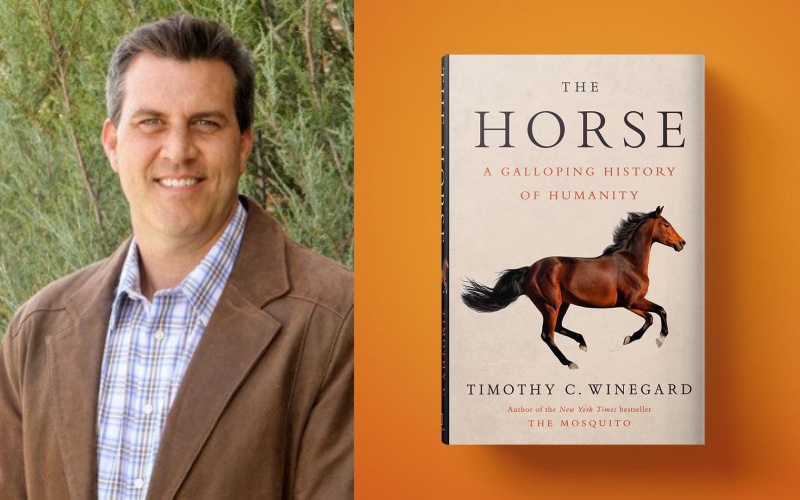
The world history of the horse

The great manure crisis of 1894 has become a half-joking reference to the very serious public health challenge that big cities around the world faced near the end of the 19th century.

A growing reliance on horse power meant the smell, disease and discomfort of manure that wasn’t being removed fast enough. Exactly because this feels so archaic a problem neatly conveys how much we relied on horses, and then how dramatically we replaced them with mechanical labor. Yet the love persists.

This is from Timothy Winegard’s summer 2024 book The Horse: A Galloping History of Humanity. It’s thicker, denser and at at times more lyrical than I expected. It’s certainly a new approach to the sweep of history. Below I share my notes for future reference.

Continue reading The world history of the horse

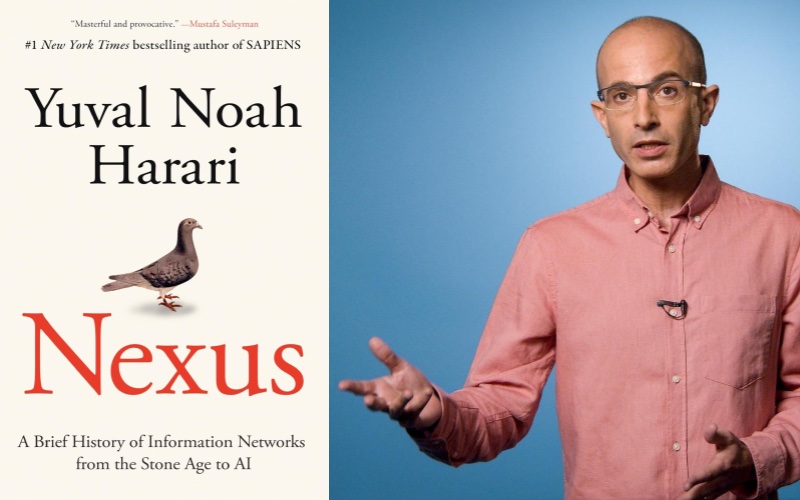
“Information has no essential link to truth”: Yuval Noah Harari in Nexus

More information does not lead to more truth. It wasn’t true in the past, and it’s certainly not true now.

Guttenberg’s printing press contributed to the Scientific Revolution, yes, but also to the explosion of witch hunts. Copernicus’s “On the Revolutions of the Heavenly Spheres” (1543) sold far fewer copies than The Hammer of Witches (1486), an international bestseller. The Industrial Revolution led both to wealth-backed investments of research, and also imperialism and totalitarianism.

That’s a main argument of Nexus, the latest book from popular historian Yuval Noah Harari, which uses the long arc of history to explore the age of artificial intelligence.

“Information has no essential link to truth,” Harari wrote. “Its defining feature is connection rather than representation “

That connection is a balance between truth and order. Information was used from the repressive Qin empire and the increasingly totalitarian Stalinist Soviet Empire to relatively more tolerant reign of the highly-distributed Roman Empire and the United States. To get a (relatively!) more benign version, self-correcting systems are necessary. AI, though, could be used as new attempt at an infallible god, even as past epochs of human history have involved groups of people attempting to mediate between god.

Below my notes for future reference

Continue reading “Information has no essential link to truth”: Yuval Noah Harari in Nexus

Hum

Call the entire industry adversarial tech.

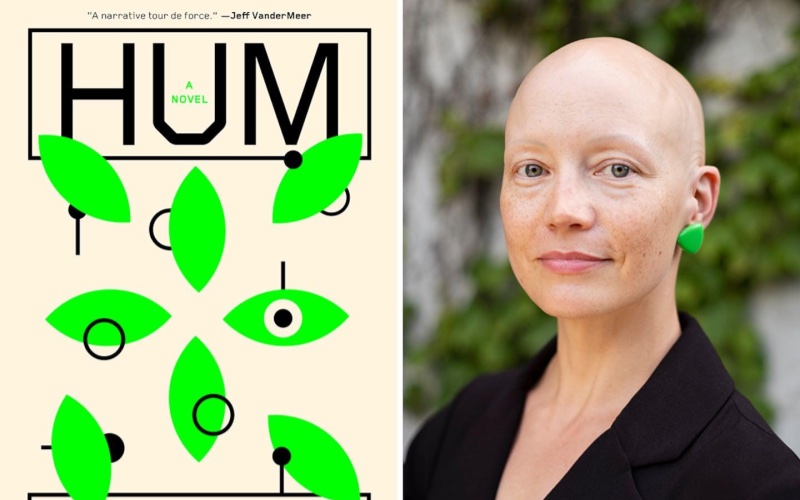
I’ve read almost only nonfiction in recent years. I’ve been quick to drop fiction so much that I don’t try as much — though I’m sure I’ll get back to it at another stage in my life. Yet some fiction does slip in, and so when I stick to it, I know I love it. Such it was with Hum, the near-future science fiction novel by Helen Phillips that uses a world in which newly ubiquitous AI robots dominate modern life to dissect marriage and parenting. It published just back in August.

Says the protagonist mother, who had just lost her job to an AI that she programmed, in reference to her kids: “Whenever she saw beauty, her only thought was that she wanted them to see it.”

Or another line that hit me, a young parent: “Their time here was brief, yes, slipping through their fingers: but it occurred to her that everyday was not twenty-four hours, it was actually ninety-six, each of the four of them living their own twenty-four hours side by side “

Meritocracy should be dismantled

Unsympathetic as they may seem to many, elite workers are stuck in a rotten cycle.

They’ve gotten their status by obsessing over rarified education and lifelong work obsession. They then work to ensure their kids get the same or better advantage, ensuring the system continues.

If a century ago, we saw the end of an aristocratic elite that earned income idly through generational wealth and factories they rarely entered, then today the meritocratic elite earn income working 100 hours a week as a corporate executive, attorney, banker or perhaps true technology leader. There was a time when we thought we solved this: In the 1950s and 1960s, well-intentioned reformers at Ivy League schools introduced a wave of merit-based admissions, which temporarily balanced the scales. But then rich families began to adapt to the rules and now they dominate them.

Rich kids are still more likely to get to elite schools, and then win in elite careers — but they bludgeon themselves with work in a way that their great grandparents wouldn’t have.

This worsens the fate of middle class, who have no chance of breaking into elite educations that are further owned by the rich — not now by hereditary handoffs but by buying elite education — and ensures generational poverty stays so. The elite get the same outcome but at a far higher cost.

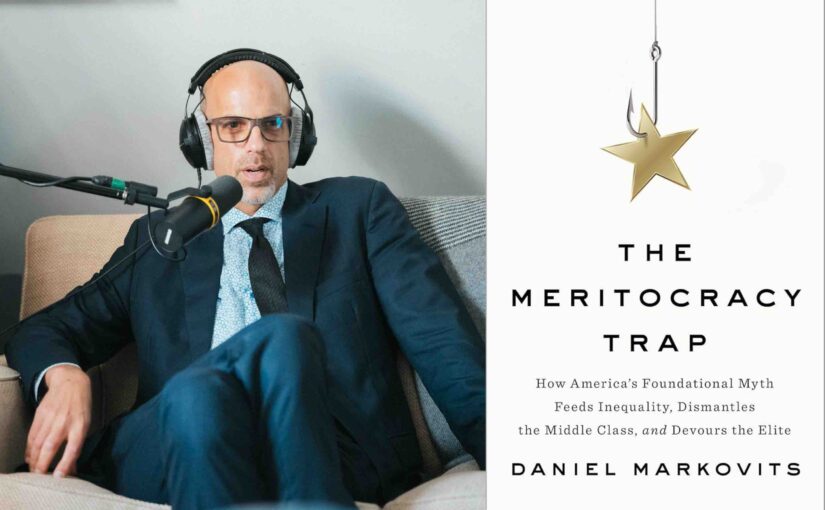
That’s the thrust of Yale Law legal scholar Daniel Markovits’s fall 2019 “The Meritocracy Trap: How America’s Foundational Myth Feeds Inequality, Dismantles the Middle Class, and Devours the Elite,” which I just read. Vox review from back then here.

No doubt his timing was tricky. As his book was published the covid-19 pandemic began to swell. It’s taken me this long to come back to the book, though it’s on one of my favorite topics. He wrote in his acknowledgements the book came from years of work, and in the book he says the final push came from this May 2015 commencement address he gave.

He’s a dazzling writer, with some wonderful turns of phrase, but he needs only half of them. I found myself marveling over a pretty sentence, only to notice that he was essentially reasserting the same point he had just made. Nonetheless, I enjoyed the myriad ways he introduced and reintroduced his concepts.

Below I share my own notes from the book for future reference.

Continue reading Meritocracy should be dismantled

Rye whiskey is much harder to make than bourbon

Rye requires more precise temperature control than corn or barley when being passed through a still to produce a spirit to age into a well-liked whiskey.

Cook corn and barley a bit too hot, and there’s more room for error. Do the same with rye, and you end with a burnt mess.

I wrote about this for Men’s Journal here.

“It’s pretty well known that rye can be tricky to work with,” said Herman Mihalich, the chemical engineer turned founder of Dad’s Hat Rye, “and that ranges from small guys to even bigger guys.”

I got this story idea in my head back in March 2024 when I visited my friend’s small micro-distillery (pictured above), and he shared that without more precise temperature control tools he found rye more difficult than bourbon.

Examples of journalism strategy outside news organizations

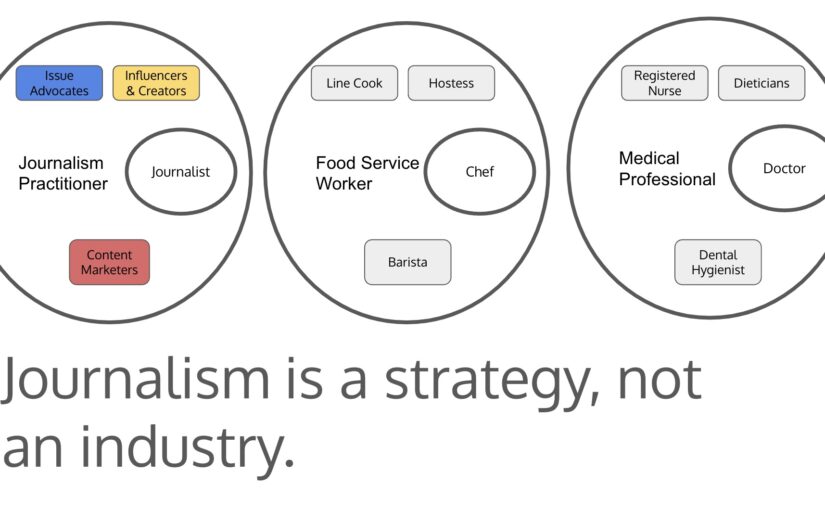
Journalism is a strategy, not an industry. More verb than noun.

I’ve written for years now about what I called “Journalism Thinking,” and so I cxontinue to collect examples of what I consider acts of journalism produced outside of news organizations. Consider this a place for me to gather these examples for future use.

Continue reading Examples of journalism strategy outside news organizations

My 2024 in review

I closed last year having felt that I set a new normal I hoped to continue in 2024. I was right.

I traveled a bit more, spoke a bit more, wrote a bit more, all while feeling more comfortable as a parent and a bit more certain where my company had to go. Plenty of vulnerabilities remain but I feel more comfortable in my life post-pandemic and post-kid. I am blessed, if challenged.

Below I share the highlights.

Continue reading My 2024 in review

America: A Farewell Tour

In 2018, progressives had an especially dim view of the American project.

The Trump administration — from the “Muslim travel ban” to unfunded tax cuts to the more general corrosion of norms — was considered a destructive symptom of “the toxic brew of American exceptionalism.” The remarkable “special century” of American-led peace, growth and economic prosperity had ended. A subtler decline was made public.

Or as prolific writer and critic Matt Taibbi famously put it back then: “Trump found the flaw in the American Death Star. It doesn’t know how to turn the cameras off, even when it’s filming its own demise.”

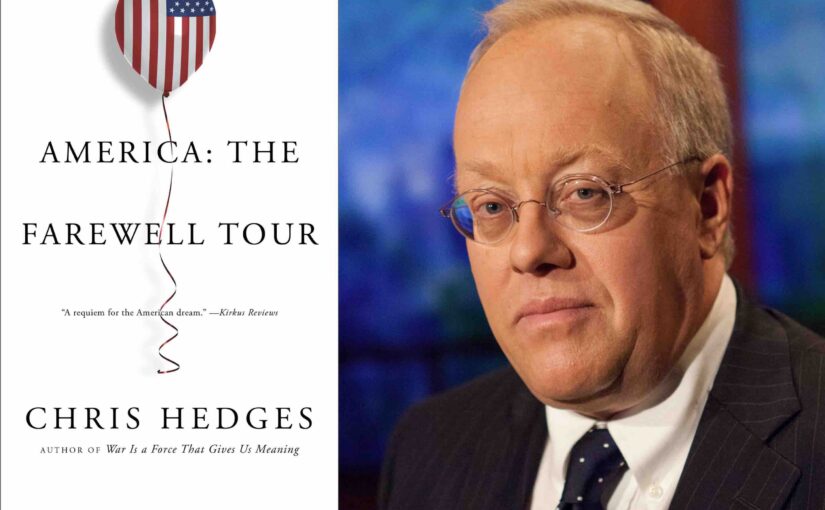
That’s from the 2018 book America: A Farewell Tour, written by journalist Chris Hedges. A Pulitzer Prize-winner, Hedges self-identifies as a socialist and has had an outspoken career — leaving the New York Times after his criticism of the Iraq War featured getting booed for a commencement speech. He later contributed to and ran Green Party campaigns.

The book thoughtfully features many in-depth character studies from far-flung corners of American life, from BDSM culture to white supremacy, from sex work to gambling.

“This is the new American capitalism,” he wrote. “It is not about producing products, but escapist fantasies.”

Regardless of whether my politics overlap with his, I respect how Hedges has pursued his sense of truth. He’s at least an independent thinker. This book came in the heat of progressive reaction to the Trump administration. With his second administration starting next month, It felt fitting to return to see how much of Hedges’s 2018 take held up, and what fell flat.

Back then, like as now, he wrote that we were in Gramsci’s interregnum — which the Marxist writer used to describe when an old order has fallen but the new one has not yet come.

“The American empire is coming to an end,” Hedges writes confidently (p. 294). “It will limp along, losing influence and electing diminished leaders. It will lose reserve currency status [Editor’s note: but to whom!?] and falter.” All “within a decade or two”, he writes. This is by no means an optimistic book, and what hope it has is in working people building something better, it is outstripped by Hedge’s antipathy to the established order. I enjoyed the book, and would recommend it to others — I especially appreciated his thoughtful argument against reactionary violence, as a distraction from the work of organizing.

Below find my notes from the book for future reference.

Continue reading America: A Farewell Tour