All told, my fellow Technically Philly co-founders and PTW co-organizers helped bring together 65 events, from more than 50 groups that attracted more than 3,000 people (we’re still tallying) in the first six day-event that we first suggested in the summer, confirmed in November but did get moving until February.
So, as is my custom, I wanted to gather together what happened, the thoughts from others and my take aways so we can do even better next year.
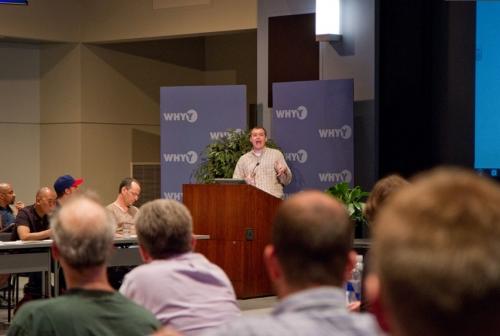
Ten dozen people, including developers, journalists, nonprofit leaders, city representatives and the curious hung around for an hour, with standing room only left, to be there when OpenDataPhilly.org officially kicked off. That says something about the Philadelphia technology community and its interest in the online transparency movement around government.
Late at a bar in my neighborhood, a friend asked me: how are you innovative?
His general assessment was that Technically Media, a consultancy, and Technically Philly, a news site, weren’t particularly innovative or interesting for 2011. We’re an online-based startup of 20-somethings creating journalism-fueled content. That might barley bass for envelope-pushing in the late 1990s.
Sure, we think editorial strategy — in which all organizations create content to build audience to have impact — is interesting, and that’s a big part of what we’re doing, but I wasn’t satisfied.
So I’m going to share what I came to: the five criteria of news entities of the future.
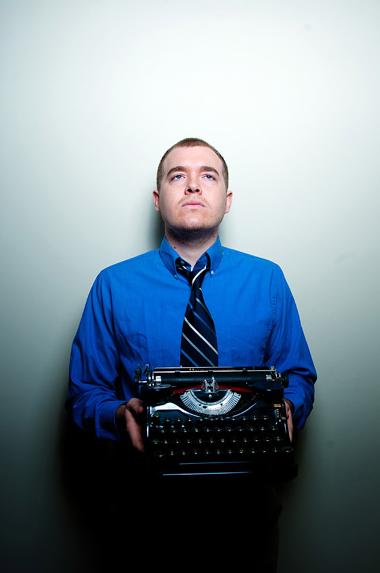
Freelance photographer took some nice shots of the three of us who founded TP and organize PTW, even if that light may have helped me look like a zombie.
The article he referenced was some coverage I did of the Philadelphia Police Department using open source technology for its website and utilizing social media for canvassing communities for tips.
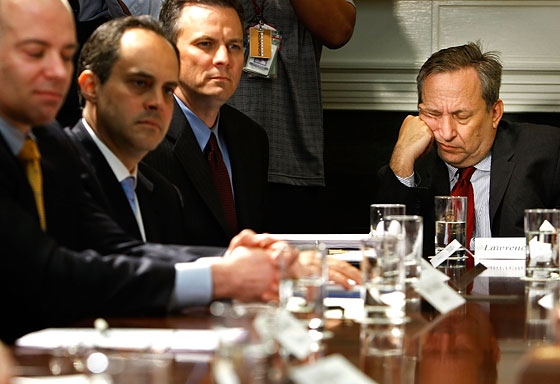
But I think we haven’t touched on what I think is our most innovative reason for sticking together for more than two years: our meeting style. And the power of drag of meetings are important to us.
OK, yah, it sounds pretty boring, and, well, maybe it is, but if you ask about our success (whatever it is) I think it has quite a bit to do with the meetings we’ve almost always held, from the very beginning.
It’s largely a style I’ve advocated for years that has now been further evolved, practiced and cemented into our culture with a lot of follow through from two colleagues who really buy into it and have crafted it on their own. So much do I prefer our meetings over others I often find myself getting into, that I often find myself bringing the style elsewhere.
Below, I share a typical agenda from a Technically Philly meeting, some unwritten rules we’ve adopted for these meetings and the phrases you’d be sure to hear at each of our meetings.
The annual national Online News Association conference, to be held this fall in Boston, has launched its 2011 panel picker, in which those interested can vote to support their favorites of a couple hundred suggested sessions.
I am somewhat involved in three. To vote, users just need to sign up with an email. If you’re interested give love to any of these three:
Data Sets You Free — Informed by my Transparencity work, I proposed to lead a session with Robert Cheetham of Azavea and Chris Satullo of WHYY that would focus on the following: “In Philadelphia, a GIS shop, an NPR affiliate, a foundation, an indie news site and a technology community are coming together to organize, catalog, share and use city government data to create applications, stories and coverage that boosts transparency and efficiency. This presentation focuses on what was done, why collaboration was important and lessons on doing the same elsewhere.” Questions: 1. Why is government data so important? 2. What are challenges, obstacles and lessons from an actual example? 3. What can other journalists learn from such a project?
This isn’t a panel: 10 lessons from Technically Philly — “10 actionable lessons derived from what we’ve learned building Technically Philly, a profitable blog that covers technology in Philadelphia. No panel discussion, just 10 takeaways that you can use at your job tomorrow including sources of revenue and editorial philosophies that you didn’t learn in journalism school.”
Making it work with a small staff — Organized by colleague Sean Blanda, “How can you keep the lights on and the posts coming when you have a staff of ten or less? Join us as we discuss the workflow hacks and editorial jujitsu necessary for a first-rate news site.”
Print is going to last longer than we might think because we can prove print in a way we cannot prove with digital.
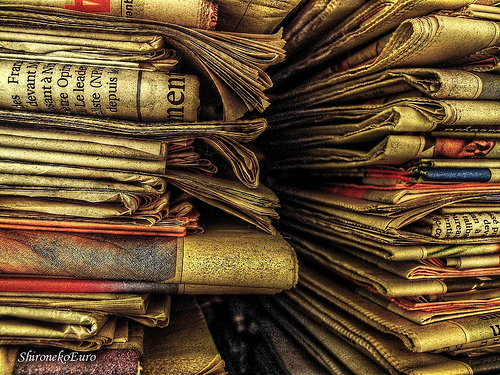
Someone recently mentioned to me that in 10 years, we’ll still be predicting the death of newspapers. I think sitting here, in my office, looking at a copy of the Wall Street Journal that I stuffed into my pocket after finding it on a bench at the 2nd Street station in Old City Philadelphia, I believe that to be true.
Let me say something controversial: newspapers mean something more than news sites. Just like printed photographs mean something more than Facebook pictures.
Digital media still should amaze in their flexibility, utility and reach. But their printed counterparts are also still remarkable for all the reasons their future seem limited: they are inflexible, expensive and in-viral.
We at Technically Philly have had many short stops with sales help, making it one of our most prominent failures. Like many startups, we found that the three of us did the best sales, particularly when we were getting started.
Just came across this September 2009 TED presentation in which Leadership theorist Simon Sinek talks about what makes Apple, Martin Luther King Jr. and other leaders different than their competitors: “People don’t buy what you do, they buy why you do it.”
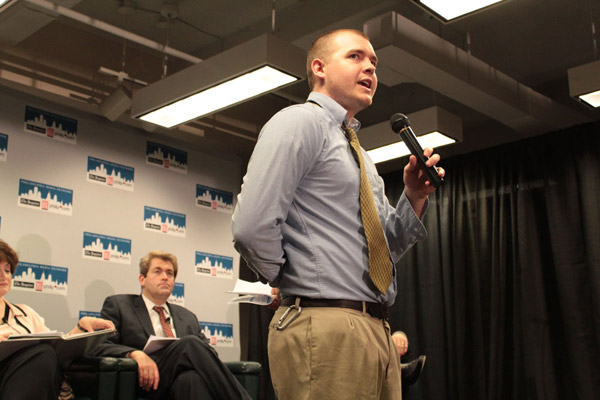
 The inaugural Philly Tech Week, made official by City Council, has come and gone.