Newspapers were once the big tech platform companies everyone hated

This is adapted from a Twitter thread.

There are many parallels between early newspapers and today. Like then, today big tech platforms are vilified for taking creative destruction to a more harmful end to civic discourse.

Then partisanship and misinformation gave rise to the modern concept of editing. Perhaps something akin is happening again.

Continue reading Newspapers were once the big tech platform companies everyone hated

News organizations: how do you get throughout feedback from your community?

I assume that the idea of ‘letters to the editor’ was once a representative and effective means for news organizations to receive feedback from their community.

I’m not certain it remains so. For one, those can of course only be sent in for what has already been announced. I also get the sense not many reporters really listened or could gauge the preponderance of feedback.

The rise of quantitative surveying helps, though of course surveys are also not necessarily representative. We at Technically Media do our fair bit of surveying, after events and annually too. We also host regular curated groups of readers and (importantly) those we aspire to be readers of ours.

Continue reading News organizations: how do you get throughout feedback from your community?

“Ability to deliver for clients” can’t be anathema for news organizations

Leading a small news organization puts me at an unusual crossroads: I’m as close to our sources as I am to our customers. In my experience, most of those interested in financially supporting Technical.ly know their stuff. Of course, there are exceptions, but on the whole, they’re better informed than average.

Yet I often encounter a default assumption among journalists: To demonstrate independence, many instinctively treat those who financially support their news organization worse than those who don’t. This creates perverse dynamics. I’ve had potential advertisers tell me they avoided sponsoring us because they feared their independent coverage would be perceived as bought-and-paid-for.

This is a dangerous place for news organizations. It’s a cultural tic that likely developed during an era when newsrooms operated as monopolies, flush with resources, and could afford to brush off financial supporters.

But that’s not where we are today, and it’s not where we should want to be.

I push my newsroom on this point: You don’t have to treat financial supporters better, but you certainly shouldn’t treat them worse. As a publisher with an entrepreneurial mindset, I see it as part of my role to find ways to acknowledge and thank those who support us. But I won’t force it.

What I will insist on is this: the “ability to deliver for clients” cannot be anathema for news organizations. If society equates a news organization leveraging its “halo effect” with content marketing, we’re missing the point.

Technical.ly’s reporting is guided by truth, not business objectives. That’s journalism. But attracting advertisers, sponsors, and investors whose goals align with ours isn’t a problem—it’s smart. The danger lies not in seeking aligned partners but in twisting journalistic goals to fit theirs.

Independence doesn’t require antagonism. It requires clarity of purpose.

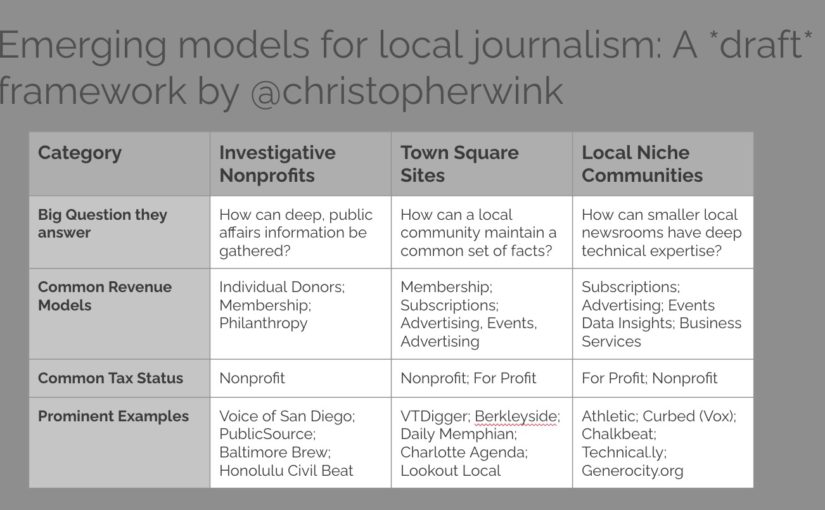
Three emerging approaches to local journalism

It’s no longer quite right to say journalism as a whole is imperiled by the internet-age. In the last decade, powerhouse national outlets have made the business model leaps. Other important and influential national and global organizations gather and produce valuable information for the civic good. Their concerns are now with truth and partisanship and objectivity. These are heady issues but they’re not directly revenue problems.

This is different from publishers with a geographic focus; previous business models don’t comport simply with web-powered scale. Local journalism is very much in crisis. I know this personally and professionally, so I follow trends closely with an applied viewpoint

I’ve long thought that we at the news organization I cofounded a decade ago are something of an outlier, trying to approach local reporting through a for-profit, multi-local strategy. (I wrote here about why Technically Media is not a nonprofit). Recently though I’ve noticed that we may fit into one of three broad approaches I see tackling local news.

This is made clear by the strengthening of the country’s superstar national commercial journalism providers as the collapse of the dominant local forms continues apace. Web-powered scale has laid bare that national and local outlets are in entirely different categories. 

Continue reading Three emerging approaches to local journalism

There was a crowd of us, now we are almost none

From an eyewitness account of the Black Death of the 1340s:

“There was a crowd of us, now we are almost none. We should make new friends, but how, when the human race is almost wiped out; and why, when it looks to me as if the end of the world is at hand? Why pretend? We are alone indeed. You see how our great band of friends has dwindled. Look, even as we speak we too are slipping away, vanishing like shadows. One minute someone hears that another has gone, next he is following in his footsteps.”

[source; first spotted in this video at 33:42; not Agnolo di Tura]

(Photo by Mads Rasmussen via Unsplash)

Advice for journalists graduating into a recession

New journalists, I graduated May 2008, and though I actually think this moment is even more challenging than then, let me share a few thoughts I wish someone told me then.

It’s ok to consider a job outside journalism. Your skills (writing, analysis, research) are portable. We do want people to shuffle to growth industries. You can bring journalism thinking and support elsewhere.

But the economy is presently stalled and many of you are true believers, so let’s talk.

Continue reading Advice for journalists graduating into a recession

Journalists as a ‘community directory of last resort’

Journalists fill such a unique role in communities. As a mirror, we show the best and the worst. We also often serve as a kind of directory of last resort.

I want to tell you something incredible, yet familiar, that happened recently.

Continue reading Journalists as a ‘community directory of last resort’

Thoughts on tax status and journalism

Journalism is the messy art of connecting that which is true with that which can be understood. I’ve defined it in other ways before. However you define it though, practitioners like me tend to assume it is important. We work to maintain it.

In the past few months, I’ve taken a critical look at that assumption, that journalism matters. One way I’ve done that is thinking about the types of organizations that produce whatever it is that journalism is.

In periods of economic change, when institutions or processes or elements of culture are lost, challenging the assumption of importance matters. It’s a crucial step. Are we trying to hold on to this thing because of tradition or because something functionally has import?

Political philosophy is rich with debate over what crucial societal functions should be enshrined into government, or maintained by charitable organizations and what the free market can do best. With the economic disruption confronting how journalism is produced, this question is relevant again.

Continue reading Thoughts on tax status and journalism

Notes on ‘The Invention of News’ by Andrew Pettegree

The journey to get to professionally-verified information includes social, economic and political coursework. To share this journey, historian Andrew Pettegree focused in his 2014 book The Invention of the News heavily on the European development.

It is dense and comprehensive, at least in the continental sense. It’s been on my list for a year or so, and I finally dug into it, with pages of notes. Find reviews of the book in the Times and Guardian, and consider buying the book yourself. The book’s focus is between the years of 1400 to 1800, and it’s clearly written by a historian, rather than a contemporary media studies approach—I prefer this more dispassionate and distant view of the origins of an industry.

Knowing that printing had earlier roots in China, the book is decidedly Eurocentric. Still I would strongly recommend it to anyone as interested as I am in the foundation of media, news and journalism. Pettegree’s stance is that the industry of professionalizing information-gathering was a European concept, which is his focus. This was one of several books on early journalism foundations I’ve read in the last year.

Find my notes below.

Continue reading Notes on ‘The Invention of News’ by Andrew Pettegree

More Americans are coal miners than local journalists

It helps to understand economic change by comparing stories.

Naturally the visualization of the soot-covered coal miner is an evocative image of blue collar industry. Almost immediately as that image became a tool during the 2016 U.S. Presidential Election, it became a political football.

To put the size of the coal industry in context, we were reminded that the middling fast food chain Arbys employed more people than the entirety of the coal industry. Turns out, though, more journalists have lost their jobs than coal miners. To understand job losses in news-gathering then, researchers asked, are journalists today’s coal miners?

Continue reading More Americans are coal miners than local journalists