What happens after Eureka?

We love to celebrate the spark of a good idea, but we too often skip over the long, uneven road it takes to get that idea into the world.

Research on innovation keeps pointing to the same tension: breakthroughs come from serendipity and “structural holes,” where people from different disciplines collide, but impact only happens when we deliberately smooth the path that follows. That’s what made a conversation I led at Baltimore’s University of Maryland Biopark, inside the innovation district’s year-old 4MLK building feel special.

I contributed Technically coverage here and here. The Biopark team had a photographer on site, so I also just pulled some of the shots of me in action below.

Continue reading What happens after Eureka?

In Covid’s Wake

Before the covid-19 outbreak, public health officials around the world largely agreed that containment of a flu pandemic is largely futile so better to focus on the most at risk populations: speak honestly, encourage healthy behaviors and work fast on a vaccine.

It didn’t all go to plan. In the United States, the Trump administration successfully oversaw a historic vaccine development, while injecting hostile politics into the system. Meanwhile, left-leaning states over-relied on non-pharmaceutical interventions (NPIs), such as widespread masking and extended school closures, that had limited gains for considerable cost. Right-leaning states contributed to vaccine skepticism, which led to hundreds of thousands of excess deaths.

The new book In Covid’s Wake: How Our Politics Failed Us, written by Princeton University political scientists Stephen Macedo and Frances Lee, attempts to put forward an unimpassioned assessment of the American-led public health response. I simplified their assessment of a handful of the most prominent public health measures into the chart below, and in a social video here.

My summary of In Covid’s Wake interpretation

It’s one of my favorite nonfiction books of the year. Below I share my notes for future reference.

Continue reading In Covid’s Wake

Katalin Karikó on “Breaking Through”

Katalin Karikó’s neurosurgery department chair kept asking her about hitting his preferred metric of “dollars per net square footage,” in terms of funding her lab time with grants, or even prestigious publication. It’s amusingly anodyne and corporate when recounted by a now eminent scientist, who had just told her boss about beginning to collaborate with a cross-disciplinary immunologist Drew Weissman, with whom she would later share the Nobel Prize.

That’s from Breaking Through: My Life in Science, the October 2024 autobiography by biochemist Katalin Karikó, who shared the 2023 Nobel Prize in medicine for her work on mRNA which contributed to the rapid deployment of the covid-19 vaccine. I admire her greatly.

In an over-simplification, cell and gene therapies directly influence DNA, whereas her research focused on using mRNA to send a temporary message to cells. mRNA is considered more unstable and difficult to work on, so it had long been dismissed as not an effective means of treatment. She’s become a canonical example of a delayed payoff for hyper-fixation on a particular problem (almost 20 years with limited academic or industry recognition).

The autobiography is an enjoyable read, starting with her being raised in Soviet Hungary. She criticizes the surveillance system, but remembers fondly its elevation of science and spotting kids with promise from households with less education. She remembers that her school transcripts always had an “F”, for “fizkai” to clarify her parents had worked “physical” jobs and were low educated, which got her extra attention from educators in communist Hungary.

She says half of her elite biology college cohort came from this working class tradition: can any elite American institution claim this?

Below I share my notes for future reference.

Continue reading Katalin Karikó on “Breaking Through”

Book of The Dead by Richard Dawkins

Science enhances our experience with the world, rather than diminishes it.

For example, by understanding genes, we better understand that all of us are a kind of palimpest, messages layered up ones before us. This is the beginning thrust of Book of The Dead, written by eminent science thinker Richard Dawkins last year.

I didn’t finish this. It didn’t capture me but I respect Dawkins. Below some notes for my future reference.

Continue reading Book of The Dead by Richard Dawkins

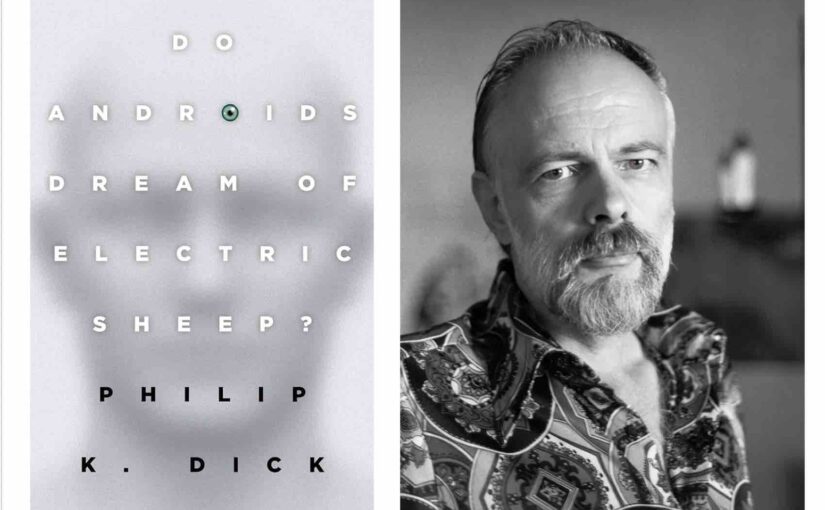
Do Androids Dream of Electric Sheep?

Initially set in 1992, later editions of the science fiction classic “Do Androids Dream of Electric Sheep” updated the setting to 2021. And so, we have now lived through Philip K. Dick’s 1968 novel.

Perhaps best known as inspiring the 1982 Harrison Ford movie Bladerunner, the novel won mixed reviews at launch but has developed a cult following. Dick (1928-1982) is not remembered as a great writer as much as a great thinker (Minority Report and Total Recall also inspired by his stories), and that’s felt truer still after a new wave of artificial intelligence hype.

The title plays off a subplot of the book in which the humans who remain on earth (after nuclear fallout) covet the status symbol of a living animal, as opposed to artificial ones. So, the question is whether androids (the increasingly human-passing machines that the main character is chasing) would dream of electric ones? Its big theme: What defines humanity, especially if machines increasingly recreate many of the skills we identify with? I enjoyed the book, and below share notes for my own future reference.

Continue reading Do Androids Dream of Electric Sheep?

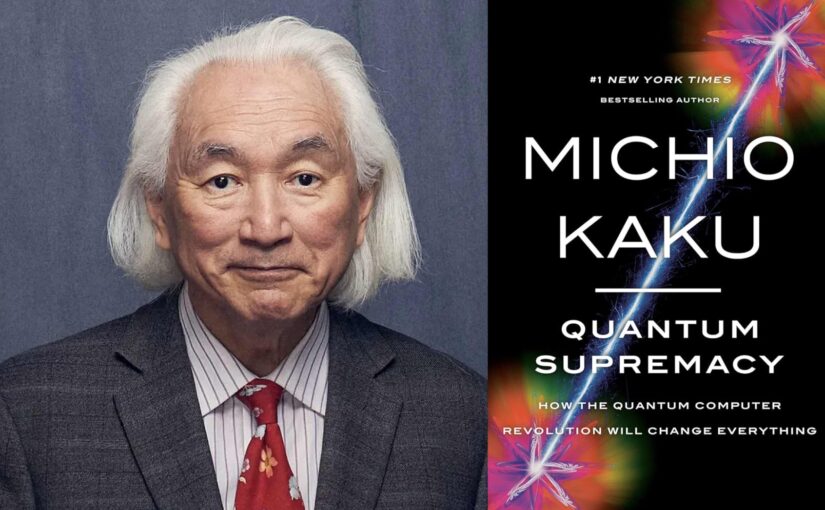
Quantum Supremacy by Michio Kaku

Newtonian physics works for most of our everyday experiences. But for the biggest systems we encounter, we need Einstein’s theories of relativity to make sense of spacetime.

Neither, nor does our own intuitive understanding of the world, work at the smallest scale we understand. This is the quantum level, where electrons can be at two places at the same time, transmit information faster than speed of light and instantly analyze infinite paths between two points.

As Danish physicist and Nobel laureate Neils Bohr (1885-1962) wrote: “Anyone who is not shocked by quantum theory does not understand it.”

And much like we didn’t understand all the ramifications of the atomic age before we developed nuclear weapons, governments and companies are busy investing in the military and commercial implications of the potentially radical advancement in quantum computing.

That’s the timing from prominent physicist and science communicator Michio Kaku in his 2023 book “Quantum Supremacy: How the Quantum Computer Revolution Will Change Everything.”

By no means exhaustive, I picked up the book for a primer on the technology my work overlaps with. Below I share my notes for future reference.

Continue reading Quantum Supremacy by Michio Kaku

How will the world end?

Given our odds, it’s a lot more likely the human species will go extinct long before Earth itself is destroyed. Funny that we don’t given that chilling nuance more thought.

The 2019 book “End Times” by journalist Bryan Walsh discusses various potential catastrophes that could threaten humanity’s survival. One of the main points made in the book is that humans have a tendency to underestimate the likelihood and consequences of catastrophic events, and that we should be more proactive in addressing potential threats to our survival. Fitting that the book was published before the covid-19 pandemic was identified.

The book covers a range of topics, including the risk of a nuclear war or environmental disaster, the possibility of an asteroid impact, the threat of pandemics and epidemics, and the long-term consequences of climate change. It also explores the psychological and economic factors that influence our ability to address these issues, such as the “arithmetic of compassion” and the social discount rate.

I found the book a mix of big-picture thinking and practical evaluation, a thought-provoking reminder of the fragility of human civilization and the importance of being prepared for potential disasters.

I shared below my notes from reading the book.

Continue reading How will the world end?

Art tells us we are important. Science reminds us we are not

version of this essay was published as part of my monthly newsletter a couple weeks back. Find other archives and join here to get updates like this first.

Art elevates the human experience. Science contextualizes it. Art says we are important. Science says we are not.

I think of this tension often — it’s a theme of a lot of the writing I’ve done for years. High culture is the best tool we have against nationalism and provincialism. The best of what we collectively create tends to come from collaboration and gains interest beyond race or country or tribe. Science is a collection of the facts as best we can see them now. Art motivates us to care, to understand, to act. I’m interested in when we seem to deploy the wrong one for a circumstance.

Continue reading Art tells us we are important. Science reminds us we are not