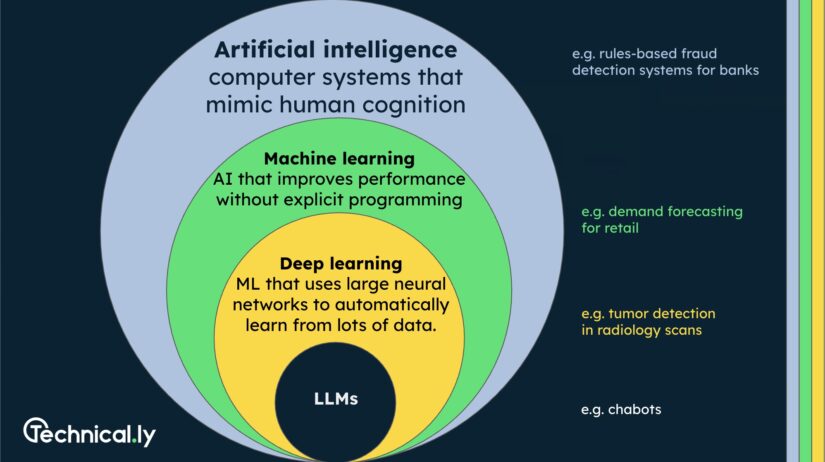
It was summer 2009 that I was first introduced to the idea that robotics and artificial intelligence are two halves of how a machine would move through our world. One is physical motion, and the other is a big term for computer systems that mimic human cognition — from computer vision and probabilistic language to sound mimicry and risk management.
Over the next near two-decades, my reporting and entrepreneurship have evolved alongside a new fast-moving chapter of these technologies we call “artificial intelligence.” I’ve spent at least a decade developing my own relationship to what some have called “the singularity.” Now the last few years have brought this into the mainstream. That’s forced me to develop a more precise view.
For my newsroom, myself and an audience I serve, I’ve spent these last few years looking back at my own reporting, reading everything I can and stacking up interviews across the spectrum. First, I’ve wanted to better describe various inner-related terms.
AI refers to essentially any computer program that mimics human cognition. But lots of ways exist to do this. Successive breakthroughs brought us today’s AI frenzy, including advances in the autonomous improvement of “machine learning” and deep learning (which basically means ML with gobs of data). Then an influential paper from Google researchers in 2017 identified more efficient ways to connect lots of unrelated information.
This got us today’s “large language models,” which predict the most likely response to a prompt by running probabilities against a given data set. They can produce uncanny results, but are ultimately reliant on whatever their training and sources are to mimic. One influential paper called them “stochastic parrots.”
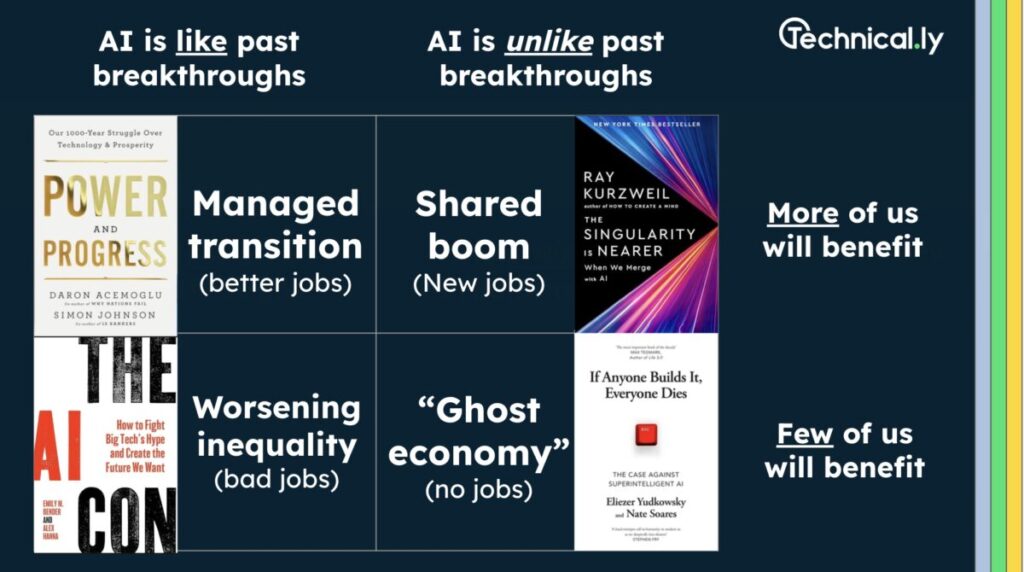
Over the last few months, I worked up the above two-by-two square to analyze research and opinions. Here’s how I recently described it:
To understand the onslaught of AI predictions and hot takes, I rely on a two-by-two square. On one axis is the severity of AI as a breakthrough: Will its effects be no greater than other seismic paradigms we’ve lived through (like internet adoption), or is this self-learning pathway unlike any others before (something closer to harnessing fire)? Pollster Nate Silver introduced a “technological richter scale” in his last book: the credit card is a 7, electricity is an 8 and the wheel was a 9. The other axis is whether these technologies will benefit more of us, or fewer of us.
The top right is highly positive: that an unprecedented breakthrough will end scarcity. The bottom right is apocalyptic: that these technologies threaten humanity. The bottom left is most critical: AI is an over-hyped grift to enrich the already rich. Cards on the table, I’m personally closer to top left: something more akin to the internet, which was truly disruptive but benefited more of us over time.
Credible, good-faith arguments exist across the board, which leaves us stuck.
Put simply, each square can be neatly represented by a book, and credible research:
- AI is unlike past breakthroughs, and will benefit more of us: The Singularity is Nearer
- AI is unlike past breakthroughs, and will benefit few of us: If Anyone Builds It, Everyone Dies
- AI is like past breakthroughs, and will benefit more of us: Power and Progress [Or other such broad economics-informed books about advancement]
- AI is like past breakthroughs, and will benefit few of us: The AI Con