Is your news organization a fire hose or a block party?

News organizations should recognize themselves to be either a fire hose or a neighborhood block party and, if particularly robust, they should have both and discern the different strategies for each.

After joining an Aspen Institute Roundtable in D.C. back in June, I met up with NPR Project Argo’s Matt Thompson, who I teamed up with around CAT Signal a few months earlier. As we tend to do, we got lost in a long and rambling conversation that came to a philosophical point from Thompson: not enough news sites recognize what they are, simply a fire hose, spreading their audience to what is interesting and important.

First, two quick definitions in this context: (a) a fire hose site has relatively large traffic with more drive-by readers and (b) a block party site has relatively less traffic with highly focused and more loyal readers. In our conversation, Thompson introduced the ideas of fire hoses. I started thinking about block parties.

Continue reading Is your news organization a fire hose or a block party?

Local media should be more local on first reference, says Philadelphia man

If you cover a big city with rambling and varied regions and neighborhoods, your reporting and writing should reflect that.

Yet, from a culture of journalism that cycled reporters through various markets to urban decay that encouraged too many of them to live outside those big cities they covered, one of the more common complaints I have from established, legacy media is a frightening disconnect from where they report.

There’s surely no better example of that than the wildly popular Right NEast/Wrong NEast column from Northeast Philadelphia hyperlocal news site NEast Philly, which skewers the very common mistakes by TV and newspapers here, when the get the wrong neighborhood name, street name or worse: tiny details that matter very little to reporters who have never been to those places but matter a great deal to those who live there.

But there’s a more subtle example of this that has long frustrated me, particularly here in Philadelphia.

Continue reading Local media should be more local on first reference, says Philadelphia man

New York City is not representative of the United States: a letter to national media

In 2007, a 44-year-old father of two fell five stories on an active construction site at Temple University Hospital and died.

The Inquirer wrote a nice feature on the man, who died a tragic, accidental death. Locally, the local ironworker union used his death as something of a rallying cry for a new achievement. There might have been some local TV coverage too, if the news day was slow enough.

It’s the kind of heart-wrenching story that happens too often, some 100,000 times in this specific case. But for most of the country, the story ends there. A local tragedy seen through the lens of local media.

I couldn’t find the news report, but I seem to remember a similar tragedy happening in Manhattan around the same time. It was a story like this one from April, where the New York Times reported on a terrible fall that made its way onto the NBC Nightly News and, if I remember correctly, other national media outlets.

This wasn’t the first time, and it hardly was the last. Tragedies are painful no matter where they happen, but in these cases, they’re representative of something else.

Continue reading New York City is not representative of the United States: a letter to national media

Clay Shirky: “News has to be subsidized, and it has to be cheap, and it has to be free”

Academic Clay Shirky tossed down another great post ahead of an undergraduate course he’s teaching at NYU. In the end, he calls for more chaos — more competitive approaches to creating meaning news for citizens, beyond news for consumers.

You ought to read the whole piece, but here are a couple of my favorite parts:

This system was never ideal—out of the crooked timber of humanity no straight thing was ever made—and long before Craig Newmark and Arianna Huffington began their reign of terror, Gannett and Scripps were pioneering debt-laden balance sheets, highly paid executives, and short-term profit-chasing. But even in their worst days, newspapers supported the minority of journalists reporting actual news, for the minority of citizens who cared. In return, the people who followed sports or celebrities, or clipped recipes and coupons, got to live in a town where the City Council was marginally less likely to be corrupt.

“There are only three things I’m sure of: News has to be subsidized, and it has to be cheap, and it has to be free.”

If we adopt the radical view that what seems to be happening is actually happening, then a crisis in reporting isn’t something that might take place in the future. A 30% reduction in newsroom staff, with more to come, means this is the crisis, right now. Any way of creating news that gets cost below income, however odd, is a good way, and any way that doesn’t, however hallowed, is bad.

NBC Philadelphia ‘Request for Proposals Cooperative Arrangement with Non-Profit Local News Organization’

As part of its agreement with FCC to take over majority stake in NBC Universal, Comcast pledged to, among other things, bolster local news.

A half dozen NBC local affiliates, including Philadelphia, announcing a request for proposals to partner with nonprofit news organizations is just that.

I’d sure hope attention is being paid by WHYY and its NewsWorks initiative and the Philadelphia Public Interest Information Network, both of which could create some dynamic, interesting partnerships with a broadcast outlet with a large online audience to boot.

Applications are due next Friday, July 22. Details and applications here.

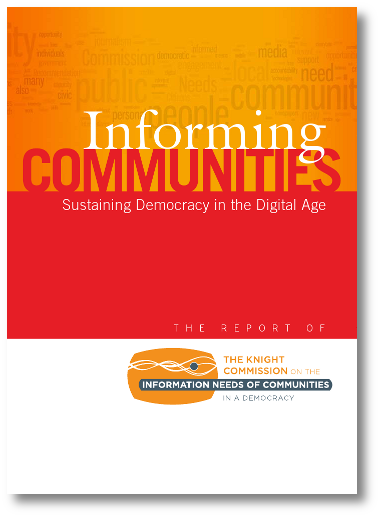
Knight Commission Report on Informing Communities: crib notes on the seminal 2009 project

Almost two years later, I read the entire Informing Communities: Sustaining Democracy in the Digital Age, the report of the Knight Commission on the Information Needs of Communities.

Debuted in September 2009, I tackled the 80-page document for “the Hardly. Strictly. Young conference I attended in April at the University of Missouri, which was dedicated to brainstorming alternative recommendations for implementing that report.

Not a journalism-only report at all and backed by a year of conversation, outreach and testimony, I wanted to share my notes and thoughts on diving into the seminal report.

Continue reading Knight Commission Report on Informing Communities: crib notes on the seminal 2009 project

“Being a reporter is only lately a respectable occupation:” Calvin Trillin

Former Time and New Yorker journalist Calvin Trillin on why there is less drinking in journalism. He references this New York Times story on the changing face of big name journalists.

“Being a reporter is only lately a respectable occupation.”

Former New York Times reporter Gay Talese telling a story about drinking in his old newspaper days

What the Philadelphia Public Interest Information Network should be

If all the timing was right on track, some time this month or next, a CEO might be named for a new collaborative nonprofit news and information project being initially funded by the William Penn Foundation.

As first shared here, the deeply invested regional foundation put an initial $2.4 million onto the table to form with Temple University a Center for Public Interest Journalism, which is being charged with initially housing the currently named Philadelphia Public Interest Information Network and represents the largest gift the university’s communications school ever received. What that will be, well, that’s up to the as-yet-unnamed CEO.

(Full disclosure, yup, the William Penn Foundations funds the Technically Philly Transparencity open government coverage project and CPIJ was the title sponsor for this year’s BarCamp NewsInnovation, so let’s go ahead and assume that I have absolutely no objectivity about anything written here.)

Now, I’ve shared broadly what I’d do if I had $7 million burning a hole in my pocket and wanted to drop it the news pot, but, after a few dozen conversations on this topic, I wanted to get a bit more detailed with my thoughts on what PPIN should be.

Continue reading What the Philadelphia Public Interest Information Network should be

What Philly.com should be: a comprehensive, collaborative and open source for all news in Philadelphia

Philly.com Vice President Wendy Warren, at left, and Philly.com producer Daniel Victor lead a BarCamp NewsInnovation session on the direction of the news site, on Saturday, April 30, 2011.

For Philly.com to maintain and expand upon its role as the dominant hub site in the Philadelphia region, it needs to become a comprehensive, collaborative and open source for all news, information and analysis that happens, reflects and impacts this metro area.

For 15 years, the now Philadelphia Media Network-owned news website has exclusively featured content from its sister newspapers, the Inquirer and Daily News (also owned by PMN), in addition to online exclusives and Philly.com-led multimedia content.

Contrary to what perhaps many at PMN may believe, the more than 200 combined editorial staff members are not, and likely cannot, currently produce that comprehension. Nor should they.

Philly.com’s reach will always be stilted — by other major, also growing online audiences for local TV news websites, suburban newspapers, a nascent, if not yet real, threat in the NewsWorks initiative from WHYY, and other community sites — until it realizes it shouldn’t be a newspaper landing page but the ultimate authority of regional content. That’s a problem for the future success of a brand with a business model predicated on more eyeballs.

Let me be clear here: I have many friends who work there. I think they do great work. This is not at all a criticism of the work done there, but rather, some thoughts for developing their Philly.com brand. I’m an outsider and a journalism geek, so it’s fun to brainstorm. OK, follow my thoughts below:

Continue reading What Philly.com should be: a comprehensive, collaborative and open source for all news in Philadelphia

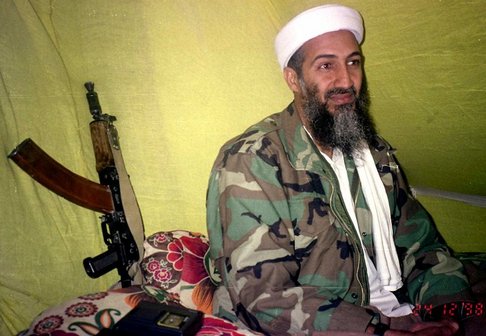
Osama bin Laden: 10 most interesting tweets around his alleged death

(AP Photo/Rahimullah Yousafzai)

So last night President Obama announced that the U.S. military had killed and reclaimed the body of al Qaida leader Osama bin Laden, accused of masterminding the Sept. 11, 2001 attacks.

Around 10:20 p.m., I was culling through Twitter following Philly Tech Week when I saw a stream of tweets referencing an upcoming Obama national address. Rumors were flying and news began coming it: the conference wasn’t about Libya, then it was said it would be about bin Laden.

From there, Twitter took off and after 11 p.m., the President made his address.

I thought I’d share some of my favorite tweets of the night, considering it was how i followed the news, though my housemate and I watched the address online via streaming White House video:

Continue reading Osama bin Laden: 10 most interesting tweets around his alleged death