Blogging for Big Kids

kids

Blogging for Big Kids

Small Business Social Media Mentoring Tele-class | Nov. 23, 2009

How to take your blog to the next level with more sophisticated, low cost features like web video, photo slideshows, free Google apps, social media integration and ways to have fun with it while jamming some traffic to your site. This is how you create a place for customers, clients and friends to know what you’re offering, how to get it, why they need it and make it look good for low cost. [Description here]

You can also download this as a PDF here.

Outline

A. Introductions

  1. What’s your 30-second introduction?
  2. I’ll pull up some of your WordPress sites you built since the previous session
  3. Why I’m worth your time — I’ll give a quick intro, so you don’t think I’m making everything up

B. What you’ll leave tonight with

  1. A clear understanding of why a small business might blog and how
  2. Tools to automate and promote your blog
  3. Tools to liven up your blog content

C. Rehash last week’s session

  1. Domain=Address; Hosting=Land; Platform=House
  2. Small businesses should use blogging to build relationships and authority
  3. You should only be blogging if you’re passionate (brief and easy to read)

D. Evangelical Embed

  • Use the existing multimedia world (i.e. Every minute, 20 hours of video is uploaded to YouTube.)
  • Slide.com for photo slideshows on WordPress.com or Flickr.com otherwise
  • Youtube for video on WordPress.com [youtube Video URL here] or Viddler otherwise

E. Learn to hug RSS

  1. RSS (Really Simple Syndication) is a chronological feed of your content (Often “YourSite.com/feed”)
  2. Plop that on your Facebook page
  3. Automate those pretty little sidebars with links to social media accounts and content

F. [If time] Give in to Google

  1. Gmail account
  2. Feedburner
  3. Google Calendar

G. Take Aways

  1. Small businesses blog to create connections, build authority and share information
  2. Tools to liven up your blog content: existing video and photos or your own
  3. Tools to automate and promote your blog: RSS feeds with social media and others on your site
  4. If you need any additional help, contact me and maybe we can work together on this stuff.

Distribution or content: which is king?

bk_crowncardTheKing_en_01Is distribution king, not content?

That’s the question posed here by Alana G.

Consider a simplified 2×2 matrix: content is either good or bad and distribution is either good or bad. Bad content with bad distribution is going nowhere. Good content with good distribution is in the best position to succeed. But there’s a lot of sports content that lives in the other two quadrants. There are distribution resources being wasted on bad content, and there are plenty of small bloggers making good content with bad distribution. This last category of unseen content may be even better quality than some of the content with good distribution, but this content will not float to the top on its own. [Source]

I like this 2X2 model of bad/good content and bad/good distribution.

Continue reading Distribution or content: which is king?

Thoughts on Future of News panel at WHYY

Edited:Future of News panel
The panel, from right to left, was moderated by WHYY’s Chris Satullo and consisted of Matt Golas, Managing Editor, PlanPhilly.com; Sandra Shea, Editorial Page Editor, Daily News; Joey Sweeney of Philebrity.com and Bruce Schimmel, Founder, Philadelphia City Paper;.

As these panels tend to go these days, really no new ground was covered, but it’s hard to argue with getting accomplished people in a room to talk about it.

Technically Philly partnered with Young Involved Philadelphia this past Thursday to host a panel discussion on the Future of News.

A heavy reliance on foundation funding, a step into telecom, donation and membership programs and other methods that have been argued and re-argued all made brief appearances in last night’s 90-minute event held in a small civic space at the headquarters of WHYY.

Though the sentiment wasn’t hearkened on enough for perhaps the taste of those more obsessively engaged in the conversation, the wider perspective was brought to light.

“It’s really what all of us are doing,” said Sandra Shea, the editorial page editor of the Philadelphia Daily News.

Continue reading Thoughts on Future of News panel at WHYY

How some established journalists see the rest of us

The 21st century graduates of The Temple News:
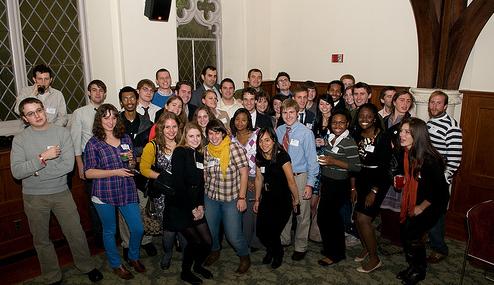
The 21st century graduates of The Temple News at the 88th anniversary alumni reception: (Back from left) Andrew Thompson, '09; Chris Reber, '08; ; Alex Irwin, '08; Brandon Lausch, '06; Lucas Murray, '05; Christopher Wink, '08; Mike Korostelev, '09 (Second from back row) Sulaiman Abdur-Rahman, '07; Chris Stover, '09; Morgan Zalot, '11; Dave Isaac, '09; Anthony Stipa, '09; Kevin Brosky '10; Kriston Bethel, '10; Tracy Galloway, '10; Unclear (Third from back row) Brian White, '04; Holly Otterbein, '09; Leigh Zaleski, '08; LeAnne Matlach, '09; Jen Reardon, '10; Sherri Hospedales, '10; Stephen Zook, '10; Chelsea Calhoun, '10; Maria Zankey, '10; Brian Dzenis, '12; Shannon McDonald, '09; Sean Blanda, '08; Rachel Playe, '08; Brian James Kirk, '08 (Front Row) Brianna Barry, '08; Melissa Dipento, '08; Ashley Nguyen, '12; Malaika Carpenter, '08; Charmie Snetter, '07; Nadia Stadnycki,'06

You just aren’t doing everything you can.

It’s the seemingly unintentional, passive-aggressive jab that I sometimes get from older or otherwise more established journalists, writers and editors. Most often and in many ways, I’m sure the sentiment is pristine in its accuracy, often abutted by the never-to-be-defended-against “it takes time,” which, of course is always true.

But I can’t help but think what’s happened since, say, 2007 or even later, is something bigger that is changing the value of a lot of once rock solid professional advice for young and otherwise aspiring journalists, and making it awfully hard out there.

Continue reading How some established journalists see the rest of us

Hyperlocal news: a definition

Image courtesy of PFSK.com.
Image by Minh Uong/The New York Times.

Hyperlocal news is as much as a buzz phrase for those in news media today as anything else — yes, even social media.

But as these things happen, no real definition seems to hit at what we’re talking about, and I was surprised to not be able to easily find someone who tried to give one.

So, expecting some comments to show where I missed one or simply critiquing my own, I humbly submit one, if only for my own understanding.

Continue reading Hyperlocal news: a definition

A loose steer makes for a great test of local news coverage

Phillipsburg Patrolman Kevin Cyphers attempts to corral the bull Wednesday night after it first got loose. Express-Times File Photo | TIM WYNKOOP

When local news is at its best, it delivers coverage no one else on the planet it can. So, it’s important to take it seriously.

A friend revisited with me a story from northeastern Pennsylvania earlier this year that exemplified it wonderfully: a steer gets loose from a pen the night before a high school agricultural fair. For more than two days it runs wild. The local press, highlighted by the Easton Express-Times and then the Morning Call when it got particularly ridiculous, chased the high school teachers — friends of mine — and the students and administrators as they chased the steer.

It made great, fun, well-followed news. If lessons can be made from when news outlets make mistakes, they can certainly be made from their triumphs. And, livestock or not, this was a triumph. Follow the news feed from that magical May week and what seemed to work.

Continue reading A loose steer makes for a great test of local news coverage

Philadelphia Inquirer John Yoo controversy doesn't seem to be much of a controversy anymore

080401_JUR_yooEX

Well that was a lot about nothing, no?

A Web site, Fire John Yoo is tracking all the news of the now dying coverage of John Yoo, who wrote controversial legal notices on torture during the Bush administration, and the virtriol surrounding his being retained as an op-ed columnist for the Philadelphia Inquirer.

There were protests across the country calling for Yoo to be fired. He wasn’t. And, as news is want to do, it seems to have all but quieted. That’s how John Yoo became a household name and will soon be forgotten.

Inquirer Editorial page editor Harold Jackson, if not perfectly, did, I think, correctly assess the situation and why the controversy may not have been worth it all.

Continue reading Philadelphia Inquirer John Yoo controversy doesn't seem to be much of a controversy anymore

Obituaries: a newspaper staple that should find a way into community news sites

memorial-obitIt’s all about alternative revenue.

Newspapers, large and small, have served for generations as a gateway for providing information about the deaths of loved ones.

Without any real numbers to back this up, it sure seems that unlike things like job listings and other classifieds, obit profits haven’t been eaten away nearly as much.

When I look at highly targeted community Web sites — successful ones like Howard Owens’s The Batvian and My Missourian (read about if they are sustainable) — I don’t see them trying to do the same. Any site that has any meaningful geographic focus and critical mass of readership there needs to see this as an important monetization strategy.

Continue reading Obituaries: a newspaper staple that should find a way into community news sites

What if advertising wasn't in a recession, but dying?

downward-trendIt would create a permanent fissure in the media world.

The question of whether plummeting advertising numbers are representative more of a broader trend than just the economy was the focus of an interesting post from James Fallows of the Atlantic, as I found from Philadelphia Inquirer online editor Chris Krewson.

The real problem is, advertising is dying. It’s just pulling down newspapers along the way. Next up: TV, radio, and Google.

This is why I was warning anyone who would listen that traditional media’s schadenfreude when the internet bubble popped in 2001 was probably misplaced. Because the reason it popped was one finally had the metrics to show Advertising Doesn’t Work. Google has forestalled the inevitable by doing the Net equivalent of the “tiny little ads” schtick of a decade or two back, but I think they see the writing on the wall, which is why they keep trying so desperately to find something, anything, other than search that’ll make money…. [Source]

Continue reading What if advertising wasn't in a recession, but dying?

What links should mean to news media in the future

Most media folks know that casual readers and viewers don’t really care if one news organization beats another by a few minutes on a story.

That’s about the pride of those involved.

If you were beaten, you either searched for a new angle or rehashed what was done, trying to add value in some way.

I figure that will long continue into the future, but I think something should change, an admission of sorts.

Continue reading What links should mean to news media in the future