
Philadelphia’s ‘blogger tax’ controversy speaks to state of blogging, future of media

I am not going to write about the brief media blitz that surrounded the controversy of the City of Philadelphia enforcing its business privilege license requirement for bloggers.

My good friend and Technically Philly co-founder Sean Blanda already handled well my perspective.

(Quickly, Philadelphia, like many municipal governments, requires a license to do business in its environs. An unnamed amount of bloggers who declared on federal tax documents some form of revenue from their publications were compelled to pay for a $50 yearly or $300 lifetime license, the latter of which both Technically Philly and NEast Philly acquired as we brought on revenue. Philadelphia CityPaper reported that the city had begun reaching directly out to bloggers demanding they pay up, a reality first noted on web forum Philly Speaks and, admittedly, ignored by us at TP, and the whole concept exploded. Soon, far flung media outlets were implying that the city’s license — which is required of anyone doing any kind of business in the 135 square miles of Philadelphia — was for bloggers only. It isn’t. And anyone solicited by the city had advertising or had otherwise declared related income federally. So, considering much of the revenue was limited to tens of dollars, it may have been a foolish chase, but certainly not illegal or unfair.)

Instead, I wanted to share two thoughts on the future of blogging that came out of this controversy.
Continue reading Philadelphia’s ‘blogger tax’ controversy speaks to state of blogging, future of media

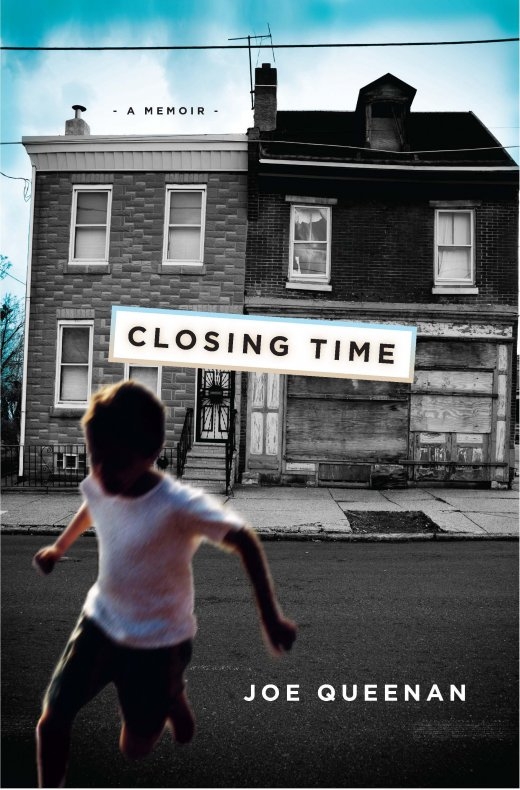
‘Closing Time:’ Joe Queenan’s on growing up poor in East Falls

My reading of choice tends to be contemporary Philadelphia non-fiction — its true stories, histories and cultural anthropology.

Across nearly all of this writing from the 20th and early 21st century is a very unexpected theme: someone growing up angry and put-on in some forgotten neighborhood and developing a very hateful relationship with their city.

Joe Queenan, the Irish Catholic, self-styled Horatio Alger character of northwest neighborhood East Falls, writes the king of these stories, from what I’ve read, in his 2009 childhood biography called Closing Time. The son of an abusive drunk and a withdrawn mother. Queenan writes of chasing dreams that he felt he could never find in Philadelphia.

Find ‘Closing Time’ on Google Books. Buy the book at Amazon.

He was mostly angry. A lot of contemporary Philadelphia writing is. But Queenan has a quick pen — the likes of which has won him the praise of all the big writing critics we’re supposed to respect. Some of those passages kept me reading, in addition to his perspective (however bitter, though, I suppose, he softens in the closing chapters).

I wanted to share some that have the most relevance to those interested in urban development — and strong writing.

Continue reading ‘Closing Time:’ Joe Queenan’s on growing up poor in East Falls

Murder rates in Philadelphia and other cities are all marketing

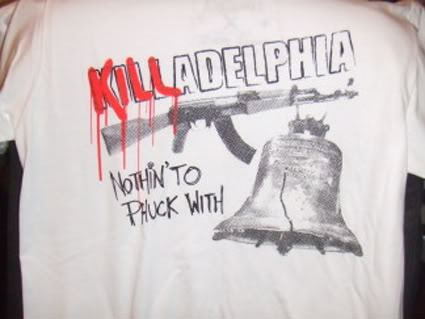
Philadelphia has developed this reputation: Killadelphia or something like it.

In a prominent New York Times profile of Philadelphia District Attorney Seth Williams last week,  the city was described as having been “battered for years by the worst sort of superlatives — the highest murder rate, the lowest conviction rate.”

What a damaging and sweeping comment that when reiterated and reinterpreted across media — that Philadelphia has been “battered” by having the “highest murder rate,” of what, well, they won’t say — can dramatically impact how the Cradle of Liberty is seen nationally.

Williams is supposed to be a part of a “sea change” in the city’s role of prosecuting criminals — a major Philadelphia Inquirer investigation found, as the Times reported, that “the city had failed to obtain convictions in two-thirds of cases involving violent crimes, and that thousands of cases were dismissed because prosecutors were not prepared or witnesses did not appear.”

So, yes, Philadelphia has a problem convicting criminals and crime is certainly a major sticking point for people living in cities (though I’ll add that violent crime is down nationally and many inner-ring suburbs have been battling increases in gangs and drugs and crime since the 1990s). And this ‘Killadelphia’ reputation doesn’t help… but how accurate the name is remains a point of contention here.

Continue reading Murder rates in Philadelphia and other cities are all marketing

Perceptions involved in how we see the livability of U.S. cities

Last month, a study from the Brookings Institution was a major news story.

White flight? In a reversal, America’s suburbs are now more likely to be home to minorities, the poor and a rapidly growing older population as many younger, educated whites move to cities for jobs and shorter commutes. [Source]

It’s complicated of course: new immigration trends chasing a different American dream, people of color from cities doing the same, white families from inner-ring suburbs moving farther from cities and younger white people moving back into those same cities (like me).

But it got me thinking about perceptions.

Continue reading Perceptions involved in how we see the livability of U.S. cities

Final words on the reprisal of the young cop and the student journalist

It’s very easy to politicize what is around us. I fight that urge, too.

Whenever accusations about cops and misdeeds make their way into headlines, most of us either rush to defend them or revile them. Wherever we rush to usually has to do with what camp we most align: either (A) policing is damn hard work and those who do it don’t get enough credit or (B) police officers have enough potentially unchecked power to make us uncomfortable.

Of course, like with most things, the truth manages to be both.

More than a year ago, I wrote about then-Temple University student journalist Shannon McDonald and the contested reporting she did on Philadelphia Police Officer Bill Thrasher. Last month, something of a conclusion was finally met.

Continue reading Final words on the reprisal of the young cop and the student journalist

The Philly Post: City departments that need a Web overhaul

As part of a push for a broader readership, back in March Technically Philly announced a content partnership with Philadelphia magazine and its new daily blog.

Fellow co-founder Brian James Kirk has been writing most of the weekly posts, as he’s still freelancing. But last week, I filled in, penning a short feature on five City of Philadelphia departments that could use a touch of Web openness.

The use of technology to transform government has been a growing municipal interest in city halls across the country.

Here, the City of Philadelphia has announced intentions to release a service-orientated 311 iPhone application, it’s applying for ultra high-speed broadband from Google and it’s in hot pursuit of a funded team of developers and technologists which may someday make our every government transparency dreams come true.

The overtures are there, even if the substance hasn’t yet hit the pavement.

Read the rest here.

Broad Street Run 2010

I ran the Broad Street Run again, after having such a great time running 10 miles through the heart of Philadelphia last year.

I started off by joining the Back on My Feet circle, but, even with the motivation of a few hundred members and volunteers, I ran slower than last year, having offered much less preparation.

Someone else took some video as some of the 30,000 runners took to the hot run around City Hall, nearly midway point. Hear the band playing nearby.

Philadelphia newspaper auction aftershocks, including Hitler

There are new owners at 400 North Broad Street, the historic home of the Philadelphia Inquirer and Daily News, which publish online with stand-alone sister organization Philly.com. The movement begins immediately and will likely result in a closing by the end of June.

Go here for the financial details of the auction of parent company Philadelphia Media Holdings, which was taken over by debt-holding lenders, not the existing local ownership led by Publisher Brian Tierney.

Such large daily newspapers going on the chopping block at a time of continued media fracturing makes for national news, meaning intellectual conversations have ranged from how Philadelphia now compares to other big cities like Minneapolis and why the conversation around this city is so prevalent in media circles.

It’s also meant that the Hitler film parody meme that had a swift death this very month, has been brought back in — I believe — wonderful, insider hilarity. (Aside from the missing ‘been’ on the first subtitle.)

Continue reading Philadelphia newspaper auction aftershocks, including Hitler

Reading: ‘City of Brotherly Mayhem’ by Ron Avery

City of Brotherly Mayhem is a collection of short reflections, culled from old newspaper clippings, on more than a dozen more prominent crimes and murders in Philadelphia between the 1860s and the 1970s.

Written by longtime Philadelphia newspaperman Ron Avery, the book is short on design and polish, but serves as a good piece connecting the dots on some important cultural moments in Philadelphia’s modern history.

Find it on Google Books here.

Some of the more interesting highlights:

Introducing the 67th ward

[Updated: URL is dead, now go here.]

With a bit of a twinkle in our eyes, my colleagues Brian James Kirk and Sean Blanda, today, we launch a small testament to our love for that city that lives in Philadelphia’s historic shadow: New York.

Today, we launch the 67th ward.

It’s not much now and probably won’t be in the future. Just a small landing page for a mentality.

Yes, it comes from that old New York Times trend story that chronicled — in a somewhat condescending tone — the young people from that city, particularly Brooklyn, who were migrating to old transitioning neighborhoods of Philadelphia.

Philadelphia, the story suggested, was the ‘next borough’ so the ‘sixth borough.’

Continue reading Introducing the 67th ward