What is a blog and why do so many people hate them?

blog_logo

If you check out Technically Philly and you follow every minute change, you may have noticed that the tagline that we boast at the site’s top has changed slightly.

Last week it still read: “Technically Philly is a blog covering the community of people who use technology in Philadelphia.” Now it says, “Technically Philly is a site that covers the community of people who use technology in Philadelphia.”

It may be a small change, but we realized we were lying.

Twelve years ago December in Ohio, they say, Jorn Barger took to calling his Robot Wisdom site a “web log,”  as his collection of links were, he said, literally logging the Web.

The type of Web site quickly took to house a variety of online diaries, often collecting news and commentary, too, but always flowing in some form of sequential order.

In 2004, with five million worldwide, the blog format was said to have hit the critical mass of being mainstream, bringing with it a new crew of news analysis and commentary, then largely from an outsider’s perspective.

Something happened then. While some even well-known blogs — like Deadspin, as Buzz Bissinger, Bob Costas and then-Editor Will Leitch made famous — maintained that the outsider’s perspective was crucial to the blog form, the world went silly with blogs.

Continue reading What is a blog and why do so many people hate them?

Advertising can't be the only option and other musings from BarCamp NewsInnovation

You missed the national BarCamp for NewsInnovation conference this past Saturday, held at Temple University in North Philadelphia — even though I encouraged you to come.

I sure didn’t. As I posted about the week prior, I was in Annenberg Hall on April 25.

It seemed to be a personification of online communities and conversations I’ve been following only online — like the value of personal branding, which was the focus of the first hour-long session  I attended, how valuable journalism school really is (why it might not be) and why news organizations and journalists need to add value.

I made it to four sessions, spoke at two and helped divvy out the sponsored food during the long day which officially went from 10 a.m. to 6 p.m., though I was out of the house before eight a.m. and not home before 11 p.m. (after a bumping after part).

These conferences are structured around creating dialogues and allowing anyone to speak on something important to him, so nobodies like me led sessions next door to ones held by executives, editors and reporters from places like the Washington Post, the New York Times, the Los Angeles Times, GateHouse Media, the Philadelphia Inquirer, Philly.com, McClatchy News and, likely more than I don’t know about. I mean, gees, the whole growing crew at Publish2, which develops tools for what it calls collaborative journalism, showed up.

See the complete schedule here.

I learned some things, and I’d like to share them.

Continue reading Advertising can't be the only option and other musings from BarCamp NewsInnovation

WHYY: Joe Frazier wants his whole story told

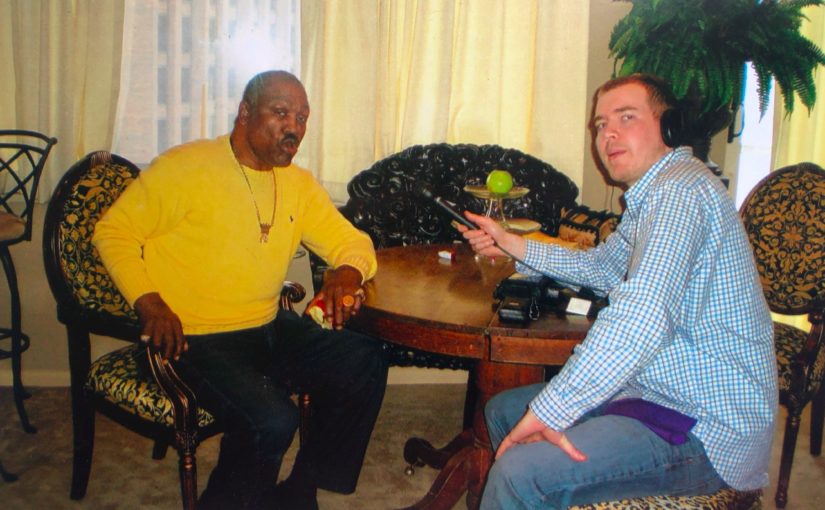
Interviewing Smokin Joe Frazier in his Center City apartment on Monday, April 6, 2009 for WHYY, Philadelphia’s NPR affiliate.

Boxing legend Joe Frazier is the focus of my second professionally produced radio piece, though the first to carry the radio station’s name in my dispatch. Eight months after filing a trial state government report for the Harrisburg bureau of KYW 1060 news radio, I proudly completed a feature report for WHYY, Philadelphia’s NPR affiliate.

I interviewed Frazier, recorded my narration in a sound booth in WHYY’s Old City headquarters and edited it all together with natural sound — aided immeasurably by the patient stewardship of WHYY Web producer Dan Pohlig. I also wrote a short post to run with the piece on the public radio station’s Unobstructed View blog.

In a city eager for celebrities, I’ve never quite understood why we haven’t embraced Smokin’ Joe Frazier. Most of Joe Frazier’s life, which has seen him rise to international, cultural icon and then fade into the shadows, has been spent calling Philadelphia home.

The 65-year-old former heavyweight champion of the world beat Muhammad Ali once, but officially lost to him twice, including in the famed 1975 Thrilla in Manila, which is featured in a new eponymous HBO documentary. [Source]

Read more and hear my audio report here or below.

Listen here.

Then come back to read the backstory and some of what didn’t make it into the final report below.

Continue reading WHYY: Joe Frazier wants his whole story told

Inquirer: The secret life of a ballerina

Brooke Moore finds her offstage challenge outdoors, hiking national parks across the country. Photo by SHARON GEKOSKI-KIMMEL / Staff Photographer

I cover the secret passions of a handful of Pennsylvania Ballet dancers in a story for the Philadelphia Inquirer yesterday.

It was last summer when Brooke Moore figured she and her father had probably scared away a mountain lion.

The deer they discovered was freshly killed, its leg just torn off; there were no bugs and the blood trail was visible. The two didn’t pay it much mind, though, and continued their weeklong, 85-mile backpacking trek through the Pennsylvania Laurel Highlands.

Just another day in the life of a ballerina. Read the rest here.

See the story, comment and return to see the Pennsylvania Ballet in action and to read what didn’t make it in my story.

Continue reading Inquirer: The secret life of a ballerina

Success by association

We are no longer in a golden age of newspapers. This we know.

There was a time when newspapers carried greater weight and bigger staffs. Those left on big urban dailies are ideologues, clingers and the occasional innovator.

I met someone who in the 1980s worked at one of those newspapers that were still power brokers. The staff was almost triple the size what it is today. He had some stories, and he had collected and organized contacts and sources. He learned the game of newspapering and reporting at a time when newspapers had enough editors to truly pass on the details of the game.

Of course, old reporters don’t like to admit that in that way, they had it a lot easier: there were more mentors and editors to teach them the craft, while I don’t know who’s teaching journalists of today.

Other than this learning and the respect he held, this old head journalist didn’t strike me as deserving of the esteem he demanded. After all, he only happened to work in a field that was succeeding. He held success by association.

Continue reading Success by association

Help me understand the credit crisis

With some business reporting background, I really should have a better, more fuller grasp on the complexities of what caused today’s growing financial meltdown. But lots of smart people are having trouble understanding.

For the Philadelphia Business Journal in April, I put together an interesting Q&A on the mortgage crisis with E. Robert Levy, the executive director of the Mortgage Bankers Association of New Jersey.

If only we knew then that that was just the beginning. Now those failing mortgages have collapsed other parts of the global economy, and everywhere – perhaps outside of North Dakota – is feeling the pinch.

A friend forwarded me a good video from American Public Media discussing collaterized debt obligations – the financial products that brought last spring’s mortgage foreclosure surge to the world.

It helps, seriously. See it below.

Continue reading Help me understand the credit crisis