Storytelling and data work together for ecosystem building

Too often when tech, startup and local economic development leaders I know say they want more “storytelling” about their “ecosystem,” they just mean “I want more people to know about my stuff.” They mean marketing and promotion alone.

But when we evoke the word “storytelling” we need more meaning. All the brain science makes clear, storytelling works when the audience learns something about themselves. With the help of strong data-backing, today storytelling can mean: Using fact-finding and people stories to help a community identify the closest approximation of its truth. It sounds like my old definition journalism.

This idea of marrying data with storytelling for local economic organizers was the focus of a keynote, and subsequent discussion, I led at SuperConnect, the user conference of Baltimore-founded startup Ecomap. It was informed in part by the “ecosystem stack” concept I’m tinkering with.

My slides are here. Earlier this year, I presented a webinar for the firm, and those slides are here.
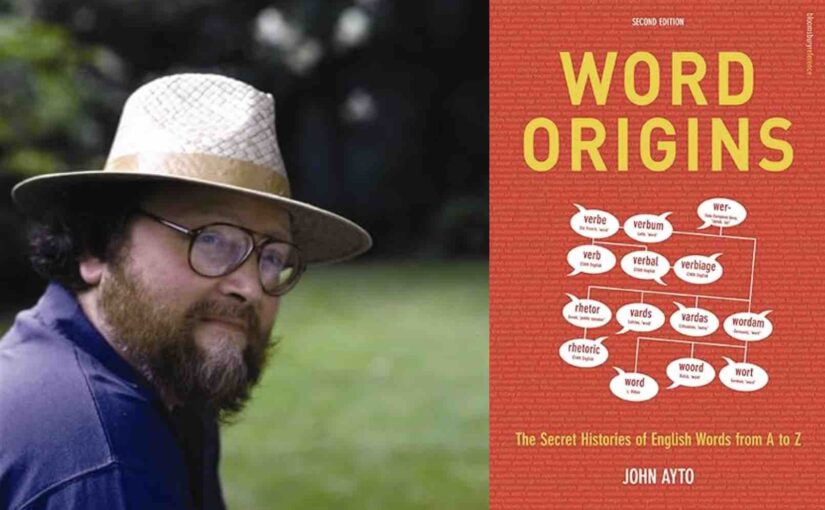
Word Origins: how etymology interprets English

How language evolves is better understood today because of a few obsessively written forms, and the development of comparative techniques. This is etymology, a science of irrational human culture that requires the balance of simple elegance and rigorous complexity.

The obscure science of etymology is broadly known but not widely considered. Years into a curiosity with linguistics, I picked up the 2005 book from lexicographer John Ayto called Word Origins: The Secret Histories of English Words from A to Z.

It wasn’t quite what I expected — less a detailed account of the process and more a  charming walk through hundreds of word origins to demonstrate the start and stop discovery process. It still does better convey the process, and fits alongside broader popular books on linguistics 

Below are my notes for future reference.

Continue reading Word Origins: how etymology interprets English

Why has war lasted for thousands of years?

The first recorded war involved the Sumerians in Mesopotamia almost 5,000 years ago. Prehistoric war is thought to be far older. Can we ever get rid of it?

Margaret Mead said war is older than the jury system but no less an invention to address conflict, and so it can be removed. As the anthropologist Douglas Fry more recently wrote: “War like slavery before it can be abolished.”

Whether peace or war is the more natural human state is disputed and complicated.

That’s from the 2024 book Why War?, which recasts an old question that previous literature has addressed, this time from British historian Richard Overy. The book is largely a review of the literature on war. All the disciplines in these chapters build on each other, starting in evolution, biologically evolved to demonstrated aggression.

“Warfare,” Overy wrote “ is not in our genes, but for our genes.” There is still a role for historians (and therefore journalists) to interpret the specific human actions of “why THIS  war” but there is also a broad universal answer to the question Why War: It’s been an effective means to resolve dispute, despite considerable cost, so war emerged from our systems by hijacking our instincts.

Or as the author himself concludes: “The co-evolution of culture and biology for most of the long human past created conditions within which nature and nurture together, not either one or the other, reinforced the resort to violence when regarded as necessary or advantageous.”

Below I share my notes for future reference.

Continue reading Why has war lasted for thousands of years?

What I’ve learned from being threatened with legal action as a journalist and news publisher

Following a series of well-reported stories by Technical.ly on a startup in turmoil (including this most recent one), the founder threatened legal action. I’ve been here before.

In fact, I had drafted here a blog post from 2013 (!) that I’m refreshing for these purposes. Once or twice a year, we at Technical.ly get some kind of threat of legal action. Sometimes this amounts to a cease and desist letter, once it was formal-sounding demands for reporter notes and more often it is bluster.

Most usually though, our legal counsel advises us to stay quiet. No use inflaming the situation. But this time, one of the startup founder’s allies posted on social media a criticism of my reporter. That gave me cause to post this video response on social here (and embedded below for ease).

Continue reading What I’ve learned from being threatened with legal action as a journalist and news publisher

What are luxury beliefs?

Rich people say one thing, but they do another.

Tech executives don’t let their kids get addicted to screens. Activists who called to defund the police lived in places that didn’t rely on cops. Well-paid professionals say marriage isn’t necessary for a kid to thrive, and publicly self-efface by saying their success was luck, but they’re much more likely to get and stay married than working class families — and they make sure their kids work hard.

These are all examples of “luxury beliefs” a catchy concept from foster kid and Air Force veteran turned new young conservative thinker and writer Rob Henderson. He expounded on the topic in his February 2024 memoir entitled “Troubled: A Memoir of Foster Care, Family, and Social Class.”

As he wrote: “The affluent have decoupled social status from goods and reattached it to beliefs.”

I enjoyed his bestseller, and found it thoughtful and critical. Because of our partisan era, it’s easily pushed by one side and dismissed by another. But I think his perspective has merit for all, even those who don’t like everything he has to say. I certainly appreciated it.

Below I share my notes from the book for future reference.

Continue reading What are luxury beliefs?

Technical.ly is honored for its “journalistic impact”

I’m proud to share Technical.ly was awarded the “Journalistic Impact” award (in the large tier no less!) last night in Chicago by the well-regarded LION: Local Independent Online News Publishers!

The leading driver was our big THRIVING reporting project on economic mobility, and I’m so proud that our other multi-local reporting was honored too. Best I can remember, this is our first proper journalism award, and it’s a big one — even though our communities have often kindly honored our work!

Continue reading Technical.ly is honored for its “journalistic impact”

How Rome fell

Leaders of the late Roman Empire faced at least as many threats from within as without. Over-extension, declining trust in its institutions, falling middle class and a series of ineffective leaders that failed to address these looming threats all contributed to the decline of antiquity’s greatest force.

That’s the theme from “Home Rome Fell,” published in 2010 by British historian Adrian Goldsworthy. I picked it up for my own sense of every amateur historian’s favorite period.

Over nearly 500 pages, the book adds considerable depth to the simple tables we learn in high school. Speaking of which, I recreated one of those over-simplified tables below, heh.

753 BCE: Rome is established509 BCE: Roman Republic established27 BCE: Octavian made first Roman emperor476 CE: Germans depose last Roman emperor1453: Ottoman Empire overthrows Constantinople
Rome’s Period of Kings (244 years)Roman Republic (482 years)Roman Empire (503 years)Byzantine Empire (977 years)

Below are my notes for future reference.

Continue reading How Rome fell

Free speech guarantees your right to speak, not your right for it to be heard

At 3:40 in this interview, Walz speaks of misinformation on elections

This was originally a social video here.

That’s Minnesota Governor Tim Walz in an interview last year that’s being resurfaced now that he’s the presumptive Democratic nominee for Vice President. And for good reason, critics are rightly pointing out that he’s flatly wrong when he says (at roughly 3:40 in the video) that free speech doesn’t protect misinformation or hate speech.

Continue reading Free speech guarantees your right to speak, not your right for it to be heard

The Singularity is Nearer

This generation of artificial intelligence bots have passed the famed Turing test, as we once knew it.

Experts may quibble with the rules, and we’ll continue to move the goal posts. Now, though, generative AI needs to play dumb to trick humans, because they move too fast, can write too convincingly and have too-comprehensive knowledge to be any person.

That’s from the new book from futurist Ray Kurzweil called “The Singularity is Nearer: When We Merge with AI”. It’s a followup to his 2005 book “The Singularity is Near.”

He’s among the best known, and longest-running champions of the kind of digital superintelligence that is called the singularity, which he says is coming — he estimates it by 2045, and has a bet with a friend that by 2029, AI will pass an even more rigorous Turing test he helped establish. His book is a wild romp of optimism and confidence. Anyone digging into the conversation will appreciate it. I recommend it.

Below I share notes for my future reference.

Continue reading The Singularity is Nearer

Takeaways from books I started but never finished

I try to read a lot of books. Mostly nonfiction. Mostly in my interests, so I tend to finish them. But some I never get through, because of time or it doesn’t hit me at the right time.

I still often get a few takeaways from what i start. Here are a few of those.

Continue reading Takeaways from books I started but never finished