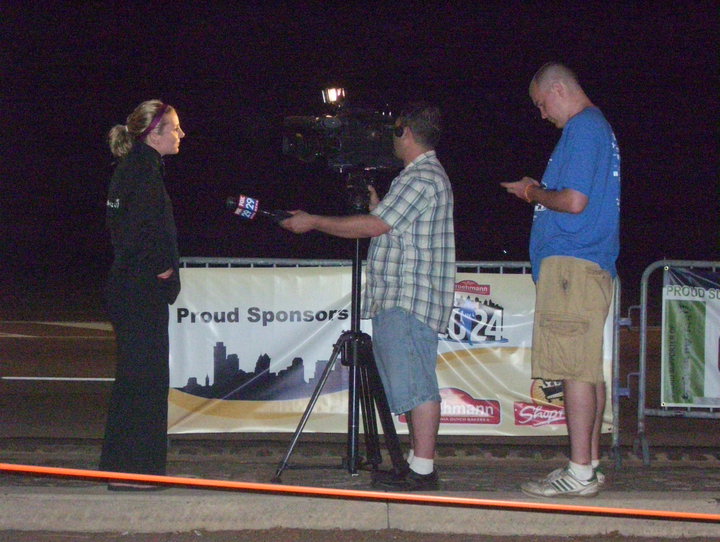
An emblematic photo of a portion of my work with Back on My Feet, as taken early in the morning of the second day of the third annual Stroehmann Back on My Feet 20in24 race event, having coordinated an intervivew of Philadelphia chapter Executive Director Sera Snyder and Fox 29. For the 20in24, every major outlet in the region covered the event.
I am leaving my role as Media Director for Back on My Feet, the running-based program to combat homelessness.
I tendered my resignation last Thursday, Nov. 11 and our staff was alerted Monday. My last day will be Friday, Dec. 3, so I’ve offered a full three weeks to help the transition process at an organization with a mission that has come to mean a great deal to me since joining in January.
I was in Washington D.C. on Saturday when the Rally for Sanity, put on by the crew at the satirical Daily Show, which is already been billed as the Woodstock for my generation.
I didn’t really see or hear much, as there were some big audio problems and, well, maybe as many as 215,000 people were there. But I suppose that won’t much matter.
I was there, or near there, specifically, and, of course, there in the broader sense of being 24 at a time when people my age were trying to do something.
Tonight, at the sixth Ignite Philly, a presentation event featuring fast-moving five minute discussions, my two Technically Philly colleagues and I discussed ‘The Power of Working in Threes.’
Find the presentation online here or flip through it below. I’m going to try to wrangle the video.
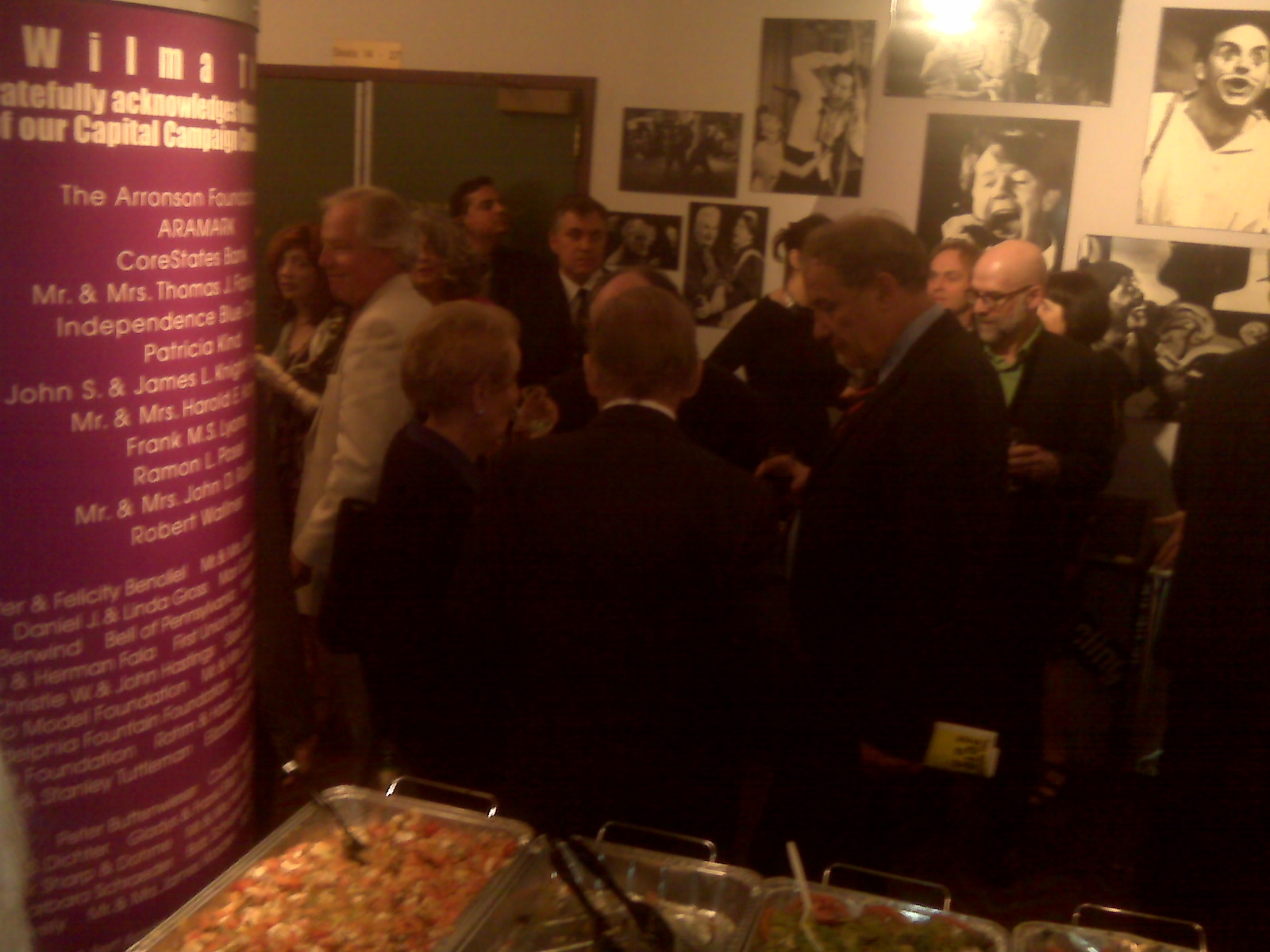
Recently the magazine held its kickoff party, and I came to see my former editor Liz Spikol, mingle, eat guacamole and, mostly importantly, end up in a vanity shot from Hugh E. Dillon, Philly’s favorite and, hell, probably only paparazzi.
Both after leaving the bathroom before the show and sitting in my third-row seat as the curtain opened, I eyed the tiny, graying lady sitting to the right and chatting with Havel, the revolutionary who was on hand to watch the premiere. Both times I gave second glances. The first time, I just thought I recognized her and dismissed it as some Philadelphia notable.
The second time, my guess was clear: that woman was the first female Secretary of State and President Bill Clinton top adviser. I dismissed it again — no security, no commotion, no press. Turns out I was right, and, boy, that has to mean something for the future of news, doesn’t it?
I announced in February my taking a job with the Center City-based organization that uses running clubs to create support around homeless populations seeking to move forward. From my first interview, I highlighted the need to use a blog to share the heavy dosage of content, member stories and updates that come from the nonprofit’s now-four chapters and growing.
I’m very interested in tracking all the web metrics I can, from traffic to social media trends, for Back on My Feet. Launching this blog — a project I initiated and have led — came without question and has been a great source of pride thus far.
It wasn’t so long after I started my job as national media director at homeless running nonprofit Back on My Feet that I was presented with what would be a rewarding opportunity. Not so long at all after I first started talking about how traditional marketing was just a small part of what I thought mission-orientated nonprofits should be chasing for audience building.
Not a month into the job I heard that HCI — the publishing house that hit a home run(s) with the Chicken Soup for the Soul book series that reigned commercially successful, if critically panned, for 15 years — was finalizingUltimate Runner, the latest edition of its newest anthology series, and had an opening.
I was working for a running-involved organization with compelling stories and came from a writing background. I also had been blabbing about how we needed to involve ourselves heavily in content creation. This sounded like something to chase.
On Dec. 30, 2009, I took the 15 minute walk from my home in Fishtown to the Penn Treaty Park complex near the Delaware River and into the station’s third floor studio, as another show closed before 7 p.m.
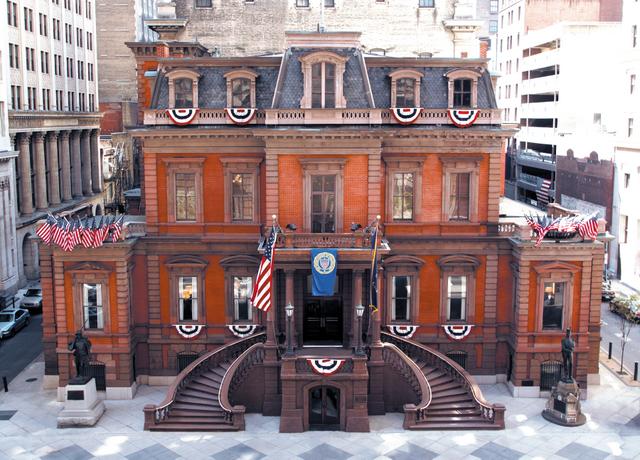
The historic, 145-year-old Union League of Philadelphia located on the Avenue of the Arts.
A tidy and frail little old man asked me to direct him to the coat rack. To walk him around the corner from the long and elegant main corridor of the nearly 150-year-old Union League of Philadelphia was my first deed.
If nothing else, it made for interesting conversation when I made it to the elaborate second-floor President’s Ballroom, featuring thirty foot ceilings, a spectacular chandelier and portraits of dour looking old white men. For an half-hour or so after 5:30 p.m., I handled a rum and coke and ambled about the pre-event cocktail reception of the Sunday Breakfast Club, a not-quite cloak-and-dagger, invitation-only private society for organization executives.
Perhaps nearly 200 members and guests of the seven decades young group patronized the open bar, chatted and nibbled appetizers. I did the same, more than a handful of times being approached by some degree of interest in the 20-something with a broken brown belt with black shoes.
No ma’am, I’m not lost. I’m on the panel to which you’re here to pay audience.
One half of the influential round table at the unveiling of a proposed William Penn Foundation news innovation involvement.
Forty leaders in Philadelphia media were on hand last week for the unveiling of a structure to develop more public affairs journalism in the region, as proposed by a university research center on behalf of the William Penn Foundation.
From 8:30 a.m. to after 2 p.m. on Jan. 7 inside the Delaware Valley Regional Planning Commission conference room of the American College of Physicians Building in Old City, a series of discussions focused on bolstering the next generation of news gathering in Philadelphia around community-building and replacing competition with collaboration.
Explicit details were left slim to encourage a dialogue, but loosely defined, Jan Schaffer, the executive director of American University-housed J-Lab, recommended an aggregated content hub that could be supplemented by a limited editorial team. The funded sustainability of that recommendation was not detailed, but rather suggested to be put off for three years until an appropriate level of support was developed, she said. Hers were only recommendations for the Penn Foundation. No action was announced, nor taken.
Rather, Schaffer, a former Philadelphia Inquirer business editor and Pulitzer Prize winner, led a fact-finding research project for the better part of 2009 on behalf of the Penn Foundation, which included more than 60 interviews and ran from July to October. The day was her chance to gauge response. She has not yet submitted a formal proposal but, she said, expects to do so this quarter. Last week’s open unveiling and ensuing feedback would inform her final suggestions, she said.
The ramifications of what Schaffer proposes could have a historic impact. That is, if anything happens at all.