If journalism is going to evolve to a savvier appreciation for ‘impact,’ its makers need to have a clearer idea of their target audience.
Like you would for any business, you need to know how big your market is, and you need to understand how hard (and necessary) it is to create that audience by acquiring new users — in this case, civic-minded residents.
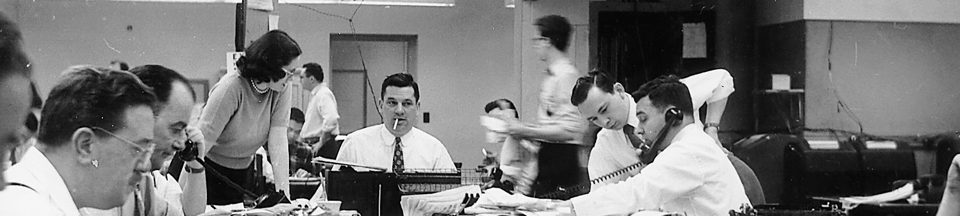
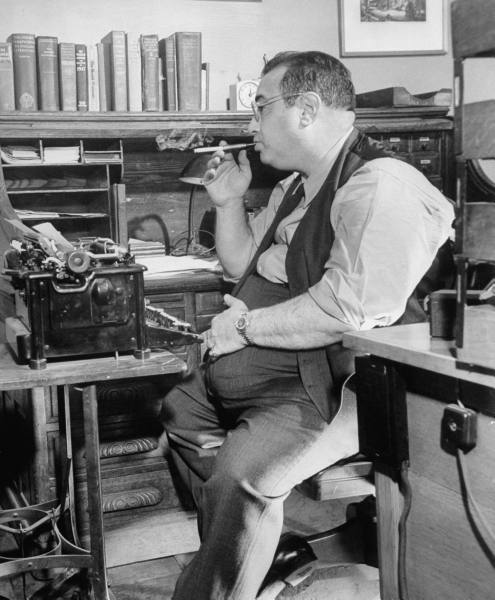
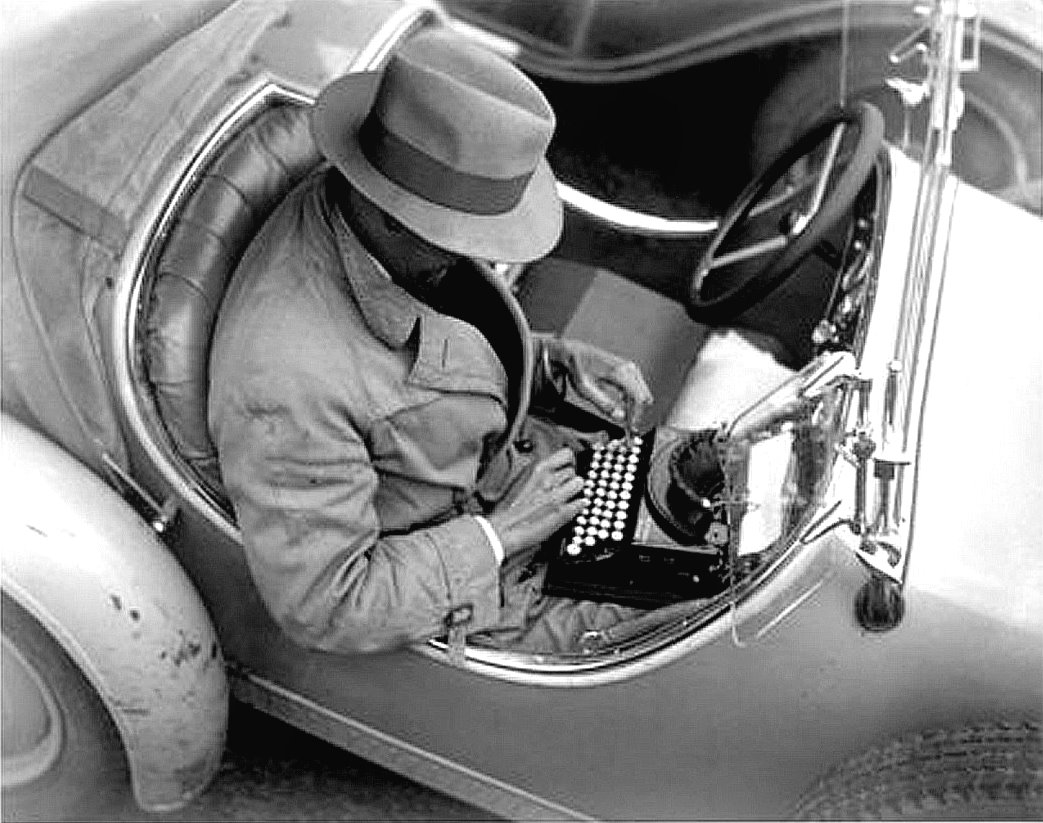
For much of the 20th century, the newspaper industry had this curious role filled by “rewrite men” — though, of course, women, too, served these positions. For breaking on-the-scene news, when telegraphs and then faxes couldn’t do the trick, a reporter would get on the phone with a rewrite man and assemble a story live, using notes and standard formatting.
The reporter would speak his story — an impressive feat, actually, having heard a few veterans do this and often trying it to keep up the old tradition — and the rewrite man would record it, transcribe it, clean it up and run it. If you talk to a newspaper reporter of a certain age, she might have stories about the good rewrite men and bad rewrite men. The good ones would take your rough story and turn it into a gem (with the help of other editors too). A rewrite man might go years without ever seeing his byline in a newspaper, never getting any official acknowledgement of his work to put out a finished piece of copy.
It is the last major feature of the Transparencity grant project I’ve been leading, and one of the more detailed investigative reports I’ve done in my journalism career. The feature, which details the nearly two-year struggle to go public with a project with internal support, is meant to show the lessons learned and obstacles faced in the hopes that future city agencies can more efficiently release their data publicly for development and citizen use.
Give it a read, for lessons to be taken for any local government. and then find some of what didn’t make it into the piece below.
Following the indicted former state Speaker of the House, whose corruption trial has been postponed until the fall, we covered what the impact the loss of a 30-year state leader would be on his district, particularly a small swath that had served as his political base.
I spoke to more than a half dozen neighborhood leaders and others with perspective on the matter.
With NEast Philly founder Shannon McDonald, I helped carve out the editorial direction and direct the Temple University Philadelphia Neighborhoods interns, who were our partnering organization.
I designed the District 172 branding.
I developed a layout for the District 172 landing page and worked with Frankford Gazette co-founder Jimmy Smiley to publish it.
I gave copy and content to Smiley for our Players and Timeline section, two more interactive tools on the page.
It gives us culture. It is a way to pay remembrance for those who came before. Yes, it’s a little bit fun.
In the world of news, there is a lot of tradition that needs to be lost. Unquestioned impartiality, balance without real context, an ignorance and distance of what funds it, a rigid belief in a strictly reactionary audience.
But, I’ve always felt, there is lot to be taken in from the past. I’ve been blessed to work alongside some talented and hungry older journalists who have imparted great wisdom on me. I thought some of that tradition was worth sharing as, in my own way, I try to preserve the best of it.
Below, find 25 pieces of advice about being a newsman that I take great value in.
The support helps bolster existing coverage and allows me to strengthen relationships with new and previously only tenuous sources. Read all about our goals and expectations on the Technically Philly post here.
Those outputs show our work will extend beyond traditional coverage, but, to start, that has been a large part. I’ll update more here on the reporting that I am doing.
The William Penn Foundation is technically funding the nonprofit Institute, which, in serving as our fiduciary agent, is contracting out for-profit Technically Media Inc.’s Technically Philly news site. …Did ya get all that?
I was asked what it is I actually enjoy about this journalism world, its form and practice.
So I rattled off some answers:
I like writing
I like telling stories.
I like getting a little bit closer to truth.
I like focusing on different conversations.
I love asking questions and learning.
All of my interest and focus on business has come from these passions, though, entrepreneurship itself has certainly become intertwined, as building your own company is one hell of an education.
I speak during Technically Philly's afternoon session at BarCamp NewsInnovation 2.0 at Temple University on April 24, 2010, organization of which was led by Sean Blanda, at left.
They weren’t from around here, were they, shouted my neighbor across the street over the weekend.
She was talking about a pack of young journalists — from Florida and Washington state and California — who had invaded my Fishtown rowhome the weekend before.
That was perhaps one of the largest take aways I drew from attending and, by way of Technically Philly, co-sponsoring BarCamp NewsInnovation 2.0 April 24 — the staggering drawing power of the event in just its second year.
There are new owners at 400 North Broad Street, the historic home of the Philadelphia Inquirer and Daily News, which publish online with stand-alone sister organization Philly.com. The movement begins immediately and will likely result in a closing by the end of June.
Go here for the financial details of the auction of parent company Philadelphia Media Holdings, which was taken over by debt-holding lenders, not the existing local ownership led by Publisher Brian Tierney.



 There are