Transparencity: Leading a Technically Philly open data grant project

On behalf of Technically Philly, I have started work on a six-month, William Penn Foundation-funded journalism project called Transparencity, covering the open data movement in Philadelphia, as was announced this morning.

Conducted in partnership with the Institute for Public Affairs at Temple University (which is chaired by my college honors thesis adviser), the project’s focus is “toward collaborative projects using technology and journalism to increase the availability and use of actionable government data.”

The support helps bolster existing coverage and allows me to strengthen relationships with new and previously only tenuous sources. Read all about our goals and expectations on the Technically Philly post here.

Those outputs show our work will extend beyond traditional coverage, but, to start, that has been a large part. I’ll update more here on the reporting that I am doing.

The William Penn Foundation is technically funding the nonprofit Institute, which, in serving as our fiduciary agent, is contracting out for-profit Technically Media Inc.’s Technically Philly news site. …Did ya get all that?
Universities should host the newsrooms of their neighborhoods

Universities should host the newsrooms of their neighborhoods, towns and counties. If a university has a journalism department, college media and audience, this seems like a foregone conclusion.

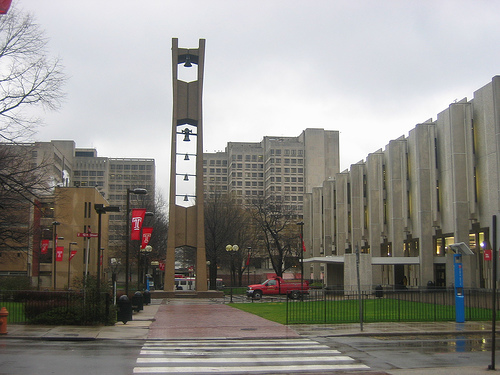
Picture Temple University. It is a big, diverse, robust, public research university with a clutch of respected professional schools and an expansive undergraduate population that has been slowly and controversially expanding into at least four different, distinct, overwhelmingly black neighborhoods around it.

When you drive south on I-95 east of Philadelphia at night, look off to your right while only the tallest skyscrapers are yet in view a few miles in the distance, the blur of bright lights made of a dozen square blocks and a cluster of high-rise buildings among a swath of stout two story row homes is the university’s main campus.

Halfway between those stadium lights and Philadelphia’s iconic City Hall is another beacon of light, that old White Lady, 400 North Broad Street, the legendary location of the Philadelphia Inquirer and its sister paper the Daily News.

Mood lighting isn’t the only lesson Temple should take from the investigators of the Inquirer.

Continue reading Universities should host the newsrooms of their neighborhoods

BarCamp NewsInnovation 2.0: My take aways and experience

I speak during Technically Philly's afternoon session at BarCamp NewsInnovation 2.0 at Temple University on April 24, 2010, organization of which was led by Sean Blanda, at left.

They weren’t from around here, were they, shouted my neighbor across the street over the weekend.

She was talking about a pack of young journalists — from Florida and Washington state and California — who had invaded my Fishtown rowhome the weekend before.

That was perhaps one of the largest take aways I drew from attending and, by way of Technically Philly, co-sponsoring BarCamp NewsInnovation 2.0 April 24 — the staggering drawing power of the event in just its second year.

Continue reading BarCamp NewsInnovation 2.0: My take aways and experience

NewsWorks: WHYY will announce new hyperlocal news initiative for northwest Philadelphia

Updated 4/13/10 @ 8:50 a.m.: Regionally-specific hyperlocal is just part of the broader system

WHYY, the public media station for the Delaware Valley region, is hoping a $1.2 million hyperlocal news initiative for the northwest region of Philadelphia will be the first successful bold Web-first journalism effort from a legacy media player.

Updated: That northwest hyperlocal is just one very large, very expensive trial vertical within a larger rollout.

But will “NewsWorks” go the way of a handful of its predecessors?

Continue reading NewsWorks: WHYY will announce new hyperlocal news initiative for northwest Philadelphia

Temple Review: Profile of lawyer-turned TV producer Lukas Reiter

I contributed a short profile of a 1995 Temple University law graduate to the winter issue of Temple Review, the university’s alumni magazine.

Trial lawyers are storytellers, and Lukas Reiter, LAW ’95, always wanted to be a storyteller. He’s just taken it one step further now.

After graduating from the Klein School of Law, Reiter, 39, took a job as an assistant district attorney in the Queens County of his native New York City. Two years in and exhausted from the grind of the homicide investigations bureau, Reiter decided he needed a break. That break became a fast-paced ride toward another avenue for storytelling, as one of TV’s most respected authorities on crime and law drama, with a Jerry Bruckheimer-produced prime time show that premiered on ABC this fall…..

Pick up a copy or browse other stories here. Watch the trailer of the Forgotten TV series.

Community newspapers: a panel and their use of the Web at PhIJI

phijilogo790

Community newspapers in Philadelphia remain wary of the Web, if any stock is to be paid to a morning panel from a journalism innovation conference held this month at Temple University.

Technically Philly was a partner in hosting PhIJI

Their thoughts just might be relevant to community-focused news gathers across the country.

Hosted by Temple’s journalism department, the Philadelphia Initiative for Journalistic Innovation was a day’s worth of smaller sessions focusing far less about the plight of big newspapers and more about smaller, more entrepreneurial ventures. Yes, the future of news just might be a series of conferences about the future of news, but I was happy to see a greater focus on the business side of the industry.

With the help of supportive chair Andy Mendelson, Temple journalism professor George Miller put together one of the first future of news conferences I’ve seen that tried to really pay attention to sustainability through profit. There’s incredible value in that, so I was thrilled to be a part of it.

Along with my two fellow co-founders of Technically Philly, I presented twice a session called ‘Be a Publisher Now’ on free tools that news-organizations and bloggers could make use of to create become more efficient and better prepared. See our presentation slides here.

I also got the opportunity to sit in on a session focused how community newspapers were dealing with the 21st-century’s dramatic paradigm shift in news-gathering. That’s where I was left more than a little puzzled.

Continue reading Community newspapers: a panel and their use of the Web at PhIJI

Metro: Temple tuition hike warned over controversy

Temple students during summer session. Rikard Larma for Metro.

I covered for Metro Philadelphia the political battle between my alma mater Temple University and another alumnus Rep. John Taylor, who is pushing to hold back a $175 million appropriation for the school because of a closed hospital.

Nathaniel Nnadiugwu says he feels like there’s nothing he can do about a political fight between Temple and state lawmakers that threatens to hike his tuition by $5,000.

Read the rest here, or pick up a copy if you’re in the city.

This Page Two story was my second in Metro today. I also had a front page piece. Below see some quotations that didn’t make it in.

Continue reading Metro: Temple tuition hike warned over controversy

The Temple News: my four-years with the college newspaper of Temple University

Sitting at my then clean and empty desk in Room 243, the newsroom of The Temple News, on May 21, 2008, the night before my college graduation.

One year ago I was cleaning out my desk in Room 243, the newsroom of The Temple News, the college newspaper of Temple University since September 1921.

I spent one year as a reporter, one year as a columnist, one year as a contributor and one year as an editor. It is, truly, where I first developed the craft, came to understand the rules and learned journalism and writing was a real professional opportunity.

I got a lot out of Room 243, TTN’s newsroom in the student center at 13th and Montgomery in Philadelphia, Pa. So, I thought it was worth revisiting what I did, what I learned and how it has affected me now 12 months clean.

Continue reading The Temple News: my four-years with the college newspaper of Temple University

Journalism classes that aren't regularly available but should be

Students learn. Now lets teach them something they need.
Students learn. Now let's teach them something they need.

My friend Sean Blanda once regularly wrote on the failures of journalism schools. It’s not exactly my territory because I studied politics, not journalism in school.

But, I’ve heard enough from friends and colleagues. It seems most everything they learned, I learned while working at my college newspaper.

The journalism school at Temple University, like many other top j-schools, is chock full of talent. Temple is dripping with accomplished reporters, so I long decided j-school is for contacts, not knowledge.

That’s never more true than now, because, well, most all professors at j-schools are from an era that digitization is fast making irrelevant (There are many exceptions, two at Temple being here and here). The rules are broken and more than ever, journalism schools are repugnantly, distastefully, woefully far from leading students to careers, aside from the Temple name and, yes, the contacts they make.

I’m nearly a year out and embroiled in a freelance career, so I thought up a few classes I’d like to see j-schools teach.

Continue reading Journalism classes that aren't regularly available but should be

Letter of Support for Eugene Martin (12/10/08)

Monday, December 10, 2008

To: President Ann Weaver Hart
Re: Professor Eugene Martin
CC: University Provost Lisa Staiano-Coico, SCT Dean Concetta M. Stewart, BTTM Department Chair Jan Fernback

President Hart:

One of the great honors of my young life was to be named the speaker at my graduation from Temple University on May 22, 2008. My five minute speech to more than 8,000 people in the Liacouras Center focused on what became my passion while studying at the big urban research university of my dreams: community involvement.

When I first walked Diamond Street long enough to realize it doesn’t stop at 17th Street, I didn’t know Eugene Martin. When I first began to realize North Philadelphia was a complex amalgamation of nearly a dozen distinct neighborhoods, I didn’t know Eugene Martin. I started my journey beyond Temple’s Main Campus before Eugene Martin, but it was never the same after meeting him.

Continue reading Letter of Support for Eugene Martin (12/10/08)