A year ago, I did a short interview with Rosemary Feal, then the Executive Director of the Modern Language Association, ahead of the group’s annual conference in Philadelphia.
The interview was due to run in the Metro but never did. With a year passed and its hook gone, I run it here for all you grammar geeks because there just might be interest in hearing the thoughts of someone who told me: “I also love the semicolon, but that’s just my personal preference.”
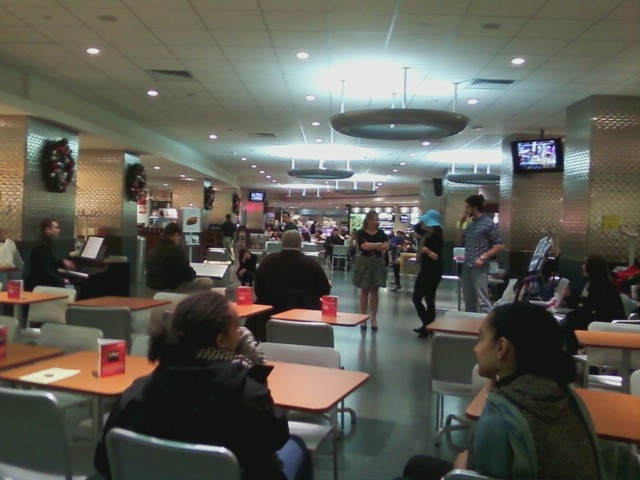
Last Wednesday, I was waiting to meet someone in the food court beneath the giant Comcast Center in Center City Philadelphia. Then people started singing, as you can sort of make out in the above photo. Turns out it was a new performance by the Opera Company of Philadelphia. It was cool, not only watching the rehearsal, but all of the people stop and watch the rehearsal.
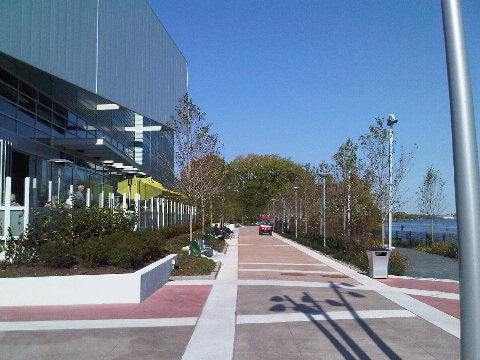
The back of SugarHouse Casino on Delaware Avenue in Philadelphia on Sunday, Oct. 10, 2010. Its restaurant and walkway offers pleasant views of the Delaware River and Ben Franklin Bridge.
SugarHouse Casino opened in mid-September, as scheduled.
The six-year battle to bring casinos to Philadelphia is not one I want to remark much on. If you want to hear argue for or against the existence of casinos in urban communities, you’ve come to the wrong place. Isaiah Thompson at Citypaper is downright obsessed with reporting on why casinos are in the net bad for communities.
That’s not what I’m writing here for.
By the time I bought my home in Fishtown, the neighborhood that the casino arguably resides within, SugarHouse was already coming. That argument was over with.
What was still up for debate were two issues that I did care about, if a casino was going to come to my neighborhood.
I wanted the casino to embrace, enhance and help develop its portion of the Delaware River waterfront, so we could start embracing this beautiful asset of ours and do so through the sensible, efficient use of commercial development.
I wanted table games to supplement slots machines so, in my experience, if there was going to be gambling, it might go beyond the droning, heartless slots. (Basically, I have friends who would play blackjack for a night socially; they wouldn’t dump coins in a machine).
This weekend, I enjoyed the beautiful weather by taking a leisurely stroll through the casino’s compact 45,000 square-foot innards and the compound that surrounds it. In an hour’s time, my initial reaction was that, if a casino were to come to Philadelphia and considering much of the debate and compromise that has come with it, what SugarHouse is to date isn’t so terrible.
Uwishunu.com (January 2009 to present): I blog on upcoming events and review concerts, culture, arts and entertainment in Philadelphia for the staple blog on what to do in one of the largest cities in the country. See my posts here, and my profile here.
August 2010 Invoice
Mauckingbird Theatre’s take on ‘A Midsummer Night’s Dream’
I am not going to write about the brief media blitz that surrounded the controversy of the City of Philadelphia enforcing its business privilege license requirement for bloggers.
(Quickly, Philadelphia, like many municipal governments, requires a license to do business in its environs. An unnamed amount of bloggers who declared on federal tax documents some form of revenue from their publications were compelled to pay for a $50 yearly or $300 lifetime license, the latter of which both Technically Philly and NEast Philly acquired as we brought on revenue. Philadelphia CityPaper reported that the city had begun reaching directly out to bloggers demanding they pay up, a reality first noted on web forum Philly Speaks and, admittedly, ignored by us at TP, and the whole concept exploded. Soon, far flung media outlets were implying that the city’s license — which is required of anyone doing any kind of business in the 135 square miles of Philadelphia — was for bloggers only. It isn’t. And anyone solicited by the city had advertising or had otherwise declared related income federally. So, considering much of the revenue was limited to tens of dollars, it may have been a foolish chase, but certainly not illegal or unfair.)
Instead, I wanted to share two thoughts on the future of blogging that came out of this controversy.
More than a year ago, I handled a half dozen interviews and a couple rewrites on a story for the Inquirer that covered what Philadelphia workplaces will look like in the future. As is sometimes the case, it never found its home in print.
The story’s primary timeliness has been lost, but I think it still has merit. So, with permission from my editor, I share it below, in addition to a slew of extras from the heavy lifting of reporting.
“But they have pledged to continue the lower tax rates for individuals earning less than $200,000 and families earning less than $250,000 — what Democrats call the middle class.”
That’s a great use of attribution to afford some kind of better description than we have in most other news articles I see. In other stories, I still see the simpler use of the phrase “middle class.” But what the hell does that mean?
Phil Pappas, of West Frankford Town Watch, investigating an alarm near Comly and Bustleton on early Saturday morning July 10. Click to enlarge. It's my photo.
Earlier this month, I went on a ride-along with the West Frankford Town Watch in lower Northeast Philadelphia. For the love of hyperlocal journalism and community coverage, I put together a 2,500 word profile of the organization, with a handful of photos of mine. It was good to remember that I got into this whole scene for a love of writing. Give it a read and let me know what you think.
Mike Mawson smells something.
It’s past midnight on Comly Street near Bustleton in Mayfair. The sun went down hours ago, but forgot to take this sticky July heat with it. Mawson is riding shotgun in the sensible four-door sedan that his partner Phil Pappas drives. The West Frankford Town Watch patrol was circling around to head back south of Cheltenham Avenue to drive the streets of its namesake neighborhood when Mawson caught a whiff of something off in the still nighttime air.
“It smells like something is burning,” confirms soft-featured Pappas, 53, sitting upright with two hands on the steering wheel and dressed with purpose in matching earthtones. “I’ll pull over.” MORE
What a damaging and sweeping comment that when reiterated and reinterpreted across media — that Philadelphia has been “battered” by having the “highest murder rate,” of what, well, they won’t say — can dramatically impact how the Cradle of Liberty is seen nationally.
Williams is supposed to be a part of a “sea change” in the city’s role of prosecuting criminals — a major Philadelphia Inquirer investigation found, as the Times reported, that “the city had failed to obtain convictions in two-thirds of cases involving violent crimes, and that thousands of cases were dismissed because prosecutors were not prepared or witnesses did not appear.”
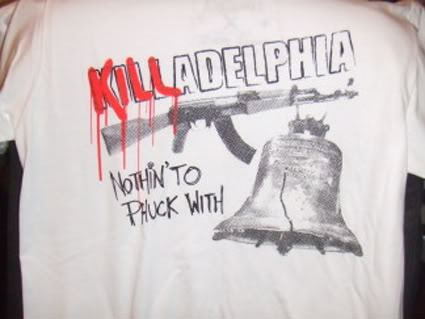
So, yes, Philadelphia has a problem convicting criminals and crime is certainly a major sticking point for people living in cities (though I’ll add that violent crime is down nationally and many inner-ring suburbs have been battling increases in gangs and drugs and crime since the 1990s). And this ‘Killadelphia’ reputation doesn’t help… but how accurate the name is remains a point of contention here.
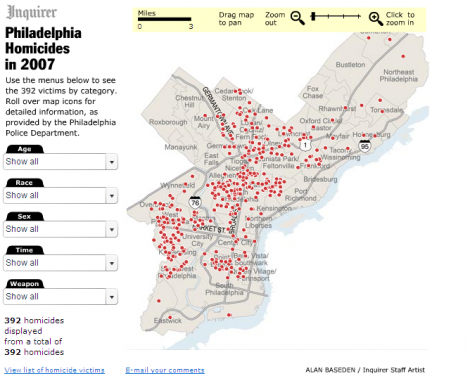
See this and other 2007 crime maps at http://www.philly.com/inquirer/special/violence/
I’m pretty passionate about the web allowing greater public affairs accountability journalism, not worse.
I was reminded of this while skulking around the Internet searching for a column I remember reading back in 2007.
Noted Philadelphia Inquirer scribe Tom Ferrick — who has since launched politics coverage site Metropolis — crunched the numbers on the shootings of young black men, a trend in all U.S. cities but one that was particularly timely amidst one of the bloodiest years in the city’s history.
Though it was written just back in 2007, it was gone. I couldn’t quite find something that fit its point, so I reached out to Ferrick. He warmly shared some of the details of the now somewhat dated piece, as he said he’s working on revisiting the topic.
If for no other reason than for my own ability to link back to it in the future and to prove how valuable the web can be in making available so much powerful knowledge and information, below, with Ferrick’s permission, I share the notes he sent me.
 A year ago, I did a short interview with Rosemary Feal, then the Executive Director of the Modern Language Association, ahead of the group’s annual conference in Philadelphia.